
On this page
Start here
Quick answer
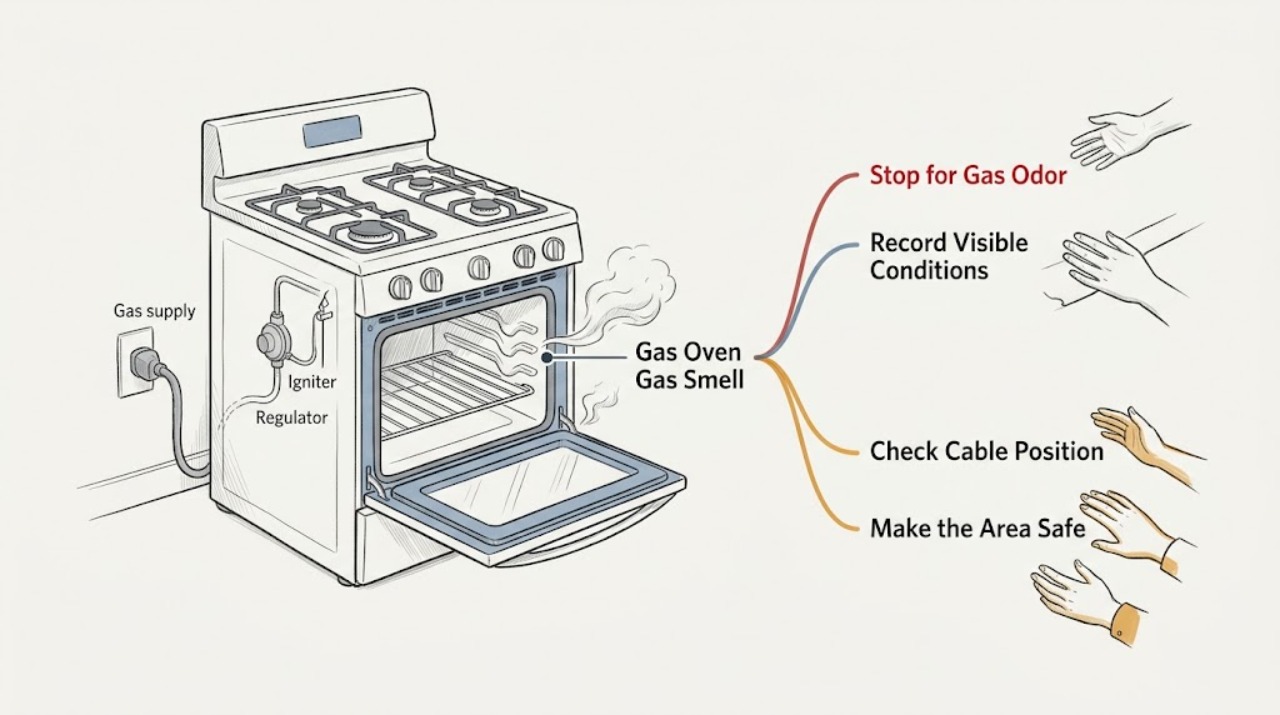
Treat a Frigidaire gas-oven gas smell as a safety issue first, not as a part-identification exercise. If you smell gas now, turn the oven controls off only if you can do so safely, avoid flames, switches, plugs, and anything that could create a spark, leave the area, and contact the local gas utility or emergency service from a safe location. CPSC guidance for affected Frigidaire gas ranges says to stop using the oven, ventilate by opening a window or door when safe, and call the gas company if gas is smelled or a leak is heard. Do not relight the oven, use a match, perform a leak test, remove panels, or keep retrying ignition. After the area is declared safe, use the exact Owner’s Manual and model information to have a qualified gas appliance technician inspect ignition, burner, regulator, and connections. A brief odor during a model-specific ignition sequence cannot be used to excuse a persistent odor, odor while off, delayed ignition, yellow flame, smoke, or a bang.
Work through in order
Diagnostic checks
Use only checks that match the exact appliance or system and its official guide.
-
Check 1
If a gas odor is present now, do not operate the oven, cooktop, light, switch, plug, phone, or other possible ignition source in the area. If it can be done without delay or risk, turn the oven control off, leave the building or affected area, and contact the local gas utility or emergency service from outside or another safe location.
Expected result: The odor is strong, spreading, present while the oven is off, accompanied by a hiss, or remains after the control is off; or it disappears before help arrives.
Next step: Follow the gas utility or emergency responder's instructions. Do not return to operation until the area and appliance have been cleared and the cause has been assessed by qualified personnel.
Stop if: Stop immediately and leave if the odor is strong, increasing, associated with a hiss, or anyone feels unwell; do not create a spark to investigate.
Why this matters
Why: Any current or recurring odor can represent unburned gas. Absence of odor after ventilation does not prove the appliance is safe, and a smell that disappears does not justify relighting.
-
Check 2
After the area has been declared safe, record whether the odor was at the oven vent, inside the cavity, near the controls, near the rear connection, or present throughout the room. Record whether it occurred before ignition, during ignition, after the flame appeared, during burner cycling, after shutoff, or while the appliance was unused. Do not reproduce the odor just to classify it.
Expected result: The timing is a single brief start event on one model, a delayed or failed ignition, a recurring smell during temperature cycling, an odor while off, or an odor tied to a visible flame or smoke problem.
Next step: Give the timing and location to the gas utility or qualified technician with the full model and serial information. Keep the oven off until they approve further use.
Stop if: Do not turn the oven on, open a gas connection, or use an ignition source to repeat the symptom.
Why this matters
Why: Timing narrows the service investigation but does not prove a harmless cause. Persistent, delayed, or off-cycle odor is outside a normal-operation assumption.
-
Check 3
Once qualified personnel confirm there is no active leak and the exact manual permits an external check, inspect only visible burner-cap or surface-burner conditions for correct seating, moisture, or obvious debris. Do not apply these cooktop checks to a concealed oven burner, remove a burner assembly, or use a needle or wire inside the oven.
Expected result: A visible surface-burner cap is displaced or wet, or the visible parts appear normal while the oven odor persists. A flame may be uneven, high, yellow-orange, or fail to establish.
Next step: Correct only a cool, accessible surface-burner condition exactly as the manual permits, then have the oven assessed if any odor remains or the flame is abnormal. Do not continue operation to see whether it improves.
Stop if: Stop for any gas odor, unstable or yellow flame, smoke, soot, delayed ignition, or a burner that will not extinguish normally.
Why this matters
Why: Frigidaire identifies cap seating, moisture, and blocked ports as possible surface-burner symptoms. Those observations do not clear the oven gas path or explain persistent odor from the oven.
-
Check 4
After the gas system is cleared by a professional, compare the report with the exact Frigidaire Owner's Manual: model, fuel type, ignition method, and regulator configuration. Check only the manual's visible control and installation information; never change fuel conversion parts, regulator settings, jets, burner alignment, or safety valves yourself.
Expected result: The manual matches the appliance and identifies a model-specific ignition or installation procedure, or the model, fuel type, or installation does not match the documentation.
Next step: Stop using the oven until a qualified gas appliance technician verifies the installation and appliance configuration. Provide the model and serial details rather than ordering a generic part.
Stop if: Do not operate a converted, newly installed, moved, or model-mismatched appliance when gas odor or combustion symptoms are present.
Why this matters
Why: A wrong manual or fuel configuration can produce unsafe conclusions. Frigidaire manuals and support pages repeatedly direct model-specific procedures to the Owner's Manual.
-
Check 5
If a qualified technician has permitted one controlled test, observe from outside whether ignition is prompt, the flame is stable, the odor is absent after ignition, and the oven heats without smoke, soot, delayed popping, or a strong flame change. Do not open the door repeatedly or place hands near the burner.
Expected result: The oven lights and runs without odor or combustion warning, or the smell returns, ignition is delayed, the flame is abnormal, or smoke or popping appears.
Next step: Turn the controls off if safe, leave the oven unused, and contact the gas utility or qualified appliance technician with the test result. Do not repeat the test.
Stop if: Stop immediately for gas odor, delayed ignition, bang, yellow or unstable flame, smoke, soot, or flame outside the burner area.
Why this matters
Why: A clean single test does not certify the gas system, but a returning odor or combustion sign confirms that operation should stop and the gas path needs further professional diagnosis.
-
Check 6
Record the model and serial number, fuel type, installation or recent move, exact odor timing and location, ignition behavior, flame description, any hiss or popping, and whether a gas utility or technician has inspected the appliance. Keep the oven off while arranging service.
Expected result: The record identifies a persistent odor, a model-specific ignition event, an installation or fuel mismatch, a combustion symptom, or a possible recalled model; the odor may be absent when the technician arrives.
Next step: Arrange qualified Frigidaire or gas-appliance service, and check applicable recall or utility guidance using the exact model and serial details. Do not open the appliance before service.
Stop if: Stop all user testing once a gas connection, burner, igniter, regulator, valve, or internal wiring would need access.
Why this matters
Why: A complete history helps a professional investigate an intermittent gas symptom without asking the user to recreate a hazardous condition. CPSC notes that model and serial information are needed to identify affected ranges in its recall notice.
Use your observations
Decision map
Find the observation that best matches what you see, then follow the next safe action.
-
PATH 01Next step
What you see
Gas odor is present, strong, spreading, present while the oven is off, or accompanied by a hiss.
Do this next
Stop using the oven, avoid ignition sources and switches, leave if necessary, ventilate only when safe, and contact the local gas utility or emergency service from a safe location.
-
PATH 02Next step
What you see
A qualified professional has cleared the area and identifies a cool, visible surface-burner cap or port issue without an oven odor.
Do this next
Follow the exact Frigidaire manual for that accessible surface-burner cleaning or seating check. Do not transfer the procedure to the concealed oven burner.
-
PATH 03Next step
What you see
Odor returns after ignition, ignition is delayed, the flame is yellow or unstable, or popping or smoke occurs.
Do this next
Turn the control off if safe, stop retrying, keep the oven out of service, and arrange qualified gas-appliance diagnosis.
-
PATH 04Next step
What you see
The appliance model, fuel type, regulator configuration, or installation does not match its manual or has recently been changed.
Do this next
Do not operate it with an odor. Have a qualified installer or gas-appliance technician verify the configuration and connections.
-
PATH 05Next step
What you see
The odor is absent after professional clearance and one permitted controlled test, with prompt ignition, stable flame, and no smoke or popping.
Do this next
Keep the exact manual and service clearance record, monitor without repeating unnecessary tests, and stop immediately if odor or any combustion symptom returns.
Helpful context
Understand the symptom
Gas odor changes the order of troubleshooting
Do not begin by removing the oven bottom or testing the igniter. A persistent or unexplained gas odor can mean unburned gas is entering the room. CPSC guidance for affected Frigidaire gas ranges is to stop using the oven; if gas is smelled or a leak is heard, turn the oven off, open a window or door when safe, and call the gas company. Leave and make the call from a safe location if the odor is strong or increasing.
Do not confuse a brief start sequence with a continuing leak
Some gas appliances can have a short odor during ignition, but that is not a universal permission to keep operating. Odor that remains after the flame should be established, returns during temperature cycling, occurs while the oven is off, or comes with delayed ignition, popping, yellow flame, smoke, or poor heating requires the gas supply and appliance to be checked by a qualified professional.
Only perform external checks after the area is safe
Once the gas utility or qualified professional has made the area safe, identify the exact model and use its Owner's Manual. Frigidaire guidance can vary by model. Do not apply a DIY leak solution to a gas connection, use a flame to find a leak, open the cabinet, adjust a regulator, or bypass a safety device.
Safety boundary
Stop conditions
- If gas odor is present now, do not relight, use a match, operate switches or plugs, or investigate the connection; leave and contact the gas utility or emergency service from a safe location.
- Do not use the oven for persistent or off-cycle odor, delayed ignition, popping, yellow or unstable flame, smoke, soot, or flame outside the burner area.
- Do not perform a DIY leak test, remove panels, adjust a regulator or jet, bypass a safety device, or access a concealed oven burner.
- Stop testing when an internal gas, ignition, valve, regulator, wiring, or installation component would need access.
When checks do not resolve it
Need a professional?
Professional diagnosis is required for persistent or recurring gas odor, delayed or failed ignition, abnormal flame, popping, smoke, suspected leak, regulator or fuel-configuration issue, and any condition requiring access to the oven burner, gas valve, igniter, regulator, wiring, or cabinet.
Common questions
FAQ
What should I do if I smell gas from my Frigidaire oven right now?
Do not relight or use switches, plugs, or flames. Turn the oven control off only if safe, leave the area, and contact the local gas utility or emergency service from a safe location. Ventilate by opening a window or door only when doing so is safe, and do not use the oven again until it is cleared.
Can a brief gas smell during ignition be normal?
A short ignition odor can vary by appliance, but it is not a universal safety clearance. Odor that persists after ignition, returns during cycling, appears while the oven is off, or comes with delayed ignition or abnormal flame needs qualified gas diagnosis.
Can I test a Frigidaire oven gas leak with soapy water or a match?
Do not use a match or flame. Do not apply a DIY leak solution to a gas connection unless a qualified professional has specifically made the appliance and area safe and directed that procedure. Contact the gas utility or qualified gas-appliance service instead.
What if the oven smells like gas but the cooktop burners look normal?
A normal-looking surface flame does not clear the oven burner, igniter, regulator, valve, or connection. Keep the oven off, record when and where the odor occurs, and arrange qualified gas-appliance diagnosis; do not remove the oven bottom or burner yourself.
When should I stop using a Frigidaire gas oven?
Stop for any persistent or off-cycle gas odor, delayed ignition, popping, yellow or unstable flame, smoke, soot, a hiss, flame outside the burner area, or suspected leak. Leave if needed and contact the gas utility or qualified appliance service from a safe location.
Read the exact guide
Official sources
- CPSC, White Consolidated Industries Announce Recall of Gas RangesU.S. Consumer Product Safety Commission · Official CPSC recall notice for specified older Frigidaire and related gas-range models; its immediate gas-odor safety action is used as an emergency boundary, not as proof that every Frigidaire model is recalled.
- What To Do If Your Gas Range Won't StartFrigidaire · Official Frigidaire owner-support article for gas ranges; it is used to direct users to the model manual and support rather than to invent a universal ignition procedure.
- Frigidaire Gas Range Use & Care GuideFrigidaire / Electrolux · Official manufacturer media-hosted manual for specified older Frigidaire gas-range models; apply only matching control and fuel configurations.
- What should I do if some or all of my burners are not lighting?Frigidaire · Official Frigidaire support guidance for applicable surface burners; it does not authorize opening a concealed oven burner or continuing to operate with gas odor.
- What should I do if my gas flames are uneven or too high?Frigidaire · Official Frigidaire support guidance for gas appliances; use the listed visible checks only when the appliance is safe and the model manual agrees.
Community feedback
Share a repair observation
Share a plain-text repair observation. Accepted observations are published automatically; this page may take a moment to update.