
On this page
Start here
Quick answer
Treat a gas smell from an LG gas oven as a possible leak or unburned gas until the source is safely ruled out. If the odor is strong, continuous, spreading through the room, accompanied by hissing, a failed or delayed ignition, an abnormal flame, smoke, a carbon-monoxide alarm, or symptoms such as headache, dizziness, nausea, weakness, or confusion, do not relight the oven, operate switches, use a phone inside, or search for the leak. Leave immediately, keep others out, and contact emergency services or the gas supplier from outside or a neighbor's location. Do not move the range or work on gas connections. A brief new-oven smell can come from packaging or factory materials, but it is not the same as a fuel-gas odor; consider LG's new-range break-in guidance only after there is no gas odor, smoke hazard, or safety symptom. A gas smell that returns after a successful ignition, lasts after the control is off, or appears with delayed ignition needs qualified gas-appliance service before the oven is used again.
Before you begin
Safety first
- Leave for strong or continuing odor and contact emergency or gas-supplier help from outside. Do not operate switches, flames, phones, or controls in the suspected-gas area; do not move the range, open the cabinet, work on gas connections, or repeat ignition tests.
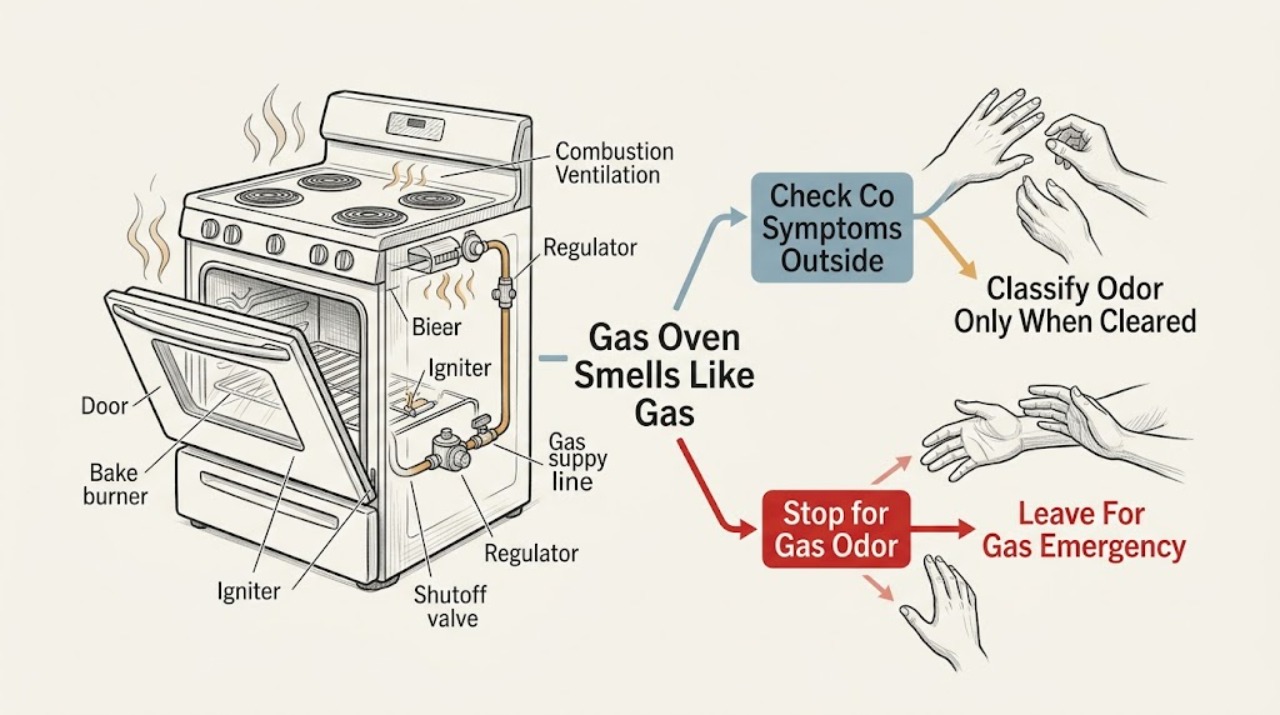
Work through in order
Diagnostic checks
Use only checks that match the exact appliance or system and its official guide.
-
Check 1
If you smell fuel gas near the LG oven, stop operating it and leave the home or building immediately; from outside or a neighbor's location, contact the gas supplier or emergency services.
Expected result: Treat a strong or continuing odor, hissing, a gas alarm, spreading odor, or an odor whose source is uncertain as an active emergency. Do not touch light switches, appliance controls, plugs, phones, matches, or other ignition sources while inside.
Next step: Keep everyone away, do not search for the leak or move the range, and follow the gas supplier or emergency responder's instructions from a safe location. Do not re-enter or restart the oven until it is cleared.
Why this matters
Why: The odor may be a leak or accumulated unburned gas, and ordinary troubleshooting could create an ignition source or delay evacuation. CPSC specifically directs people who suspect a gas leak to leave and avoid phones, flames, and electrical switches.
-
Check 2
Once outside, ask whether a carbon-monoxide alarm sounded or anyone has headache, dizziness, weakness, nausea, vomiting, chest pain, confusion, or unusual sleepiness.
Expected result: A CO alarm or these symptoms can occur without a recognizable odor because carbon monoxide is colorless and odorless; symptoms affecting more than one person are especially important to report.
Next step: Stay in fresh air, contact emergency services, and do not re-enter until responders say it is safe. Tell responders that a gas oven or range was operating or smelled of gas.
Why this matters
Why: The immediate risk may be combustion products as well as fuel gas. A gas oven must not be used as a heater, and a suspected CO exposure requires fresh air and medical or emergency guidance rather than an appliance experiment.
-
Check 3
Only after the gas supplier or emergency responder has ruled out an active gas hazard, record when the smell occurred: before ignition, during an attempted start, after a flame went out, while the oven was heating, or after the control was turned off.
Expected result: A smell before ignition or after a failed start suggests unburned gas; a smell that returns during a successful bake suggests incomplete combustion, a valve or ignition problem, or another service issue. An odor that occurred only during the first use of a new range may instead match LG's described packaging or factory-material break-in odor, but smoke or a fuel-gas smell overrides this distinction.
Next step: Write down the timing, whether the oven ignited normally, whether the flame was visible only as allowed by the model instructions, and whether the odor cleared. Give this record to LG or a qualified gas-appliance technician.
Why this matters
Why: Timing changes the service handoff, but it does not authorize repeated ignition tests. A short-lived smell during an otherwise successful ignition is not proof that the appliance is safe if it repeats or lasts.
-
Check 4
From a safe location, retrieve the complete LG model number and note whether the range was recently installed, moved, converted between fuel types, cleaned, or serviced; do not pull the appliance forward to read a rear label.
Expected result: A new installation, recent movement, or fuel conversion changes which installer, gas supplier, manual, and regulator information must be checked. LG says gas installation and service are for an authorized licensed installer, service agency, or gas supplier.
Next step: Use the model number to open the LG manual after the area is safe, and contact the installer, gas supplier, or LG support with the installation and odor history. Keep the oven off until the cause is cleared.
Why this matters
Why: The model determines the correct manual and ignition arrangement, while a connection disturbed during movement or installation requires qualified inspection. The correct response is not to tighten fittings or alter a regulator yourself.
-
Check 5
Use the recorded event and any error display to describe the ignition pattern without attempting another ignition: no ignition, clicking or glow without flame, delayed flame, flame-out, or normal ignition followed by odor.
Expected result: LG's gas-oven guidance identifies the gas supply and hot-surface igniter as separate conditions; an igniter that does not work can prevent the bake burner from igniting, while a delayed flame can leave unburned gas in the cavity.
Next step: If there was delayed ignition, a gas smell after the control was off, a flame-out, repeated clicking, or any abnormal flame, stop use and request qualified service. Do not keep cycling the control to reproduce it.
Why this matters
Why: The pattern helps a technician separate supply, ignition, burner, control, or combustion diagnosis, but it cannot safely prove which component failed from outside observation alone.
-
Check 6
If the range is new and the safety authority has ruled out fuel gas, inspect from ordinary safe access for remaining plastic film, cardboard, ties, or packaging and compare the odor with LG's new-range description; do not touch hot surfaces.
Expected result: LG attributes some first-use odor or smoke to packaging, insulation, and factory material, and says the kitchen should be ventilated and the oven empty during its model-appropriate break-in. A sulfur-like gas odor, recurrent odor, smoke from a fault, or abnormal flame does not fit a routine break-in assumption.
Next step: Follow only the exact LG model instructions for removing accessible packaging and any break-in cycle after the appliance has been cleared. If the odor persists or the source is uncertain, keep it off and arrange service.
Why this matters
Why: A new-oven break-in explanation is conditional on the appliance being correctly installed and no gas emergency signs being present. It is not a reason to ignore an odor that returns after ignition or appears on an older, previously normal oven.
-
Check 7
Leave gas connections, the regulator, connector, burner assembly, igniter, and oven cabinet undisturbed; inspect only labels or visibly accessible controls after the area has been cleared by the appropriate authority.
Expected result: If finding the suspected source would require moving the LG range, removing a panel, loosening a fitting, testing gas flow, or working near wiring, the check has reached a professional boundary.
Next step: Stop the inspection and give the technician the odor timing, installation history, model number, display code, and any safe photos taken without moving the range. Do not attempt a leak test or part replacement.
Why this matters
Why: LG says installation and gas-line work require an authorized licensed installer, service agency, or gas supplier. CPSC also warns that moving an appliance to inspect its connector can cause a connector failure.
-
Check 8
After the gas hazard has been cleared and before any future use, have the qualified installer or technician confirm the LG oven's fuel type, combustion-air openings, venting, and installation against the exact manual; do not treat opening a window as a repair.
Expected result: Blocked or incorrect ventilation, an unapproved fuel conversion, or an installation that does not match the model documentation can change combustion and create a carbon-monoxide or fire risk. A clear room after airing out does not prove the appliance is safe.
Next step: Keep the oven out of service until the professional confirms the installation and combustion path. Report any CO alarm or symptoms separately to emergency responders.
Why this matters
Why: Ventilation and fuel-conversion checks require model-specific installation knowledge. LG notes that conversion and gas connections are qualified-installer work, and the CDC says gas appliances must be vented properly.
-
Check 9
Prepare a service record with the LG model, fuel type if known, exact odor description, location, timing, ignition result, flame or smoke observation, error display, recent installation or movement, and any CO alarm or symptoms.
Expected result: A complete record lets the gas supplier or appliance technician decide whether to inspect the supply, connector, regulator, valve, igniter, burner, controls, combustion, or venting without asking the household to recreate the odor.
Next step: Contact LG support, the authorized installer, the gas supplier, or qualified gas-appliance service. Do not use the oven until the professional has cleared the condition.
Why this matters
Why: Recurring odor, delayed ignition, abnormal flame, or unexplained odor after the control is off is not a user-maintenance issue. It is a service boundary even if the oven later appears to operate normally.
Use your observations
Decision map
Find the observation that best matches what you see, then follow the next safe action.
-
PATH 01Next step
What you see
The gas odor is strong, continuous, spreading, unexplained, or accompanied by hissing, a gas alarm, smoke, fire, or an abnormal flame.
Do this next
Leave immediately without operating switches, controls, phones, or flames inside; contact emergency services or the gas supplier from outside or a neighbor's location. Do not move the LG range or re-enter until cleared.
-
PATH 02Next step
What you see
A carbon-monoxide alarm sounds or anyone has headache, dizziness, weakness, nausea, vomiting, chest pain, confusion, or unusual sleepiness.
Do this next
Get to fresh air and seek emergency or medical help. Do not re-enter or operate the oven until authorities and a qualified technician establish that it is safe.
-
PATH 03Next step
What you see
The odor appeared before the burner lit, after a failed start, after a flame went out, or following a delayed ignition.
Do this next
Stop using the oven and request qualified gas-appliance service. Do not repeatedly turn the control on or try to verify the igniter or burner yourself.
-
PATH 04Next step
What you see
The range is new, the authorized installer has ruled out fuel gas and installation faults, and the smell matches packaging or factory material without an abnormal flame or safety symptom.
Do this next
Follow the exact LG model's ventilated, empty-oven break-in instructions only; remove accessible packaging as directed and stop if the odor becomes fuel-like, persistent, smoky from a fault, or otherwise abnormal.
-
PATH 05Next step
What you see
The oven ignites, but a gas smell returns during heating, remains after the control is off, or is paired with yellow or unstable flame, smoke, or unusual combustion noise.
Do this next
Keep the oven off and arrange qualified service for gas supply, ignition, burner, valve, regulator, combustion, and venting diagnosis. Do not adjust gas pressure or clean internal parts as a substitute.
-
PATH 06Next step
What you see
The gas supplier or emergency responder has cleared the area, the installer confirms the appliance is safe, and the only odor was a documented first-use material odor that does not recur.
Do this next
Keep the model manual and service clearance with the appliance record. If the smell returns or the ignition pattern changes, stop use and reopen the service branch.
Helpful context
Understand the symptom
The emergency decision comes before troubleshooting
A gas-oven smell is not a prompt to keep turning the knob until the burner catches. Odorant can indicate unburned fuel, and a damaged connection or valve can leak even when the oven is not running. If the smell is strong or does not promptly clear, leave first. Do not pull the LG range forward to inspect the connector, and do not use an open flame or electrical equipment to locate a leak. The exact LG model manual and the local gas supplier determine the safe service path.
Do not confuse a new-oven break-in smell with fuel gas
LG says a new range can give off odor or smoke from packaging, insulation, or factory-applied material, and recommends ventilation and removal of packaging before its model-appropriate break-in procedure. That guidance does not make a rotten-egg or sulfur-like fuel-gas odor safe, and it does not justify operating an oven that has delayed ignition, an abnormal flame, or a recurring gas smell.
Carbon monoxide has a different warning pattern
Carbon monoxide is colorless and odorless, so a working nose cannot rule it out. The CDC lists headache, dizziness, weakness, upset stomach, vomiting, chest pain, and confusion among common symptoms. A CO alarm or symptoms require fresh air and emergency help; do not stay inside to identify which appliance is responsible or re-enter until authorities say it is safe.
Only after diagnosis
Potential parts
- oven igniter
Consider this only after a qualified technician confirms an ignition fault or delayed ignition and rules out gas supply, burner, control, and installation causes.
Confirm the complete LG model and professional diagnosis before ordering; do not remove or test the igniter yourself. - gas valve or regulator
Consider this only when a qualified gas-appliance technician diagnoses a model-specific valve or regulator fault after the safe emergency response.
Gas-system components require exact model fit and qualified installation; no part should be selected from the odor alone. - burner assembly
Consider this only when professional diagnosis finds a burner or combustion fault consistent with the recorded odor and ignition pattern.
Verify the complete LG model and have gas-appliance service confirm compatibility and installation.
When checks do not resolve it
Need a professional?
Leave immediately and seek emergency or gas-supplier help for a strong or continuing gas odor, hissing, spreading odor, a gas alarm, fire, smoke, abnormal flame, delayed ignition, or an odor that remains after the control is off. Seek fresh air and emergency medical help for a carbon-monoxide alarm or symptoms. For any recurring odor, recent installation or movement, fuel conversion, abnormal ignition, or uncertain cause, keep the LG oven off until an authorized installer, gas supplier, or qualified gas-appliance technician clears it. Never move the range, search for a leak, open the cabinet, alter gas connections or pressure, bypass a safety device, or use an open flame or electrical switch to test the appliance.
Safety scope: Leave for strong or continuing odor and contact emergency or gas-supplier help from outside. Do not operate switches, flames, phones, or controls in the suspected-gas area; do not move the range, open the cabinet, work on gas connections, or repeat ignition tests.
Common questions
FAQ
Is a gas smell from a new LG oven normal?
LG says a new range can have odor or smoke from packaging, insulation, or factory material, but a fuel-gas odor, delayed ignition, abnormal flame, continuing smell, smoke from a fault, or any safety symptom is not a routine break-in assumption. Have the appliance cleared before using any break-in guidance.
What should I do if the LG gas oven smells like gas after it lights?
Turn use into an immediate stop condition. Leave for a strong, continuing, or recurring odor and contact emergency services or the gas supplier from outside. Do not repeatedly relight the oven or move the range; recurring odor after ignition needs qualified service.
Can I check the LG oven gas connector myself?
No. CPSC warns not to move an appliance to inspect its connector, and LG says gas connections and gas-line service require an authorized licensed installer, service agency, or gas supplier. Give the technician the model and odor history instead.
Can a gas oven smell cause carbon-monoxide poisoning?
A fuel-gas odor and carbon monoxide are different hazards, and CO is colorless and odorless. A CO alarm or symptoms such as headache, dizziness, weakness, nausea, chest pain, or confusion require fresh air and emergency help; do not stay inside to troubleshoot the appliance.
When can I use the LG gas oven again?
Only after the gas supplier, emergency responders, authorized installer, or qualified gas-appliance technician has cleared the suspected leak or ignition and combustion problem. A smell that returns, a delayed ignition, abnormal flame, smoke, or a CO alarm means keep it off.
Read the exact guide
Official sources
- LG New Range - Strong Odor or SmokeLG USA Support · LG ranges and ovens during initial use; exact model instructions still control.
- LG Range – How to Install a Gas RangeLG USA Support · LG gas ranges; model-specific installation instructions and qualified professionals control.
- Oven Not Heating - Gas RangesLG USA Support · LG gas ranges; exact model and displayed code can change the diagnosis.
- Carbon Monoxide Poisoning BasicsCenters for Disease Control and Prevention · Household carbon-monoxide safety, including gas ranges and other fuel-burning appliances.
- gasU.S. Consumer Product Safety Commission · Consumer gas appliances when a gas leak is suspected.
Community feedback
Share a repair observation
Share a plain-text repair observation. Accepted observations are published automatically; this page may take a moment to update.