
On this page
Start here
Quick answer
A Whirlpool gas oven that will not start may have no power, a locked or delayed control, Demo Mode, an open door, a closed main or regulator gas valve, or a model-specific ignition or control fault. First record whether the display and cooktop work, confirm the selected mode and Start command, and check the door and visible settings without opening the appliance. If there is any gas smell, delayed ignition or boom, abnormal yellow flame, smoke, arcing, repeated breaker trip, or a hot or damaged cord, stop immediately: do not light anything, touch electrical switches, test for a leak, or remove panels. Use the exact model manual for any one-time reset and arrange qualified service when the safe checks do not restore operation.
Before you begin
Safety first
- Do not manually light the oven, search for a gas leak, slide a hard-piped range, kink a flexible connector, adjust gas pressure, remove panels or burner parts, probe wiring, bypass an interlock, or repeatedly reset a hazardous appliance.
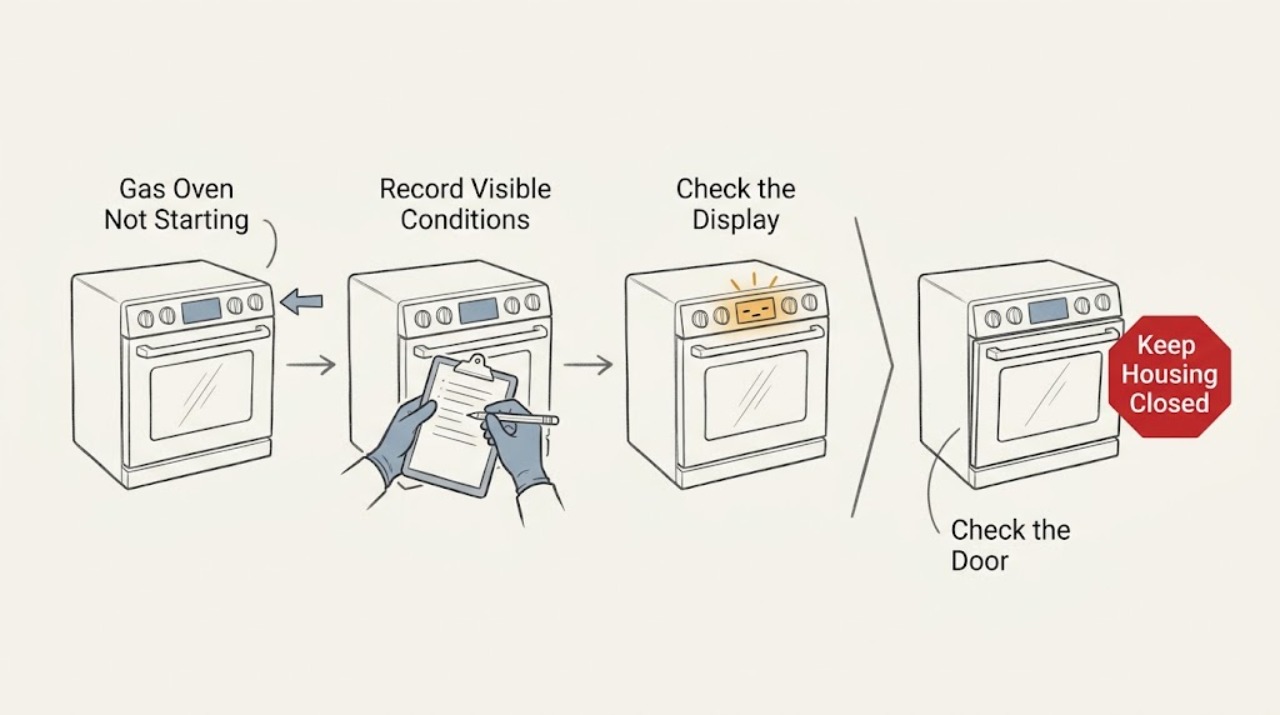
Work through in order
Diagnostic checks
Use only checks that match the exact appliance or system and its official guide.
-
Check 1
From a safe position, record whether the Whirlpool display is dark, shows a clock or message, responds to touch, and whether the cooktop or oven light has power; do not remove covers or disturb wiring.
Expected result: Classify the range as fully without power, display powered but oven function unavailable, or display powered with a specific code/message; note any recent outage or tripped protection without repeatedly restoring it.
Next step: Photograph the display and model label from a safe position, check only that the cord is visibly seated in the required grounded outlet, and arrange an electrician or appliance technician if power is absent, uncertain, or repeatedly interrupted.
Stop if: Do not use an adapter or extension cord, touch exposed wiring, open the control area, or repeatedly reset a breaker or fuse.
Why this matters
Why: A fully dark range points to the receptacle, cord, household circuit, or control power path. A responsive display shifts attention to settings, door, gas supply, ignition, or a model-specific fault; a code must be interpreted only in the exact manual.
-
Check 2
Using only the normal control panel, select the intended Bake or Broil function, confirm a temperature or mode as the manual requires, and press Start once; do not infer a code meaning from another Whirlpool model.
Expected result: Record whether the display shows Control Lock, Demo/Showroom/Try the Product, Delayed Start, PRESS START, a flashing clock, an error code, or no response.
Next step: Follow the exact owner's manual procedure for clearing a lock, canceling a delay, setting the clock, or leaving Demo Mode; if a code returns, save it and arrange qualified Whirlpool appliance service.
Stop if: Do not repeatedly enter codes, bypass Control Lock, or operate the oven if it starts heating unexpectedly or the controls behave erratically.
Why this matters
Why: A lock, Demo Mode, delayed start, unset clock, or missing Start confirmation can block a normal cycle. A returning letter-number code or no response after the documented control sequence points to model-specific service rather than a gas-line adjustment.
-
Check 3
With the oven cool, close the door normally and inspect the visible door edge, latch area, rack position, and storage drawer opening for cookware, packing material, foil, or debris that prevents closure; do not force the latch.
Expected result: Record whether the door closes fully, a rack or dish interferes, the latch appears damaged, the bottom is covered, or the door and cavity are clear.
Next step: Remove only a cool, clearly accessible obstruction, restore the door normally, and make one normal start attempt; arrange service if the latch, hinges, door alignment, or burner area is not clearly intact.
Stop if: Do not run with the door forced or defeated, cover the oven bottom with foil or a liner, reach into the burner or igniter area, or dismantle the door.
Why this matters
Why: Whirlpool notes that some models will not operate with the door open, and that a blocked oven bottom can affect burner air or gas flow. A damaged latch or a door that cannot close is a service condition, not a reason to defeat the interlock.
-
Check 4
Only when there is no gas odor and the shutoff is already visible without moving the range, observe whether the household main gas valve and any clearly labeled accessible appliance valve are in their normal ON position; do not slide the range or touch the gas line.
Expected result: Record whether the cooktop already works, the main valve appears on, the oven regulator status is unknown, or a valve/line is inaccessible or damaged; note whether the range was recently installed or reconnected.
Next step: Use the model installation instructions or request a certified appliance/gas technician to verify the supply and regulator. Do not move a hard-piped range or overextend, pinch, or kink a flexible connector.
Stop if: If gas is smelled, a line is damaged, a valve is stuck, or the installation is unclear, do not operate switches or flames; leave the area and follow the gas supplier or fire-department emergency guidance from a safe location.
Why this matters
Why: A working cooktop does not prove that the oven regulator shut-off is open. A recently connected range may have air in the line, but gas-line purging and regulator access must follow the exact installation instructions or a qualified technician; an unknown or damaged supply path is not a DIY ignition check.
-
Check 5
Do not remove the bottom panel or attempt a manual ignition; if a normal, hazard-free start was already attempted, record only what was heard or seen from outside the closed oven.
Expected result: Record no click or glow, clicking without a stable flame, a delayed whoosh or boom, a stable normal flame that does not continue heating, abnormal yellow/noisy flame, smoke, or gas odor.
Next step: Keep the oven off for any abnormal result and provide the exact symptom to a qualified appliance or gas technician; do not repeat the ignition attempt to confirm it.
Stop if: Do not light the oven manually, search for a leak, adjust gas pressure, probe wiring, remove burner parts, or continue after a delayed ignition, boom, yellow flame, smoke, or gas odor.
Why this matters
Why: No sound or glow can indicate power, control, or ignition-path issues; clicking without ignition can involve supply or igniter conditions; delayed ignition, boom, abnormal flame, smoke, or gas odor indicates an unsafe combustion or gas condition. Sound alone cannot identify a valve, igniter, sensor, or control part.
-
Check 6
If there is no gas smell, smoke, heat damage, arcing, or repeated trip, use only the exact one-time power-reset procedure in the Whirlpool owner's manual for the recorded model; do not improvise a reset duration.
Expected result: After the documented reset, record whether the display returns normally, the original message returns, the controls remain unresponsive, or the oven starts but fails to ignite or heat.
Next step: Stop repeating resets and arrange qualified service with the model, message, timing, power state, gas-supply observation, and ignition result.
Stop if: Do not reset during a gas, smoke, arcing, overheating, or water/electrical hazard, and do not bypass a protective device.
Why this matters
Why: A cleared display or transient control state may be resolved, but a returning code, dead control, failed ignition, or unexpected heating means the reset did not diagnose or repair the fault.
-
Check 7
Prepare a service record from safe observations: model number, display message, selected mode, door state, cooktop state, power history, gas-valve visibility, ignition sound, and any odor or flame change.
Expected result: Include when the fault began, whether the range was installed or moved, whether the issue affects the whole range or only the oven, and whether the condition is repeatable without a hazardous test.
Next step: Give the record and photos to qualified Whirlpool appliance service; request model-specific diagnosis of the electrical supply, controls, door interlock, gas path, igniter, burner, and safety functions as applicable.
Stop if: Do not open panels, remove the regulator or burner, adjust gas pressure, repair ignition wiring, or continue operating through any safety warning.
Why this matters
Why: This separates a power/control problem from a door interlock, gas-supply/regulator, ignition, sensor, or control fault and prevents a technician from guessing across Whirlpool models.
Use your observations
Decision map
Find the observation that best matches what you see, then follow the next safe action.
-
PATH 01Safety boundary
What you see
The display and other range functions are dead, or power protection trips again after a normal check.
Do this next
Leave the appliance off and arrange qualified electrical or appliance service; provide the outlet and interruption history without using an adapter or extension cord.
Why this path and its safety boundary
Why it matters: The problem is electrical supply, grounding, cord, or internal control power rather than an oven-only gas setting.
Safety stop: Do not repeatedly reset protection, open the control area, or touch exposed wiring.
-
PATH 02Safety boundary
What you see
The display works and shows Control Lock, Demo Mode, Delayed Start, a flashing clock, or PRESS START.
Do this next
Use the recorded model's owner's manual to clear or confirm the setting once, then make one normal start attempt; service a returning code or unresponsive control.
Why this path and its safety boundary
Why it matters: A model setting or missing confirmation may be preventing the cycle from beginning.
Safety stop: Do not bypass the lock or continue if the oven heats unexpectedly or controls act erratically.
-
PATH 03Safety boundary
What you see
The door does not close fully, a rack or drawer item interferes, or the oven bottom is covered or obstructed.
Do this next
With the oven cool, remove only a visible safe obstruction and restore the door; arrange service for latch, hinge, alignment, or burner-area damage.
Why this path and its safety boundary
Why it matters: The door interlock or burner airflow path may be preventing a normal start.
Safety stop: Do not force the latch, defeat the door interlock, or use foil or a liner over the oven bottom.
-
PATH 04Safety boundary
What you see
The cooktop works but the oven does not, the range was recently connected, or a main/regulator valve is unknown or inaccessible.
Do this next
Use the exact installation instructions or arrange certified appliance/gas service to verify the supply and regulator without moving a hard-piped range.
Why this path and its safety boundary
Why it matters: The oven gas path may differ from the cooktop path; a supply or regulator condition remains possible but cannot be safely inferred or adjusted.
Safety stop: Do not search for a leak, move the range, kink a connector, turn gas controls in response to an odor, or use a flame to test supply.
-
PATH 05Safety boundary
What you see
There is no ignition response, repeated clicking without a stable flame, delayed ignition/boom, abnormal yellow or noisy flame, smoke, or gas odor.
Do this next
Keep the oven off and arrange qualified appliance or gas service. If gas is smelled, do not operate switches or flames; leave and follow the gas supplier or fire-department emergency instructions from a safe location.
Why this path and its safety boundary
Why it matters: The oven may have an ignition, burner, gas-supply, conversion, or combustion fault; an abnormal flame or odor is a safety issue rather than a part-selection clue.
Safety stop: Do not manually light the oven, repeat the start attempt, adjust gas pressure, or open the burner area.
Helpful context
Understand the symptom
Separate no power from an oven that has power but will not begin
Look at the display and note whether the cooktop burners, oven light, and other controls have power. A dark display and a display that responds but does not begin are different paths. Whirlpool says a gas range needs a grounded operational electrical connection for the oven igniters, even though the cooking fuel is gas. Do not use an adapter or extension cord, and do not keep resetting a tripped circuit if the interruption repeats. Record the model number from the frame or documentation before applying code or reset instructions.
A visible setting can prevent a normal start
On Whirlpool models, Control Lock, Delayed Start, Demo Mode, an unset clock, an unconfirmed Start command, or a door that is not fully closed can make an oven appear not to start. These features vary by model, so use the owner's manual for the exact keys and display wording. Check only the normal controls and the closed-door position; do not force a latch or remove an oven bottom, storage drawer, or control panel to reach an igniter.
Gas supply and ignition need a strict stop boundary
A Whirlpool gas range may have both a household main gas shutoff and a regulator shut-off that supplies the oven. Whirlpool notes that the cooktop can have gas while a regulator valve still prevents gas from reaching the oven. A valve or supply check is limited to a clearly visible, safely accessible control with no gas odor; do not slide a hard-piped range, kink a flexible line, search for a leak, or relight a burner to investigate. A gas smell, delayed ignition, booming, abnormal flame, smoke, or carbon-monoxide alarm is a stop condition, not an ignition test.
Only after diagnosis
Potential parts
- oven igniter
Consider only after a qualified technician confirms an igniter fault for the exact model and ignition design.
Confirm the full model and revision, gas type, connector, mounting, and manufacturer fit information; do not infer compatibility from the symptom or appearance. - oven temperature sensor
Consider only when the technician's model-specific diagnosis shows a sensor or sensing circuit fault rather than a start-control, gas, or ignition problem.
Use the exact model documentation and technician confirmation; do not probe or replace a sensor as a gas-ignition test. - oven control or safety component
Consider only after qualified diagnosis identifies a failed control or safety component and rules out settings, power, door, gas supply, and ignition causes.
Controls and safety parts are model-specific and must be installed and tested by qualified service.
When checks do not resolve it
Need a professional?
Arrange qualified Whirlpool appliance service when the safe power, control, door, and visible supply checks do not restore a normal start, when a code returns, when ignition is absent or abnormal, or when the cause is behind a panel. Treat gas odor, delayed ignition/boom, abnormal flame, smoke, arcing, repeated electrical interruption, or a carbon-monoxide alarm as an immediate safety stop requiring appropriate emergency or gas-safety help.
Safety scope: Do not manually light the oven, search for a gas leak, slide a hard-piped range, kink a flexible connector, adjust gas pressure, remove panels or burner parts, probe wiring, bypass an interlock, or repeatedly reset a hazardous appliance.
Have this ready
- Provide the exact Whirlpool model number, display/code photo, whether the display and cooktop work, selected mode, door/latch observation, recent installation or movement, visible main/regulator valve status if safely known, ignition sound or flame observation, and any odor, smoke, heat, arcing, or breaker history.
Common questions
FAQ
Why does my Whirlpool gas oven have power but not start?
Check the exact model's Control Lock, Delayed Start, Demo Mode, clock, selected function, and Start confirmation, then check that the door closes normally. If the display still will not begin a cycle or a code returns, arrange model-specific service.
Can the cooktop work while the Whirlpool oven has no gas?
Yes. Whirlpool explains that an oven regulator shut-off can stop gas to the oven while cooktop burners still receive gas. Do not move a hard-piped range or adjust the gas path; use the installation instructions or a qualified technician.
What should I do if I smell gas while the oven will not start?
Do not try to light an appliance, touch an electrical switch, or use a phone inside the building. Leave the area and contact the gas supplier or fire department from a safe location, following the Whirlpool manual's emergency instructions.
Should I manually light a Whirlpool gas oven to test it?
No. Do not manually light the oven or repeat an ignition attempt, especially after clicking without flame, delayed ignition, a boom, yellow or noisy flame, smoke, or gas odor. Keep it off and arrange qualified appliance or gas service.
Can I reset a Whirlpool gas oven that will not start?
Only use the one-time reset documented for the exact model and symptom, and only when there is no gas, smoke, heat, arcing, water, or repeated electrical hazard. If the message or failure returns, stop resetting and provide the code and model to service.
Read the exact guide
Official sources
- Oven Not Working - GasWhirlpool Product Help · Whirlpool gas-range guidance; exact model installation and control details remain authoritative.
- Owner's ManualWhirlpool · A Whirlpool gas-range manual example; use the owner's manual for the recorded model for exact controls.
- Oven Not Working - Light Doesn't Turn OffWhirlpool Product Help · Whirlpool range door guidance; exact interlock behavior varies by model.
- PUSH or PSH - RangeWhirlpool Product Help · Only models that display the documented PUSH or PSH message.
- How to Check the Gas Regulator Shut-Off Valve on an OvenWhirlpool Product Help · Whirlpool gas ranges with the described regulator arrangement; exact installation instructions govern.
- No or Partial Display - RangeWhirlpool Product Help · Only an example for the documented no/partial-display symptom; the exact model manual controls.
- Nothing is Working - GasWhirlpool Product Help · Whirlpool gas-range control guidance; display labels and key sequences vary by model.
- Oven Not Working - Cooktop Working - Not ClickingWhirlpool Product Help · Whirlpool gas-range troubleshooting; do not generalize across model variants.
Community feedback
Share a repair observation
Share a plain-text repair observation. Accepted observations are published automatically; this page may take a moment to update.