
On this page
Start here
Quick answer
The opened Reddit post does describe both assigned symptoms: an approximately four-year-old LG side-by-side refrigerator stopped making ice again after a replacement, and popping/groaning freezer noises stopped at the same time. Before deciding to abandon the appliance, separate an ice-maker-only fault from a refrigerator-wide cooling or fan problem. LG says no ice can result from the icemaker being off, water-supply trouble or an insufficiently cold freezer, while some ice-maker rattling, cracking, drilling, humming and buzzing are normal. Confirm the icemaker is on, the water supply is open and the freezer is cold enough using the exact model guidance. If the noise is unusually loud, returns when doors close, or the icemaker still fails its model-approved check, obtain a diagnosis before buying an unverified replacement or replacing the refrigerator.
Before you begin
Safety first
- Do not force the ice tray, remove powered components, open sealed refrigeration tubing, bypass controls, or select a replacement assembly by appearance. Stop the icemaker and protect food if cooling or electrical safety is affected.
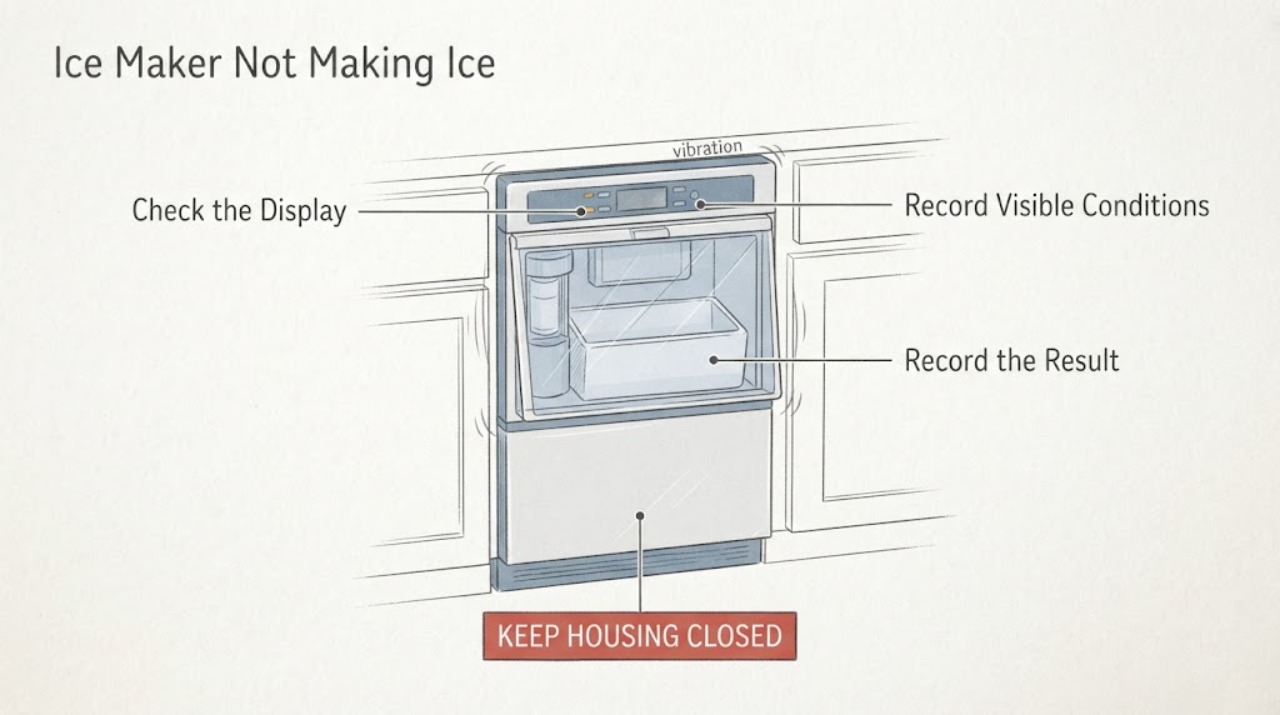
Work through in order
Diagnostic checks
Use only checks that match the exact appliance or system and its official guide.
-
Check 1
Record the refrigerator's complete model and identify whether the no-ice symptom is no cubes at all, slow production, a failed harvest, or ice that is made but will not dispense. Confirm whether the refrigerator and freezer otherwise hold temperature.
Expected result: The model is known and cooling is normal, or the refrigerator/freezer is also warm, the symptom is dispensing-only, or the model label is unavailable.
Next step: Use the complete model for LG's manual/support route. If the freezer is not maintaining temperature or the model is unknown, do not order an icemaker by appearance; arrange diagnosis before making a repair-or-replace decision.
Why this matters
Why: An icemaker-only decision is different from a cooling, dispenser or whole-refrigerator fault. LG's public guide branches by refrigerator type and directs owners to model-specific support when the general path does not resolve the issue.
-
Check 2
Check the external water supply valve, the refrigerator's accessible water connection and the icemaker ON/OFF state. Confirm the control lock is not preventing the Ice On/Off control from changing, and do not disconnect water lines or remove covers as a test.
Expected result: The icemaker is off/locked, the water valve is closed or the supply is kinked, or those external conditions are normal.
Next step: Correct only the accessible setting or supply issue and allow the model's stated production time. If the problem persists with the external supply confirmed, use the exact model's diagnostic/service route.
Why this matters
Why: LG says an icemaker that is switched off, locked or not supplied with water will not make ice. Normal external settings do not prove that the icemaker assembly or valve is good.
-
Check 3
Check the freezer temperature using the appliance display or a suitable thermometer without dismantling the refrigerator, and compare it with the exact model guidance. LG's general no-ice guide says the freezer must be below 19°F and recommends -4°F or colder for ice production.
Expected result: The freezer is warmer than the applicable threshold, or it is cold enough and the icemaker still produces no ice.
Next step: If warm, address only model-approved temperature, door-closure and external airflow checks and allow the stated recovery time. If cold enough with no ice, continue to a model-approved icemaker test or service; do not force the tray.
Why this matters
Why: A warm freezer can slow or prevent ice production and shifts attention to cooling, door sealing or airflow. A sufficiently cold freezer makes an icemaker/water/controls diagnosis more relevant, but does not identify one component.
-
Check 4
Classify the noise by timing and location without removing the icemaker: note whether it is a normal drop/rattle, thermal crack/click/drip, short drilling/harvest sound, hum/buzz, water-supply knocking, or a persistent noise that changes when the doors open.
Expected result: The noise matches normal ice drop/thermal/harvest/fan behavior, is unusually loud during water supply, or stops with doors open and returns when closed.
Next step: Do not use sound alone to select an icemaker part. Correct only an obvious external hose/setting issue; otherwise keep the refrigerator in service only if safe and request a model-specific diagnosis, especially for door-dependent or persistent abnormal noise.
Why this matters
Why: LG lists the first group as normal possibilities. Unusually loud water-supply knocking can indicate an unsecured hose, while a noise that follows door position is likely fan-related and requires service.
-
Check 5
If the exact LG model manual provides a reset or test procedure, follow that procedure only as written, with the ice bucket positioned as instructed and a towel ready for possible water or ice. Do not insert tools into an unverified test hole, force the tray, open sealed refrigeration components or remove the icemaker while powered.
Expected result: The model-approved test cycles the icemaker and water/ice is present, or the test fails, produces no water/ice, jams or the abnormal noise returns.
Next step: If the model-approved test fails or the noise is abnormal, stop repeated resets and obtain a model-specific service diagnosis. Do not buy or install a replacement assembly solely from the symptom.
Why this matters
Why: LG says a successful cycle should be monitored, while failure to cycle or failure of water/ice indicates service is needed. A generic test instruction cannot establish fit across LG icemaker styles.
Use your observations
Decision map
Find the observation that best matches what you see, then follow the next safe action.
-
PATH 01Next step
What you see
The icemaker was off or locked, the water valve was closed, or the freezer was not cold enough, and the condition is corrected without any abnormal noise.
Do this next
Allow the exact model's production interval and monitor ice production; do not replace the appliance or order a part until the corrected condition is evaluated.
Why this path and its safety boundary
Why it matters: The no-ice symptom may have an operating, supply or temperature explanation rather than a failed icemaker assembly.
-
PATH 02Next step
What you see
The refrigerator and freezer hold temperature, the icemaker is on with water supplied, but the model-approved test does not cycle or no water/ice appears.
Do this next
Obtain an LG/model-specific diagnosis and compare the repair quote with the value of the otherwise-working refrigerator; do not install an unverified replacement part.
Why this path and its safety boundary
Why it matters: The icemaker system needs service, but the public evidence does not identify whether the assembly, valve, sensor, wiring or control is at fault.
-
PATH 03Next step
What you see
Noise is persistent and unusually loud, follows door position, is accompanied by water-line knocking, warming food, leaking water or an electrical/burning symptom.
Do this next
Stop the icemaker and arrange LG or qualified refrigerator service. Protect food according to its temperature and safety requirements; do not open sealed refrigeration parts or bypass controls.
Why this path and its safety boundary
Why it matters: The issue may involve fan, water-line, cooling or electrical service rather than an isolated icemaker repair; continued operation or repeated tests could worsen the risk.
Helpful context
Understand the symptom
The original report supports a repair decision, not a part diagnosis
The opened r/appliancerepair post describes a four-year-old LG side-by-side refrigerator whose icemaker had already been replaced, then stopped working again. The owner also heard popping and groaning from the freezer for about a month, and says those sounds stopped when the icemaker stopped. The post does not provide a model number, measured freezer temperature or a confirmed failed component. Treat it as evidence of the symptoms and repair-versus-replace question, not as proof that an icemaker, valve, fan or control board is the cause.
Why noise timing matters
LG identifies several normal sounds: ice falling into the bin, thermal expansion and contraction, the icemaker motor moving ice, and normal fan or water-valve operation. LG also says a noise that stops when the doors open and returns when they close is likely fan-related and requires service, while unusually loud knocking or tapping during water supply can indicate a hose that is not secured. A sound that disappears with an icemaker failure is therefore a useful timing clue, but not a diagnosis by itself.
When checks do not resolve it
Need a professional?
Request LG or qualified service when the icemaker remains inactive after model-approved checks, a replacement would be the second repair, noise returns with the doors closed, water-supply knocking is unusually loud, freezer temperature is not maintained, or parts/removal are not model-confirmed.
Safety scope: Do not force the ice tray, remove powered components, open sealed refrigeration tubing, bypass controls, or select a replacement assembly by appearance. Stop the icemaker and protect food if cooling or electrical safety is affected.
Have this ready
- Provide the complete refrigerator model, serial if requested, side-by-side or other configuration, freezer temperature, icemaker ON/OFF state, water-supply observations, noise timing/location, prior icemaker replacement information and whether the refrigerator otherwise cools normally.
Common questions
FAQ
Does the freezer noise prove the icemaker failed?
No. The opened report links the timing, but LG lists several normal ice-maker, fan, water-valve and thermal noises. A door-dependent noise may be fan-related and needs service; sound alone does not identify a failed assembly.
What should I check before paying for an icemaker repair?
Confirm the exact model, icemaker ON/OFF and control-lock state, accessible water supply and freezer temperature. LG says no ice can result from a disabled icemaker, water-supply issue or insufficiently cold freezer. If those conditions are normal, use only the exact model's test/reset procedure or request service.
Should I replace the whole refrigerator after a second icemaker failure?
The public evidence does not establish a universal replacement rule. If the refrigerator and freezer otherwise hold temperature, obtain a model-specific diagnosis and compare the repair quote with the appliance's condition and expected use. If cooling or fan symptoms are present, diagnose those before treating the issue as an icemaker-only repair.
Read the exact guide
Official sources
- [LG Refrigerator] Troubleshooting water/ice related issuesLG USA Support · Opened the official LG USA article. It covers disabled/locked icemakers, water-supply valve checks, first-ice timing and turning the icemaker off during long nonuse. It is family-level guidance and does not establish a model-specific replacement part.
- LG Refrigerator - Troubleshooting Ice Maker Noises On My LG RefrigeratorLG USA Support · Opened the official LG noise guide. It distinguishes normal ice-drop, thermal, drilling, humming and buzzing sounds from door-dependent fan noise or persistent abnormal noise, and recommends service when the listed patterns do not explain the sound.
- LG Refrigerator – Why is My Refrigerator Not Making Ice?LG USA Support · Opened the official LG USA Help Library article. It covers refrigerator-type selection, icemaker power, water/ice presence, model-dependent test mode, service after failed cycling, and general freezer temperature guidance. It explicitly uses different icemaker styles, so no one test sequence is transferred to the unknown model.
- My LG refrigerator makes a loud noise when ice drops into the bin. How can I reduce it?LG USA Support · Opened the official LG guide. It identifies ice-drop and valve/pipe vibration sounds, says unusually loud water-supply knocking may indicate an unsecured hose, and notes that model support for Night Quiet Mode varies. It is used for sound classification, not component fitment.
- Repair an LG ice maker or let it go?Reddit r/appliancerepair · Opened the exact supplied Reddit permalink. The owner reports a four-year-old LG side-by-side, a repeat icemaker failure after a prior replacement, and popping/groaning noises that stopped when the icemaker stopped. It is used to establish the topic symptoms and repair decision, not to diagnose a part or justify the community's repair advice.
Community feedback
Share a repair observation
Share a plain-text repair observation. Accepted observations are published automatically; this page may take a moment to update.