
On this page
Start here
Quick answer
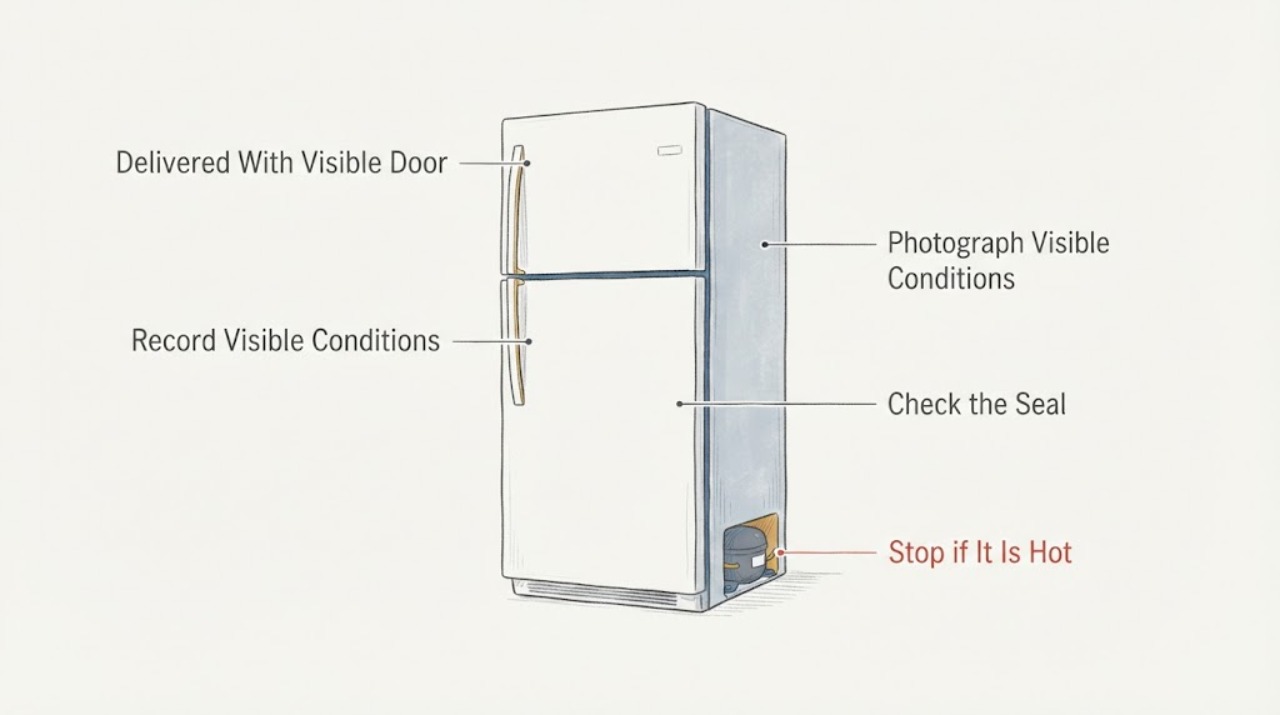
A newly delivered Monogram ZWE23NSTSS with a visible door or insulation defect needs an evidence-preserving inspection before any repair attempt. The official Owner Center identifies this model as a Monogram counter-depth French-door refrigerator and provides its manual and service route. Check whether shipping material is still blocking closure, whether each door closes and seals evenly, and whether the magnetic gasket is seated smoothly in its groove. Photograph bulging insulation, a crooked badge, film impressions, or a gasket that will not seat before changing anything. Do not press a bulge flat, glue a gasket, remove a door, or order an unverified part. If a door does not close/seal or the cabinet/door skin is visibly distorted, keep the unit available for Monogram or qualified service and provide the full model, serial number, delivery date, photos, and a description of the defect.
Work through in order
Diagnostic checks
Use only checks that match the exact appliance or system and its official guide.
-
Check 1
Read the product label and record the full model and serial numbers before contacting service. Confirm that the label is ZWE23NSTSS and that the appliance is the Monogram counter-depth French-door refrigerator shown in the official Owner Center.
Expected result: The label matches ZWE23NSTSS, or the delivered model/suffix differs from the assigned identity.
Next step: If the label differs, stop using this article's model scope and give the actual label to the seller or manufacturer service. If it matches, continue with external inspection and preserve the delivery condition.
Why this matters
Why: A matching label keeps the gasket, door, manual, and service scope tied to the assigned model. A different label means the model-specific page and any replacement-door or gasket decision cannot be assumed to apply.
-
Check 2
Photograph the exterior from each front corner and close-up every visible defect, including any bulge, surface imprint, crooked badge, gap, dent, or loose-looking seal. Also photograph the model/serial label, delivery packaging, and the date the unit arrived.
Expected result: The defect is visible in a photograph and remains in the same location after the protective film or shipping material is identified, or it disappears with removable film/material.
Next step: Do not press the bulge flat, scrape an imprint, straighten the badge, apply adhesive, or discard packaging before the delivery/service decision is documented. Send the images with the model and serial information to the responsible service channel.
Why this matters
Why: A persistent cabinet, door skin, insulation edge, or badge defect is a physical condition to show service; removable film or packing is not proof of a refrigerator failure. Photographs preserve what was delivered without forcing a repair diagnosis.
-
Check 3
With the refrigerator empty of obstructions and the doors closed, check from the outside whether each fresh-food door closes fully and whether the visible magnetic gasket contacts the frame evenly. Do not remove the gasket from a newly delivered unit just to test it.
Expected result: The door closes and the gasket appears smooth, fully seated, and in contact around the perimeter, or there is a visible gap, fold, loose section, or contact loss.
Next step: If the gasket is visibly loose or the door does not seal, keep the refrigerator from being treated as ready for normal use and arrange model-specific service. Do not glue, cut, heat, or substitute a gasket on a new appliance without the exact manual and service direction.
Why this matters
Why: GE's French-door guidance identifies the gasket groove and even sealing surface as the sealing interface. A visible gap or gasket that will not seat is service-relevant; a smooth even contact does not make a cabinet bulge or other cosmetic defect acceptable, and does not prove hidden damage is absent.
-
Check 4
Check only for removable delivery causes of poor closure: look for packaging material at the bottom or around the doors, a bin or shelf preventing closure, or a door that is visibly misaligned. Do not loosen hinges or remove a door while documenting a new delivery defect.
Expected result: Shipping material or a package blocks closure, the door closes normally once the accessible obstruction is removed, or the door still does not close/seal.
Next step: Remove only loose, clearly removable packing material identified by the installation instructions and retest closure once. If closure remains abnormal or the cabinet/door is distorted, stop and request service with photographs; do not force the door.
Why this matters
Why: GE lists blocked doors, packing/shipping material, and leveling as accessible possibilities and states that a broken hinge requires service. If the closure problem remains after an external obstruction is removed, it is not a reason to improvise an adjustment on a new unit.
-
Check 5
Escalate the physical defect to Monogram/GE or qualified appliance service when the door cannot seal, a gasket will not remain seated, insulation or the door skin is bulging, or the condition remains after the accessible closure check. Provide the full label, photos, packaging condition, and whether cooling has been started.
Expected result: The defect is cosmetic only with normal closure, or the defect changes door fit, seal contact, alignment, or safe operation.
Next step: Keep the unit and evidence available for the service inspection and follow the exact model's manual/service route. Do not disassemble the door, cut insulation, drill the cabinet, or continue using it if the door cannot seal or the cabinet is unstable.
Why this matters
Why: A cosmetic-only observation may be assessed as a finish or delivery condition, while a closure/seal or distorted-cabinet observation requires a service assessment. The opened official sources do not establish that a user can repair a cabinet bulge, replace a door, or select a compatible part without a model-specific service decision.
Use your observations
Decision map
Find the observation that best matches what you see, then follow the next safe action.
-
PATH 01Next step
What you see
The model label is ZWE23NSTSS, the doors close evenly, and the gasket is smooth and seated all around, but an exterior bulge, imprint, or crooked badge remains visible.
Do this next
Keep photographs and delivery materials, avoid cosmetic self-repair, and request a Monogram/GE service assessment with the model and serial information.
Why this path and its safety boundary
Why it matters: The reported condition is a persistent physical or finish defect without an established cooling failure; the official pages do not justify treating it as a user-adjustable repair.
-
PATH 02Next step
What you see
A loose-looking gasket is fully seated in its groove and contacts the frame evenly when the door closes.
Do this next
Do not glue or replace the gasket on appearance alone. Photograph the fit and ask model-specific service to assess the new unit if the seal still looks abnormal.
Why this path and its safety boundary
Why it matters: The visible seal concern may be a seating appearance rather than a confirmed leak, but it does not explain or repair a separate cabinet or finish defect.
-
PATH 03Next step
What you see
The gasket has a gap or fold, the door does not close, or the defect prevents even contact with the frame after removable packing is cleared.
Do this next
Stop forcing the door, preserve the condition, and schedule Monogram/GE or qualified service using the exact model and photographs. Do not adjust hinges or remove the door yourself.
Why this path and its safety boundary
Why it matters: The refrigerator has a door-fit or sealing concern that can affect operation and requires service assessment; GE's closure guidance also identifies a broken hinge as service-required.
-
PATH 04Next step
What you see
The delivered model or serial label does not match ZWE23NSTSS, or the visible condition cannot be tied to the assigned unit.
Do this next
Stop model-specific troubleshooting and provide the actual label and delivery photographs to the manufacturer or responsible service channel.
Why this path and its safety boundary
Why it matters: The model-specific scope is unresolved, so this article cannot establish compatible door, gasket, finish, or service procedures.
Helpful context
Understand the symptom
Separate a cosmetic delivery defect from a door-sealing fault
A wrinkle or crooked logo may be cosmetic, while a bulging door/insulation area or a gasket that cannot seal can affect fit and deserves service review. The ZWE23NSTSS is a French-door model, so use the French-door gasket and closure checks below. These checks document what is visible and confirm whether the door can seal; they do not establish that a sealed-system or cooling component is defective.
Keep the new-appliance condition intact
Because the concern is reported immediately after delivery, photograph each defect before pressing, warming, trimming, gluing, or disassembling anything. Keep the model and serial label, delivery paperwork, packaging, and a short timeline with the photographs. The official model page supplies the model-specific manual and service path; it does not authorize a user to reshape a cabinet or replace a door on a new unit.
When checks do not resolve it
Need a professional?
Arrange Monogram/GE or qualified appliance service when the ZWE23NSTSS door does not close or seal evenly, the gasket will not remain seated, a hinge or cabinet/door skin appears damaged, or a visible insulation bulge persists. Preserve the delivery evidence and do not glue, cut, drill, remove the door, or order an unverified door or gasket.
Common questions
FAQ
Is a bulging insulation area on a newly delivered ZWE23NSTSS something to press flat?
No. The opened official sources do not give a user procedure for reshaping a cabinet or insulation. Photograph it in place and request a model-specific service assessment before pressing, cutting, heating, or disassembling the door.
How can I tell whether the loose-looking gasket is a sealing problem?
With the door closed, look for a smooth gasket surface that is seated in its groove and contacts the frame evenly around the perimeter. A gap, fold, or contact loss is service-relevant. Do not glue the gasket or replace it from appearance alone on a new appliance.
Could shipping material keep the refrigerator door from closing?
Yes, GE's closure guidance says accessible packing or shipping material can prevent closure on some refrigerators. Check only for loose, clearly removable material identified by the installation instructions. If the door still does not close or the cabinet is distorted, stop and arrange service.
Does a normal door seal mean the visible defect is harmless?
No. Even sealing only shows that the accessible door interface is working at that moment. It does not prove that a bulging cabinet, door skin, or finish defect is acceptable or that hidden damage is absent. Preserve photographs and have the new unit assessed.
Read the exact guide
Official sources
- Refrigerator - Easy to Remove GasketGE Appliances · Used for the general visible check that the gasket is firmly seated, smooth/flat, and sealing around the closed door. It is not used to infer that every Monogram new-unit gasket should be removed or replaced by the user.
- Troubleshooting for ZWE23NSTSSGE Appliances / Monogram Owner Center · Used for exact-model service escalation and the boundary that the Owner Center provides a model-specific manual and service scheduling rather than a user procedure for cabinet or door reconstruction.
- French-Door Refrigerator - Adjusting or Replacing the Door GasketsGE Appliances · Used for the French-door family interface: magnetic gasket in the retaining groove and a separate service/parts path. It supports visible seal inspection, not cross-model part fit or unsupervised new-unit disassembly.
- Refrigerator - Door Will Not CloseGE Appliances · Used for checking accessible obstruction, packing/shipping material, leveling context, and the boundary that a broken hinge or unresolved closure problem requires service.
- User Manual & Care for ZWE23NSTSSGE Appliances / Monogram Owner Center · Opened exact model Owner Center; used to verify ZWE23NSTSS as a Monogram counter-depth French-door refrigerator and to route model-specific manual/support. It does not establish a cosmetic defect cause or authorize cabinet repair.
Community feedback
Share a repair observation
Share a plain-text repair observation. Accepted observations are published automatically; this page may take a moment to update.