
On this page
Start here
Quick answer
First identify which compartment and foods are freezing. Monogram's support says the fresh-food control may need to be checked and gives 37°F as a reference in its support guidance, but controls and cooling layouts vary by model. Confirm the setting, keep food away from direct cold-air outlets, and use the exact manual; persistent freezing after those checks needs service.
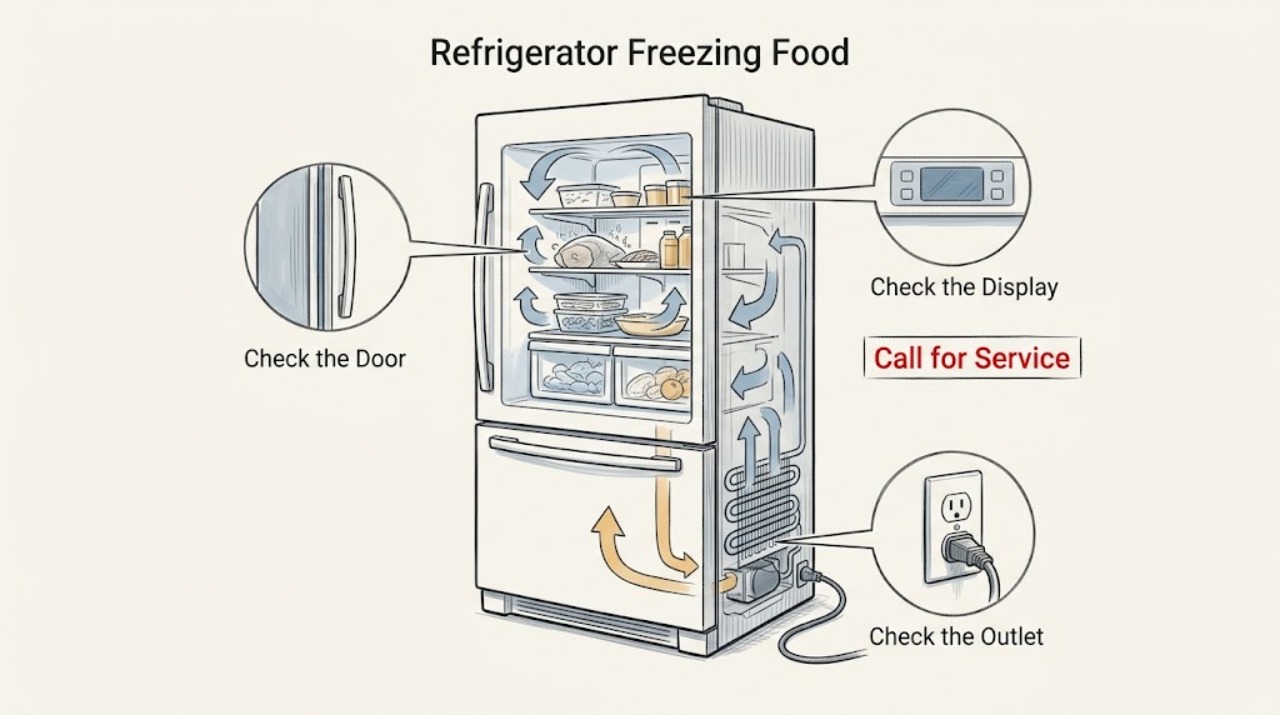
Work through in order
Diagnostic checks
Use only checks that match the exact appliance or system and its official guide.
-
Check 1
Identify whether the freezing is in the fresh-food compartment, freezer, door bins, or only near one vent, and check the actual food location.
Expected result: Only food near an outlet freezes, or the entire fresh-food compartment is below its intended condition.
Next step: Reposition food away from direct airflow and continue with the setting check; widespread freezing needs model-specific guidance.
Why this matters
Why: Localized freezing suggests airflow/placement; widespread freezing suggests a control, sensor, or cooling-system issue.
-
Check 2
Check the fresh-food temperature control and compare it with the exact model manual; Monogram's support article uses setting 5 or 37°F as its reference for that guidance.
Expected result: The control is colder than intended, or it is already at the documented setting.
Next step: Adjust only as the exact manual directs and monitor; do not assume the support article's setting applies to every model.
Why this matters
Why: An incorrect setting can cause freezing; a correct setting with continued freezing points toward airflow or a control fault.
-
Check 3
Keep food from touching rear walls or direct cold-air outlets and confirm packages are not blocking circulation.
Expected result: Items are directly in the airflow or space is clear.
Next step: Rearrange the affected items and monitor with the model's normal temperature guidance.
Why this matters
Why: Direct cold air can freeze localized food even when the compartment average is acceptable; clear circulation helps distinguish placement from whole-cabinet overcooling.
-
Check 4
Find the model number and check whether it uses the cooling layout described in its manual before changing dampers, sensors, or controls.
Expected result: The manual identifies a model-specific damper/airflow or dual-cooling design, or the identity is unavailable.
Next step: Follow only the matching manual. If freezing persists after the documented setting/placement check, arrange service.
Why this matters
Why: Monogram support documents multiple designs, including traditional damper and dual-compressor/evaporator systems; one mechanism cannot be assumed.
Use your observations
Decision map
Find the observation that best matches what you see, then follow the next safe action.
-
PATH 01Next step
What you see
Only items directly in a cold-air path freeze and the rest of the compartment is normal
Do this next
Move items away from the outlet and monitor; use the manual if the pattern returns.
-
PATH 02Next step
What you see
The fresh-food control is colder than the documented setting and freezing is widespread
Do this next
Restore the exact model's recommended setting and allow normal stabilization before judging it.
-
PATH 03Next step
What you see
Freezing is widespread at a correct setting or returns after placement changes
Do this next
Protect food and schedule Monogram service; do not replace parts based on the symptom alone.
Helpful context
Understand the symptom
Confirm the compartment before changing controls
Freezing in the fresh-food section is different from a freezer operating normally. Record where the ice forms and whether only food near an outlet is affected; Monogram has more than one cooling architecture.
When checks do not resolve it
Need a professional?
Arrange Monogram service when fresh-food freezing is widespread, persists at the documented setting, returns after airflow changes, or would require damper, sensor, compressor, or sealed-system work.
Common questions
FAQ
What temperature should a Monogram refrigerator be?
Monogram's too-cold support article uses 37°F as a reference for the fresh-food section, but use the exact model's manual because controls and designs vary.
Why does only food near one vent freeze?
Localized freezing can be caused by direct cold airflow or placement even when the rest of the compartment is normal. Move food away from the outlet and monitor before assuming a whole-system fault.
Read the exact guide
Official sources
- Monogram Refrigerator - Too ColdGE Appliances / Monogram Support · Monogram support article; exact model controls may differ
- Monogram Refrigerator - Single and Dual Cooling SystemsGE Appliances / Monogram Support · Monogram refrigerator designs; model-specific
Community feedback
Share a repair observation
Share a plain-text repair observation. Accepted observations are published automatically; this page may take a moment to update.