
On this page
Start here
Quick answer
A multi cooker may delay heat while it completes a priming cycle, but persistent no-heat needs checks for power, water flow, level, and fault messages. Breville’s manual says its appliance runs a 40-second priming cycle before the heater turns on; do not open the unit or defeat a thermal safeguard.
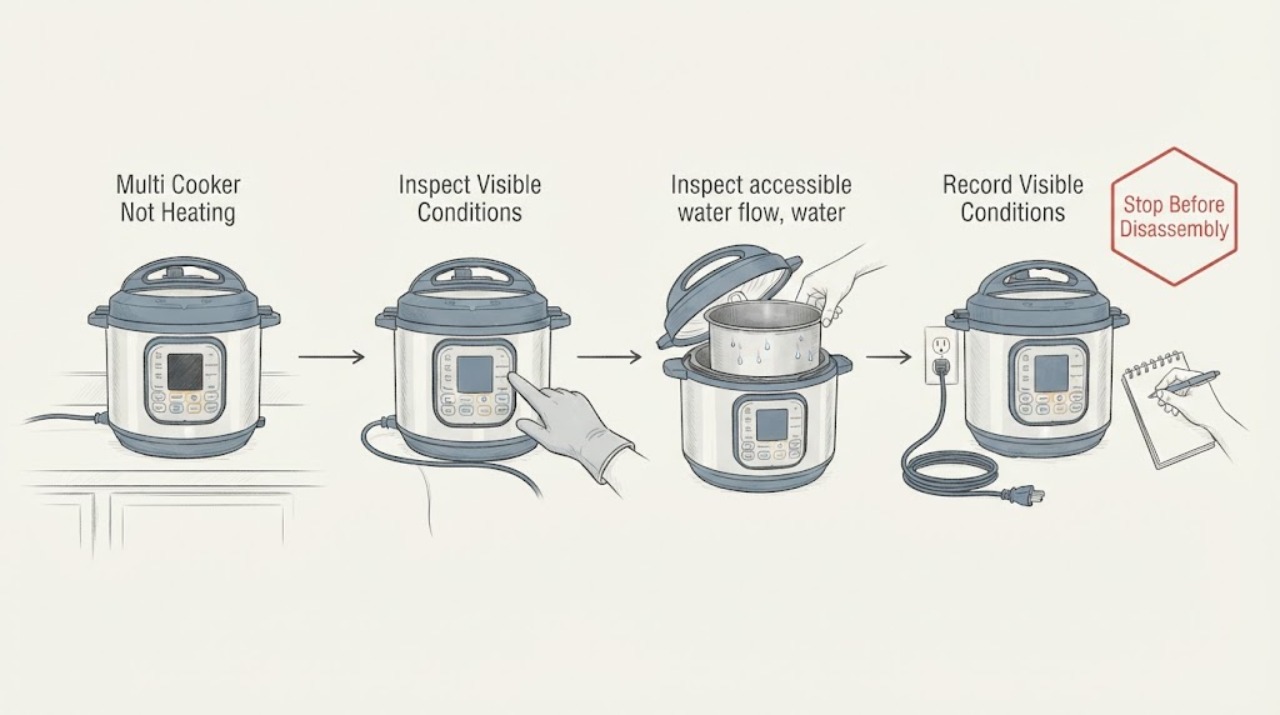
Work through in order
Diagnostic checks
Use only checks that match the exact appliance or system and its official guide.
-
Check 1
Confirm the cooker is powered and a cooking program is selected, then observe whether the documented priming cycle completes before judging the heater.
Expected result: Heat starts after priming, or no heat follows the cycle.
Next step: Wait through the documented cycle once; arrange service if the heater remains cold.
Why this matters
Why: A short priming delay is expected for the cited design; no heat after it needs diagnosis.
-
Check 2
Inspect accessible water flow, water level against appliance marks, and scale or obstruction without opening the heater assembly.
Expected result: Water is below minimum, above maximum, blocked, or unobstructed.
Next step: Correct level or clear an accessible obstruction only while cool, then follow the manual.
Why this matters
Why: Water flow and level affect heating and temperature protection.
-
Check 3
Record any High Temperature Detected, Fault detected, or unplugged-mid-cook message and stop the program.
Expected result: A repeated fault or high-temperature message appears.
Next step: Stop use and arrange service; do not bypass a thermal protector.
Why this matters
Why: A repeated fault or overheat message is a service boundary, not a part diagnosis.
-
Check 4
After the cooker is cool, check the vessel, lid, and controls for correct seating and try the exact manual reset sequence once.
Expected result: The vessel and controls are seated, or the unit remains unresponsive.
Next step: Use the exact reset sequence once and call service for repeat no-heat behavior.
Why this matters
Why: Correct seating and a single reset can clear an operating setup issue; persistence points internal.
Use your observations
Decision map
Find the observation that best matches what you see, then follow the next safe action.
-
PATH 01Next step
What you see
Heat begins after the documented priming cycle and temperature rises normally.
Do this next
Continue the program while monitoring it normally.
Why this path and its safety boundary
Why it matters: The observed delay is consistent with the manual’s operating sequence.
-
PATH 02Next step
What you see
Water level or flow is abnormal and the message clears after correction.
Do this next
Use the cooker only with the correct level and clear flow.
Why this path and its safety boundary
Why it matters: A setup, obstruction, or protection condition was more likely than a failed heater.
-
PATH 03Next step
What you see
No heat follows priming, or a fault repeats with correct level and flow.
Do this next
Stop using the cooker and arrange service; do not open the housing.
Why this path and its safety boundary
Why it matters: An enclosed heater, sensor, or control fault needs qualified diagnosis.
Helpful context
Understand the symptom
This guide focuses on whether the heater starts after the documented priming period. The symptom is a starting point, not a part diagnosis; use each observation to choose the next safe check.
Manufacturer guidance supports these symptom-level checks. Model-specific controls, parts, and service procedures must be confirmed in the appliance manual.
Only after diagnosis
Potential parts
- heater or temperature sensor
Relevant only after priming, level, flow, and fault checks fail.
Confirm the exact appliance model and manufacturer instructions before ordering.
When checks do not resolve it
Need a professional?
Arrange qualified appliance service when no heat follows priming, a fault recurs, or a heater or sensor would require housing access.
Common questions
FAQ
How long can a Breville unit wait before heating?
The cited Breville manual describes a 40-second priming cycle before the heater turns on.
Should I replace the heater from a no-heat symptom?
No. Confirm power, priming, water level, flow, and messages first; the symptom cannot identify a part safely.
Read the exact guide
Official sources
- Instruction ManualBreville · cooking appliance heating, priming cycle, water flow, temperature and fault guidance
Community feedback
Share a repair observation
Share a plain-text repair observation. Accepted observations are published automatically; this page may take a moment to update.