
On this page
Start here
Quick answer
For a pressure cooker that will not turn on, check the grounded outlet, cord, lid and inner-pot seating, control lock, and display. Never bypass pressure or lid interlocks. Stop for steam, damaged seals, scorching, or electrical odor and arrange service.
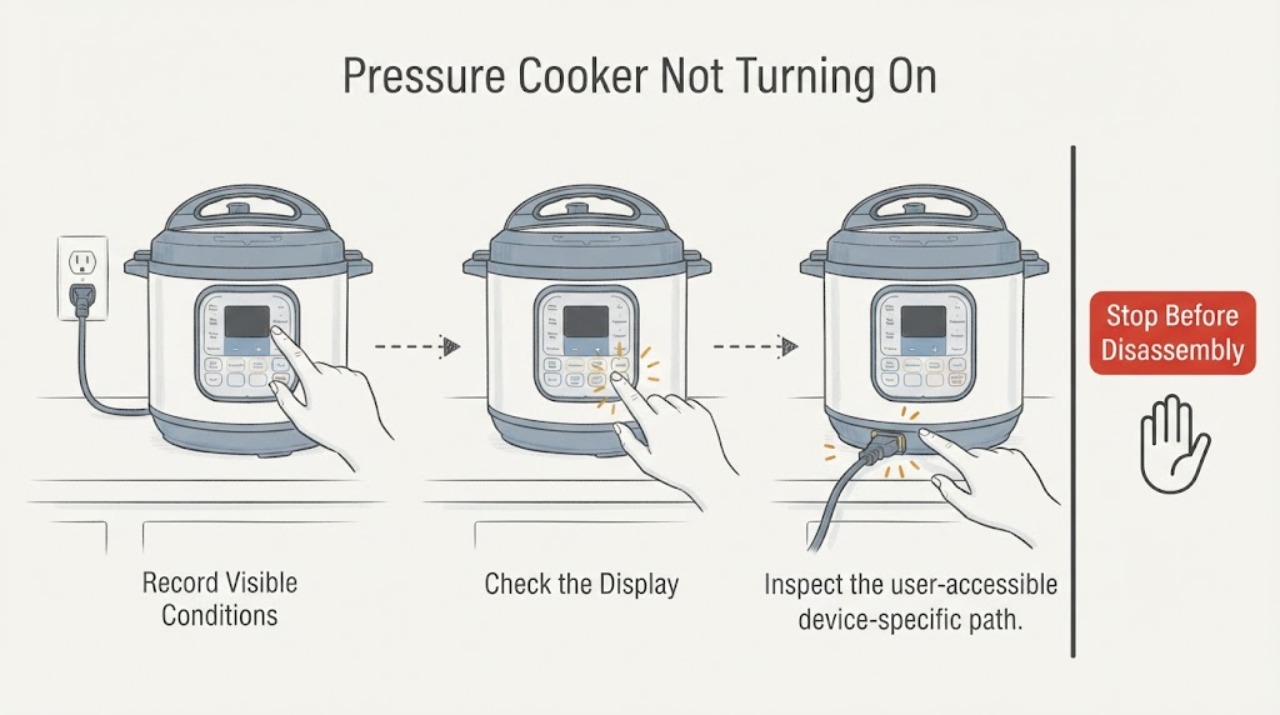
Work through in order
Diagnostic checks
Use only checks that match the exact appliance or system and its official guide.
-
Check 1
Record when and where the symptom occurs.
Expected result: The symptom appears at startup, during operation, or after a command.
Next step: Use the exact manual and continue one safe check.
Why this matters
Why: Timing narrows the likely branch.
-
Check 2
Check power and the primary control or safety lock.
Expected result: Power/control is abnormal or normal.
Next step: Correct one obvious condition and retry once.
Why this matters
Why: An abnormal supply or interlock can prevent normal operation.
-
Check 3
Inspect the user-accessible device-specific path.
Expected result: A blockage, misseating, leak, or restriction is present or absent.
Next step: Correct only as the manual permits; never bypass a safety device.
Why this matters
Why: A visible restriction can explain the symptom; a clear path shifts suspicion inward.
-
Check 4
Check settings, load, water, airflow, or seating as applicable.
Expected result: The operating condition is corrected or unchanged.
Next step: Record the result and continue only if safe.
Why this matters
Why: The corrected condition distinguishes setup from component failure.
-
Check 5
Run one supervised test after the safe checks.
Expected result: The unit recovers, repeats, or shows a warning.
Next step: Stop for warnings and document the result.
Why this matters
Why: One recovery does not prove a repair.
-
Check 6
Apply the stop boundary for recurrence or hazard.
Expected result: A safety symptom or inaccessible fault is present.
Next step: Disconnect power or supply if safe and arrange service.
Why this matters
Why: Hazard or recurrence requires professional diagnosis.
Use your observations
Decision map
Find the observation that best matches what you see, then follow the next safe action.
-
PATH 01Next step
What you see
The external supply, setting, lock, or seating is abnormal and the symptom clears.
Do this next
Maintain the documented setup and monitor one cycle.
Why this path and its safety boundary
Why it matters: An operating condition was the leading explanation.
-
PATH 02Next step
What you see
A device-specific path is blocked, kinked, leaking, or misseated and the issue persists.
Do this next
Stop repeated testing and arrange service.
Why this path and its safety boundary
Why it matters: A flow, drain, airflow, interlock, or mechanical fault is more likely.
-
PATH 03Next step
What you see
All external checks are normal but the symptom returns.
Do this next
Keep the unit off and obtain qualified service.
Why this path and its safety boundary
Why it matters: An internal control, motor, sensor, heater, pump, or compressor fault is likely.
-
PATH 04Next step
What you see
Smoke, odor, arcing, steam, gas, water near electrics, or dangerous heat appears.
Do this next
Disconnect power or supply if safe and obtain service.
Why this path and its safety boundary
Why it matters: A safety fault overrides routine troubleshooting.
Helpful context
Understand the symptom
For a pressure cooker that will not turn on, check the grounded outlet, cord, lid and inner-pot seating, control lock, and display. Never bypass pressure or lid interlocks. Stop for steam, damaged seals, scorching, or electrical odor and arrange service.
Use the exact owner manual for model-specific controls, reset, access, and part information. Do not open live or sealed components.
When checks do not resolve it
Need a professional?
A qualified technician may test the relevant power, control, sensor, motor, heater, pump, fan, valve, or sealed-system components.
Common questions
FAQ
What should I check first for Pressure Cooker Not Turning On?
For a pressure cooker that will not turn on, check the grounded outlet, cord, lid and inner-pot seating, control lock, and display. Never bypass pressure or lid interlocks. Stop for steam, damaged seals, scorching, or electrical odor and arrange service.
Can I reset it?
Use only the exact manual's reset after recording the symptom. A returning fault needs service.
When should I stop using it?
Stop for smoke, burning odor, exposed wiring, uncontrolled water or steam, dangerous heat, or recurrence after safe checks.
What should service receive?
Provide the model, code or display, timing, settings, and results of external checks.
Read the exact guide
Official sources
- Instant Pot Recall Safety NoticeCPSC · Use for pressure-cooker symptom guidance; exact controls and access remain model-specific.
Community feedback
Share a repair observation
Share a plain-text repair observation. Accepted observations are published automatically; this page may take a moment to update.