
On this page
Start here
Quick answer
Do not force, pry, twist, or otherwise defeat a pressure-cooker lid lock. Keep your face and hands away from the steam path, and use only the pressure-release procedure and indicator described for your exact cooker. The opened Instant Pot guidance says to release pressure according to the recipe, set its valve to venting, and open only after the float valve has dropped or the display says it is safe; the opened Tefal guidance likewise requires the locking indicator or pressure indicator to be down before opening. If pressure remains, the indicator stays raised, the lid is damaged, or the lid stays stuck after complete depressurization and cooling, stop and contact the manufacturer or an approved/qualified service provider.
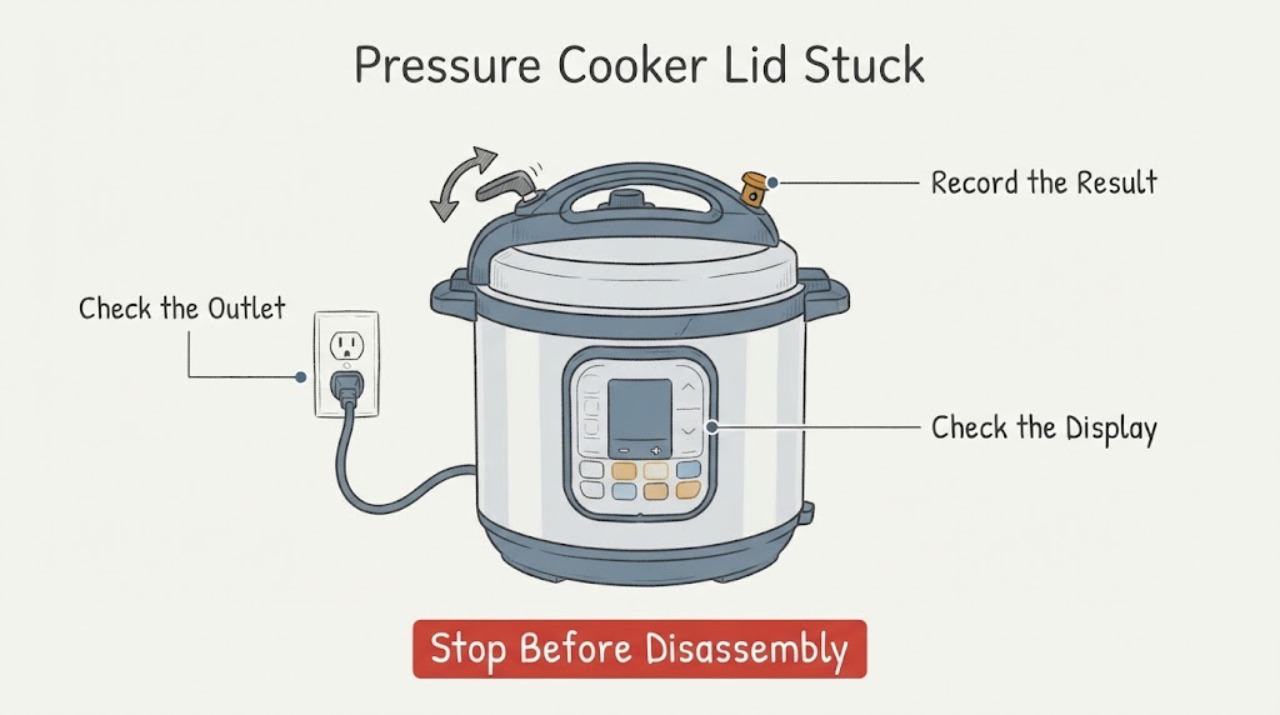
Work through in order
Diagnostic checks
Use only checks that match the exact appliance or system and its official guide.
-
Check 1
Stop trying to open the lid. Keep your face, hands, and exposed skin away from the valve, float, and any steam outlet; do not pry, twist with extra force, strike, or bypass the locking mechanism.
Expected result: The lid is still locked, steam is escaping, the cooker is hot, or the pressure indicator/float is raised.
Next step: Leave the cooker in place and continue only with the exact model's documented pressure-release process. If steam is uncontrolled, the lid or vessel is damaged, or anyone is at risk of burns, stop and arrange professional help.
Why this matters
Why: These observations are compatible with residual pressure or a safety lock. A locked lid is not evidence that the mechanism may be defeated.
-
Check 2
Without disassembling anything, identify the cooker type and read its pressure indicator: an electric cooker may use a float valve or display, while a stovetop cooker may use a locking or pressure indicator. Do not assume that a control or indicator from another brand fits this cooker.
Expected result: The exact manual is available and its indicator shows pressure released, or the indicator is raised/uncertain and the model cannot be identified.
Next step: If the indicator is raised or unknown, do not open the lid; follow the exact manual or contact the manufacturer. If the indicator is down, continue only after the cooker has reached the manual's safe temperature and pressure state.
Why this matters
Why: Instant Pot says its lid is opened only after the float drops or the display allows opening. Tefal says its locking or pressure indicator must be down. An unknown or raised indicator leaves the safe state unconfirmed.
-
Check 3
Use only the pressure-release control described for the identified cooker and recipe. For an Instant Pot that matches the opened guidance, set the valve to venting as directed and wait for the float to drop or the display to indicate it is safe; for a Tefal Clipso-style cooker, use its documented release control and wait for the locking indicator to reach the low position. Keep away from escaping steam.
Expected result: Pressure is fully released and the cooker gives the model's safe-to-open indication, or the indicator remains raised/steam continues after the documented release process.
Next step: Open only when the exact manual's safe indication is present. If pressure or steam remains, stop using the cooker and contact its manufacturer or qualified service; do not improvise a valve sequence.
Why this matters
Why: The first result permits the model's normal opening step. The second means the cooker is not in a confirmed safe state or may have a blocked, damaged, or model-specific mechanism; it does not justify forcing the lid.
-
Check 4
After the exact indicator confirms zero pressure and the cooker is fully cool, inspect only the visible lid alignment, handle/lock position, seal edge, and accessible valve or cover for obvious displacement or debris. Do not insert a tool into an unknown release opening or open the housing.
Expected result: The lid opens normally after the model-specific alignment step, or it remains stuck despite zero pressure and cooling; the lid, rim, seal, bowl, or valve is visibly damaged.
Next step: Use the cooker only if the exact manual permits it and all safety parts are intact. If it remains stuck or any safety part is damaged, leave it unused and contact the manufacturer or approved service rather than forcing or repairing it yourself.
Why this matters
Why: A normal opening after a confirmed zero-pressure state can indicate a lock or alignment condition. Persistent sticking or visible damage needs model-specific inspection; Tefal directs service for damaged/deformed parts, and Instant Pot warns against using a damaged sealing ring.
Use your observations
Decision map
Find the observation that best matches what you see, then follow the next safe action.
-
PATH 01Next step
What you see
Steam is escaping, the cooker is hot, or the pressure/locking indicator is raised.
Do this next
Do not touch the lid lock or force the lid. Follow only the exact cooker manual's pressure-release process and wait for its safe indication.
Why this path and its safety boundary
Why it matters: The lid is not in a confirmed safe-to-open state and may still be under pressure.
-
PATH 02Next step
What you see
The exact cooker manual is identified, pressure is fully released, and its float or locking indicator is down.
Do this next
Open using the exact manual's handle or lock direction, keeping the lid tilted away from your face. Stop if it resists instead of adding force.
Why this path and its safety boundary
Why it matters: The official Instant Pot and Tefal materials treat those model-specific indications as the condition for normal opening; controls still vary by model.
-
PATH 03Next step
What you see
The cooker is completely depressurized and cool, but the lid remains stuck or a visible lid, rim, seal, bowl, valve, or lock part is damaged.
Do this next
Leave the cooker unused and contact the manufacturer or an approved/qualified service provider with the exact model and the indicator state.
Why this path and its safety boundary
Why it matters: The remaining problem is a model-specific mechanical or safety-part issue; it is no longer safe to diagnose by forcing the lid or guessing a release point.
-
PATH 04Next step
What you see
The cooker was heated without liquid, has uncontrolled steam, smoke, a burning smell, or a damaged cord or pressure component.
Do this next
Stop using the cooker, keep clear of hot steam and surfaces, and arrange approved or qualified service; do not energize it, bypass a safety device, or continue cooking.
Why this path and its safety boundary
Why it matters: The opened manufacturer guidance treats overheating without liquid, damaged safety components, and damaged cords as service conditions rather than user repair tasks.
Helpful context
Understand the symptom
A lid that will not turn or lift may still be held by pressure. With an unidentified cooker, treat the lid as pressurized until the exact manual's pressure indicator or float confirms otherwise. The same safety boundary appears in the opened Instant Pot and Tefal materials: do not force the lid, and do not open while pressure remains.
The release control is not interchangeable between electric and stovetop cookers. Instant Pot describes a valve and float/display check, while Tefal Clipso describes a locking indicator or pressure indicator. Identify the appliance and use its own instructions before touching a valve, pin, handle, or lid.
When checks do not resolve it
Need a professional?
The pressure or locking indicator remains raised, steam continues, or the safe-to-open state cannot be confirmed., The lid remains stuck after complete depressurization and cooling, or the model-specific manual does not cover the mechanism., The lid, rim, seal, bowl, valve, lock, cord, or other safety component is damaged., The cooker was heated without liquid, emits smoke or a burning smell, or has uncontrolled hot-liquid or steam release., Do not pry, strike, bypass a lock, insert an unknown tool, open the housing, or perform electrical testing.
Common questions
FAQ
Can I force a pressure-cooker lid open if it will not turn?
No. Instant Pot says never to force the lid after pressure cooking, and Tefal describes an opening safety system that prevents opening while pressure remains. Wait for the exact model's pressure indicator or float to show the safe state; if it remains stuck after cooling, arrange service.
What should I check before trying to open the lid?
Identify the brand and model, keep away from the steam path, and verify the exact manual's pressure-release state. Instant Pot uses a valve plus float/display indication; Tefal uses a locking or pressure indicator. Do not transfer one brand's control sequence to another cooker.
What if the lid is still stuck after the pressure indicator drops?
Let the cooker cool completely, then perform only the visible alignment check and exact model procedure. If the lid still resists, or a lid, seal, rim, bowl, valve, or lock is damaged, stop and use manufacturer or approved service. Do not insert a tool or open the housing on an unidentified cooker.
Read the exact guide
Official sources
- User manual and frequently asked questions Clipso + 0500108Tefal · Used for the conditional Tefal Clipso-style branch only; indicator and release details must not be transferred to another cooker.
- Frequently Asked QuestionsInstant Pot Brands · Used for the conditional Instant Pot branch only; it is not a universal control sequence for an unidentified pressure cooker.
- User manual and frequently asked questions COOKEO/COOK4ME CY701 CY701840Tefal · Used only for the conditional Cook4me branch; its release-hole and lid mechanism must not be applied to an unidentified cooker.
Community feedback
Share a repair observation
Share a plain-text repair observation. Accepted observations are published automatically; this page may take a moment to update.