
On this page
Start here
Quick answer
If the Siemens SF64660/02 was transported on its side and now stops after about a minute, treat the transport history as a safety and installation clue, not proof that a pump or control has failed. If there is active water, water near the plug or socket, a burning smell, smoke, sparking, or a tripped breaker, close the water tap, isolate power only if safe, and stop using it. Otherwise keep the dishwasher upright and do not tilt it, repeatedly reset it, or keep running cycles. Record the exact E-Nr, program, time to stop, water left in the tub, sounds, and every display or light sequence. The BSH dishwasher transport guidance says to transport the appliance upright because residual water can reach the control and affect the program sequence; use the exact SF64660/02 documentation before any model-specific check.
Work through in order
Diagnostic checks
Use only checks that match the exact appliance or system and its official guide.
-
Check 1
Before changing a setting, photograph the SF64660/02 E-Nr/type plate and record the selected program, the approximate time to stop, whether the tub is empty or contains water, whether you heard draining or filling, whether the detergent flap opened, whether the controls respond normally, and every complete code or light sequence.
Expected result: The stop repeats at about one minute with water present, no water, a code or light sequence, a silent display, or working controls.
Next step: Keep the record and use the matching branch below. Do not infer a failed pump, valve, sensor, or control from timing alone.
Stop if: Stop immediately for smoke, sparks, burning odor, water near electrical parts, an active leak, or a breaker that trips again.
Why this matters
Why: Visible water makes a drain or residual-water path worth separating from a no-water stop; a code only has meaning when checked against the exact E-Nr; a dead or unresponsive control state is not distinguished safely by the word ‘stopped’ alone.
-
Check 2
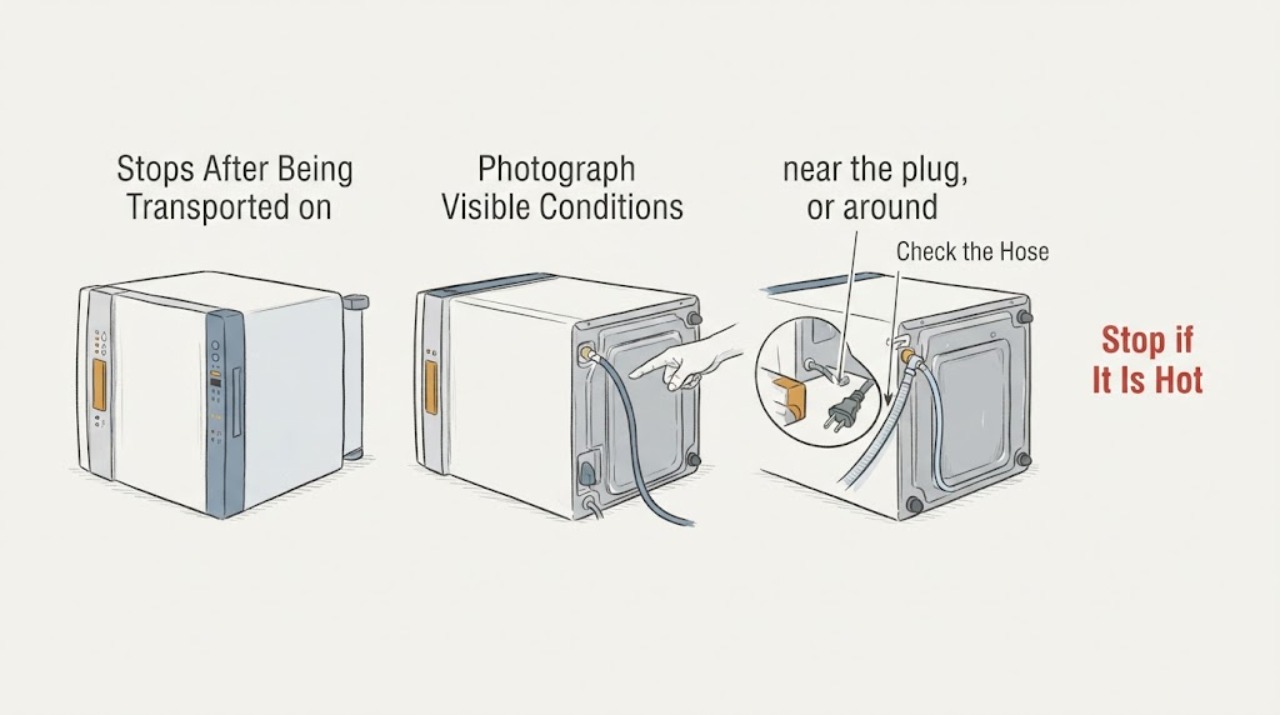
If there is water on the floor, near the plug, or around the appliance, close the accessible water tap and isolate power only from a dry, safe position. Leave the dishwasher upright and stable; do not tip it to drain, pull an integrated unit out alone, or remove any cover or base panel.
Expected result: The appliance is dry and electrically quiet, or there is a leak, wet electrical area, damaged cord or plug, odor, smoke, sparking, or repeated breaker trip.
Next step: For a hazard, keep it out of use and arrange qualified appliance service; tell the provider it was transported on its side and where water or damage was observed.
Stop if: Never touch wet electrical areas, probe wiring, bypass a door or water-protection device, or reconnect power to an actively leaking appliance.
Why this matters
Why: A dry, stable appliance permits an identity and installation review. Any water or electrical warning crosses the ordinary user-check boundary, and side transport does not make a hazardous tilt or reset appropriate.
-
Check 3
From a safe, accessible position, confirm that the appliance has been returned to an upright, level, supported position and that the visible supply and drain hoses are not kinked, crushed, pulled, or visibly disconnected. Do not alter plumbing or move the integrated dishwasher to reach hidden connections.
Expected result: A hose is visibly kinked or loose, the unit is unstable or still lying on its side, or the external installation looks intact.
Next step: Correct only an obvious, manual-permitted routing or reconnection issue without dismantling the appliance; otherwise stop and give the installation history to service.
Stop if: Do not force a concealed connection, disconnect a pressurized hose, or continue if the unit must be pulled, tilted, or supported by hand.
Why this matters
Why: A visible installation problem can interrupt filling or draining without proving internal damage. An intact external view does not rule out residual water, a hidden leak, or a component fault after transport.
-
Check 4
Only when the appliance is dry, cool, upright, stable, and the exact SF64660/02 instructions permit normal operation, make at most one brief documented observation of the start sequence. Note whether it drains, fills, begins washing, stops silently, leaves water behind, or reaches the expected end indication; do not use a service mode or repeat a failing cycle.
Expected result: The sequence completes, drains but stops again, never fills, stops with water remaining, or loses display/control response.
Next step: Stop testing when the same failure returns and arrange qualified service with the exact E-Nr, transport orientation, program, timing, water level, sounds, and any codes.
Stop if: Do not run any observation if there is a leak, water near electrical parts, a burning smell, unusual heat, smoke, sparking, or an unsafe installation.
Why this matters
Why: Completion after a corrected external installation issue supports a temporary setup or transport-related sequence problem. A repeated stop, no-fill state, residual water, or lost response leaves drain, inlet, door sensing, power, control, or transport damage possibilities open and does not select a part.
-
Check 5
Match the complete display or light pattern and the E-Nr SF64660/02 to Siemens documentation before interpreting any code. If the E-Nr is unreadable, preserve a clear type-plate photo and do not borrow a code definition or reset sequence from another Siemens or Bosch model.
Expected result: The code or indicator is fully identified for SF64660/02, it is different or incomplete, or no code appears.
Next step: Use only the matching manual instructions for an identified code. For an unresolved or recurring stop, provide the full display and E-Nr to Siemens support or qualified appliance service.
Stop if: Do not enter service mode, force a reset copied from another model, or order a part from a code alone.
Why this matters
Why: A model-matched code can choose a documented external check; an incomplete or cross-model code cannot safely identify a pump, valve, board, or water-protection state. No code does not prove that the transport history is irrelevant.
Use your observations
Decision map
Find the observation that best matches what you see, then follow the next safe action.
-
PATH 01Next step
What you see
The dishwasher was placed upright and stable, visible connections are intact, there is no hazard, and one model-approved observation completes normally.
Do this next
Monitor the next normal use without repeated resets; stop and arrange service if the one-minute stop or any leak returns.
Why this path and its safety boundary
Why it matters: The immediate stop may have reflected setup or transport sequence conditions, but successful completion does not prove that prior residual water caused no lasting issue.
-
PATH 02Next step
What you see
The stop repeats after the appliance is upright and the visible installation is intact, especially with water left in the tub or a documented drain sound.
Do this next
Keep the appliance off, do not tilt or run another cycle, and arrange qualified Siemens service with the transport history and the recorded stage, water level, and display.
Why this path and its safety boundary
Why it matters: A continuing drain-path, residual-water, pump, hose, sensor, or control issue is possible; side transport is a context clue, not enough evidence to choose which internal cause is present.
-
PATH 03Next step
What you see
The appliance stops with no water and no code, never reaches fill or wash, or loses its display while the external installation looks correct.
Do this next
Stop repeated starts, preserve the exact timing and response, and have the model-specific documentation and appliance assessed by qualified service.
Why this path and its safety boundary
Why it matters: This is less consistent with a simple standing-water blockage and leaves inlet, door sensing, power, program sequence, control, or transport-related damage open. The symptom does not identify a safe replacement part.
-
PATH 04Next step
What you see
There is active leakage, water near electrical parts, a damaged cord or plug, burning odor, smoke, sparking, unusual heat, or a repeated breaker trip.
Do this next
Close the water tap, isolate power only if safe and dry to do so, keep the dishwasher upright and out of use, and arrange qualified appliance service or an electrician as appropriate.
Why this path and its safety boundary
Why it matters: This is an immediate stop-use condition. Continued cycling or a tilt-and-reset attempt could worsen water or electrical damage.
Helpful context
Understand the symptom
The one-minute stop should not be read as a diagnosis from the video or from the transport position alone. A dishwasher may stop during its initial drain, fill, door-protection check, or another program stage, and the useful distinction is what was heard and seen: empty or still holding water, filling or silent, showing a code or not, and responding to normal controls. The SF64660/02 support page confirms the exact model identity and provides the path to its manuals and service information.
Transported-on-its-side changes the first decision because BSH transport instructions say to keep the dishwasher upright and warn that residual water can reach the control and affect the program sequence. That guidance does not establish that this particular unit is damaged, so avoid a tilt-and-reset experiment. Establish a dry, stable, correctly connected appliance and preserve the exact stop pattern for the SF64660/02 manual or a qualified Siemens technician.
When checks do not resolve it
Need a professional?
Arrange Siemens or qualified appliance service when the stop repeats after a safe upright installation review, the E-Nr/code cannot be matched, the appliance will not fill, drain, or respond, or any leak, water/electrical warning, odor, smoke, sparking, heat, or breaker trip appears.
Have this ready
- Provide SF64660/02 and the full type-plate information, market if known, transport direction and duration, whether the dishwasher was emptied, the selected program, time to stop, water level, drain/fill/wash sounds, detergent-flap status, display or light sequence, visible hose findings, and any photos of water or damage.
Common questions
FAQ
Does transporting the Siemens SF64660/02 on its side prove that a pump or control is damaged?
No. BSH's transport guidance makes upright transport the safer handling rule because residual water can reach the control and affect the program sequence, but the side position does not identify which part, if any, was affected. Keep it upright and use the recorded stop pattern and exact E-Nr for diagnosis.
Should I tilt the dishwasher back or keep resetting it after it stops after one minute?
No. Do not tilt an integrated appliance or repeat a failing cycle. If it is safe and dry, verify that it is upright and that visible connections are intact; if the stop returns, or any leak or electrical warning is present, keep it off and arrange service.
What should I tell Siemens service?
Give the complete SF64660/02 type-plate information, where and how long it was transported on its side, whether it was emptied, the program and timing, whether water remains, the sounds and control response, and every exact code or light sequence. Siemens' documentation search uses the E-Nr to select the correct appliance documents.
Read the exact guide
Official sources
- Page de Service - fully-integrated dishwasher | SF64660/02Siemens Home Appliances · The page explicitly identifies SF64660/02 as a fully integrated dishwasher 45 cm and links the model's manuals, documents, self-help, and professional service information; it does not by itself diagnose the one-minute stop.
- Instructions for UseBSH Hausgeräte · The opened BSH dishwasher instructions state that the appliance should be transported upright and explain that this prevents residual water from reaching the machine control and damaging the program sequence; this is transport guidance, not proof of damage to every Siemens model.
- User manual | Siemens HomeSiemens Home Appliances · Siemens states that the E-Nr is needed to identify the appliance and retrieve the correct documentation, and that it is shown on the type plate; this supports matching the SF64660/02 manual rather than borrowing another model's code guidance.
Community feedback
Share a repair observation
Share a plain-text repair observation. Accepted observations are published automatically; this page may take a moment to update.