
On this page
Start here
Quick answer
For inconsistent cleaning on a Smeg DI613ATP, first compare the dirty areas with the loading pattern, then inspect the spray arms and filters with the dishwasher disconnected from power. Smeg's opened DI613-family user manual says to use the correct detergent amount, regenerating salt, a program suited to the load and soil level, clean and correctly seated filters, clear spray-arm nozzles, and no object blocking arm rotation. Correct only those user-accessible conditions; do not infer a failed pump or heater from uneven results. If the same areas remain dirty after a correctly loaded cycle with clean filters and freely rotating spray arms, stop repeated test cycles and contact Smeg After-Sales service using the exact DI613ATP product code.
Before you begin
Safety first
- Unplug the dishwasher before maintenance. Do not open the electrical cabinet, dismantle the pump or heater, probe wiring, force a spray arm or filter, bypass a water-safety device, or order an internal component from uneven cleaning alone.
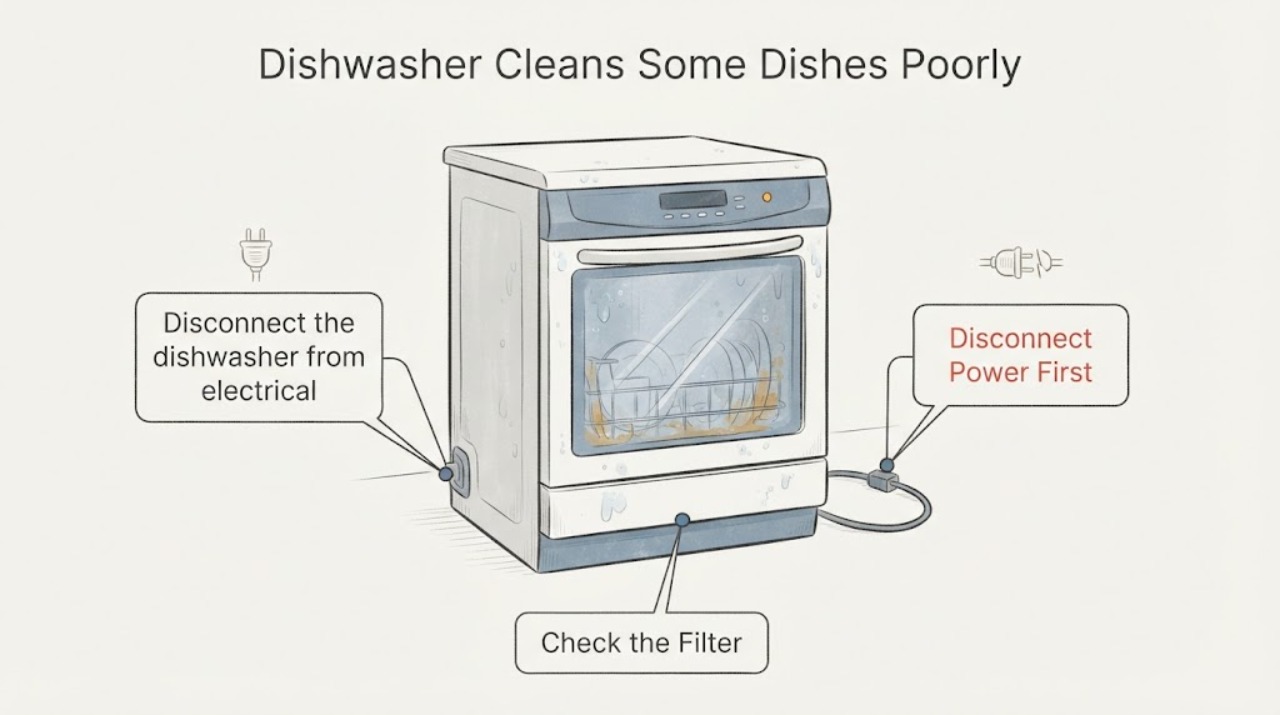
Work through in order
Diagnostic checks
Use only checks that match the exact appliance or system and its official guide.
-
Check 1
Before changing parts or detergent, map the result: note whether the same rack, corner, dish face or soil type remains dirty. With the appliance off and safe to open, reload plates vertically with soiled faces exposed, leave gaps between bowls, place cups and bowls facing down in the upper basket, and keep long items away from the upper spray arm.
Expected result: Dirty dishes are clustered behind one another, face away from the water jets, under an overpacked rack, or the same area is dirty despite open loading.
Next step: Run the exact-model program suited to the load and soil level once after correcting the layout. If the same area remains dirty, continue with the spray-arm and filter checks rather than ordering a part.
Why this matters
Why: A clustered or shielded result is consistent with the manual's loading and water-jet exposure guidance. The same localized result after open loading points to a spray-arm, filter or service branch, but does not identify a pump or heater.
-
Check 2
Disconnect the dishwasher from electrical power before maintenance. Remove the upper and lower spray arms only as the opened Smeg manual describes, wash the nozzles under running water, refit each arm carefully and confirm by hand that the arms turn freely without a dish, rack support or residue obstructing them.
Expected result: A nozzle is blocked, an arm is not seated, an arm cannot turn freely, or the arms are clear and rotate freely after refitting.
Next step: Correct only the visible blockage or seating issue and run one suitable cycle. If an arm remains damaged, cannot be seated or still cannot rotate freely, leave the dishwasher out of service and request Smeg service rather than forcing it.
Why this matters
Why: A blocked nozzle or restricted rotation can leave specific dishes or rack areas unwashed because the water pattern is not reaching them. Freely rotating, clear arms make that user-level cause less likely; they do not prove a circulation pump or heating fault.
-
Check 3
With power disconnected, inspect the centre filter and micro-filter. Remove them by the manual's tabs and lifting sequence, wash them under running water with a suitable brush, ensure no food falls into the sump, and reinstall every filter in its seat before restoring power.
Expected result: The filters contain food residue or are not seated correctly, or they are clean and correctly seated while the wash result remains uneven.
Next step: Correct the filter condition and run one appropriate cycle. If the filters cannot be removed or reseated without force, stop and call service; do not reach into the pump or probe the sump.
Why this matters
Why: Smeg says clogged filters can stop the dishwasher functioning and that residues left in the washing pit can block hydraulic components or foul spray-arm nozzles. A clean, correctly seated filter removes that external restriction from the likely causes but does not diagnose the wash pump.
-
Check 4
Check the consumables and program without changing internal settings: use the detergent amount directed by the product instructions, confirm regenerating salt is present, and select a program suitable for the dish type and soil level. Confirm the full product code is DI613ATP before relying on a program table from any manual.
Expected result: The load was on an unsuitable or shortened program, detergent or salt was missing/incorrect, or the consumables and program were already appropriate.
Next step: Run one properly loaded cycle using the suitable program and correctly handled consumables. If the same dishes remain dirty after the arms and filters are clear, stop repeated testing and contact Smeg After-Sales service with the model code and observations.
Why this matters
Why: Smeg's poor-cleaning checklist treats detergent, salt, load arrangement and program selection as separate contributors. Correcting one can change cleaning without implying a component failure; an appropriate setup with persistent uneven cleaning needs service assessment.
Use your observations
Decision map
Find the observation that best matches what you see, then follow the next safe action.
-
PATH 01Next step
What you see
The dirty result follows blocked loading or a dish/utensil that prevents spray-arm rotation, and one properly arranged cycle cleans normally.
Do this next
Keep the Smeg loading pattern that leaves soiled faces exposed and spray arms unobstructed; do not order a pump or heater.
Why this path and its safety boundary
Why it matters: The problem was consistent with water-jet coverage and loading rather than evidence of an internal component failure.
-
PATH 02Next step
What you see
A nozzle or filter is visibly clogged, or a spray arm was not seated and could not rotate freely, and the result improves after safe cleaning and refitting.
Do this next
Continue routine inspection and cleaning with power disconnected. If the obstruction returns quickly or an arm/filter will not seat, request service rather than dismantling the wash system.
Why this path and its safety boundary
Why it matters: The manual-supported cleaning boundary explains the uneven spray coverage; improvement after the check does not establish a replacement part.
-
PATH 03Next step
What you see
The DI613ATP is correctly loaded, the selected program and consumables are appropriate, filters are clean and seated, spray arms are clear and free, but the same dishes remain poorly cleaned.
Do this next
Stop repeated test cycles, keep the dishwasher disconnected if it leaks, fails to operate or presents an electrical/water fault, and contact Smeg After-Sales service with the exact product code and the rack-specific result.
Why this path and its safety boundary
Why it matters: The Smeg user checklist has not identified a safe external cause. It does not support calling the pump, heater or control the failed component from the cleaning pattern alone.
Helpful context
Understand the symptom
Uneven results usually begin with coverage and loading checks
The opened Smeg user manual treats poor cleaning as a set of observable conditions rather than proof of a failed component. Look at which dishes remain dirty, whether their soiled faces were exposed to the water jets, whether bowls and plates were packed tightly, and whether an item blocks a spray arm. The lower basket receives the lower arm's strongest spray, while cups and bowls belong face down in the upper basket. This can explain why one area is consistently missed without identifying a pump or heater fault.
Clean the spray arms and filter unit only within the user-maintenance scope
Smeg's opened manual says to unplug the appliance before maintenance. It permits removing the spray arms for nozzle cleaning under running water, checking that they rotate freely when refitted, and inspecting the centre filter and micro-filter under running water. The manual warns that food residue left in the sump can foul nozzles or block hydraulic components and that filters must be seated carefully to avoid damaging the wash pump. That is an external cleaning boundary, not permission to dismantle the pump.
Keep exact-model and service boundaries visible
Smeg's official manual portal asks for the product code from the appliance label. The opened DI613-family PDF is hosted by Smeg but its route is labelled DI613P rather than DI613ATP; it is used here only for the common cleaning and poor-wash checklist. Confirm the complete DI613ATP code before relying on a program table or ordering a component. If cleaning, loading and program selection do not change the result, Smeg's manual directs the owner to After-Sales service rather than an internal repair.
When checks do not resolve it
Need a professional?
Call Smeg After-Sales service when the properly loaded DI613ATP still cleans unevenly after the user-level detergent, program, spray-arm and filter checks, or immediately for a leak, damaged hose, electrical fault or a component that cannot be safely accessed. Do not attempt internal pump or heater repair.
Safety scope: Unplug the dishwasher before maintenance. Do not open the electrical cabinet, dismantle the pump or heater, probe wiring, force a spray arm or filter, bypass a water-safety device, or order an internal component from uneven cleaning alone.
Have this ready
- Provide the full DI613ATP product code from the inner-door label, the program used, detergent and salt status, which rack or dish faces remain dirty, whether the spray arms rotate freely, and photos of any visible obstruction with power disconnected.
Common questions
FAQ
Why does my Smeg dishwasher clean some dishes but not others?
Smeg's user manual points first to loading, the selected program, detergent and salt, clean filters, clear spray-arm nozzles, and anything obstructing spray-arm rotation. Compare the dirty rack area with those checks before suspecting an internal component.
Can I remove and clean the Smeg spray arms and filters?
The opened Smeg manual permits user cleaning of the spray arms and filter unit, but says to disconnect electrical power before maintenance. Wash the parts under running water, refit them carefully and verify free spray-arm movement; do not dismantle the pump or electrical cabinet.
Should I replace the pump or heater if cleaning remains uneven?
Not from this symptom alone. If the DI613ATP is correctly loaded with a suitable program and consumables, the filters are clean and seated, and spray arms rotate freely, the opened Smeg manual directs persistent problems to After-Sales service rather than naming a pump or heater.
Read the exact guide
Official sources
- User manualsSmeg USA · Opened Smeg's official manual portal. It instructs the owner to enter the product code shown on the appliance label and select a language before downloading a manual. This preserves the DI613ATP identity boundary and prevents transferring a program table or internal repair step from a differently coded appliance.
- GUIDE FOR USING THE DISHWASHER AND THE WASHING PROGRAMS — INSTRUCTION MANUALSmeg · Opened the official Smeg-hosted PDF. Its URL path is DI613P rather than the task's DI613ATP, so it is used only for common DI613-family user checks explicitly stated in the manual: loading, detergent/salt/program selection, spray-arm and filter cleaning, safe power isolation and After-Sales escalation. It is not used to assert a DI613ATP-specific program table, component fit or internal diagnosis.
Community feedback
Share a repair observation
Share a plain-text repair observation. Accepted observations are published automatically; this page may take a moment to update.