
On this page
Start here
Quick answer
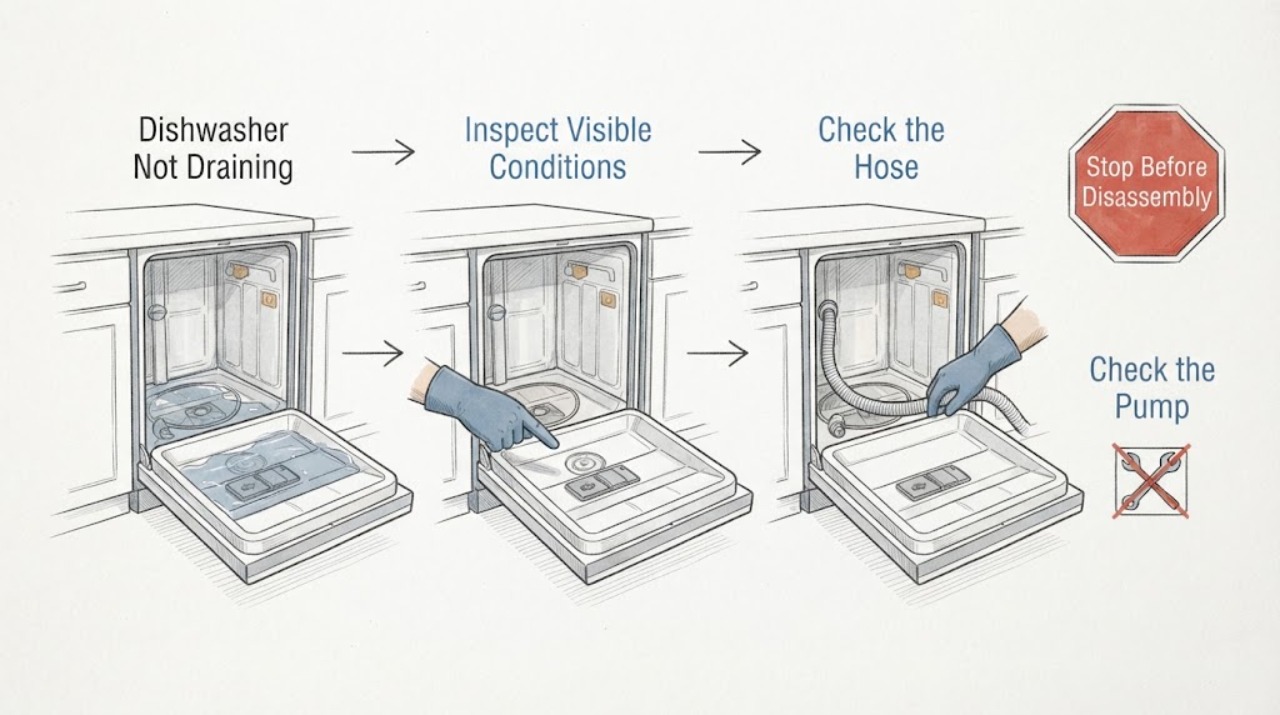
Standing water in a Smeg dishwasher is first checked at the filter, sump, drain hose, and sink connection using owner instructions. Do not reach into a running pump or dismantle the appliance.
Work through in order
Diagnostic checks
Use only checks that match the exact appliance or system and its official guide.
-
Check 1
Turn the dishwasher off and observe whether water is standing above the filter or only in the normal sump area.
Expected result: The symptom location, timing, or control response is clear, or another symptom is present.
Next step: Continue with the next documented check only if the area is safe; otherwise stop use and arrange qualified service.
Why this matters
Why: Standing water in a Smeg dishwasher is first checked at the filter, sump, drain hose, and sink connection using owner instructions. Do not reach into a running pump or dismantle the appliance.
-
Check 2
Clean the accessible filter and check the visible drain hose and sink connection for kinks or blockage using the model instructions.
Expected result: The accessible condition is corrected, or it is normal and the original symptom remains.
Next step: Continue with the next documented check only if the area is safe; otherwise stop use and arrange qualified service.
Why this matters
Why: The result narrows the fault to an external condition or leaves a model-specific internal fault unresolved.
-
Check 3
If water remains after one owner-approved drain attempt, or the pump only hums, keep the appliance off and request service.
Expected result: The appliance operates normally after the check, or the symptom returns or creates a safety concern.
Next step: Continue with the next documented check only if the area is safe; otherwise stop use and arrange qualified service.
Why this matters
Why: The result narrows the fault to an external condition or leaves a model-specific internal fault unresolved.
Use your observations
Decision map
Find the observation that best matches what you see, then follow the next safe action.
-
PATH 01Next step
What you see
The dishwasher not draining clears after the permitted filter, door, inlet, drain, rack, or programme check.
Do this next
Monitor the next normal cycle and keep the exact model manual available.
Why this path and its safety boundary
Why it matters: The result fits an owner-accessible condition documented by Smeg; the symptom does not identify a part.
-
PATH 02Next step
What you see
The dishwasher not draining returns after the external checks or the exact manual does not cover the display.
Do this next
Leave the dishwasher off and arrange Smeg or qualified service.
Why this path and its safety boundary
Why it matters: A model-specific pump, valve, latch, sensor, or control fault remains possible.
-
PATH 03Next step
What you see
Water reaches the floor or electrical base, smoke or burning odor appears, or the door cannot be controlled safely.
Do this next
Close the water supply and isolate power from a dry location, then obtain qualified service.
Why this path and its safety boundary
Why it matters: This is a water or electrical safety boundary.
Helpful context
Understand the symptom
What the first check tells you
Standing water in a Smeg dishwasher is first checked at the filter, sump, drain hose, and sink connection using owner instructions. Do not reach into a running pump or dismantle the appliance.
Use the exact model guidance
Smeg publishes model-specific instructions for the dishwasher. Preserve the full model identity and use the opened support or manual page before disassembly.
When checks do not resolve it
Need a professional?
Stop use for active leaks near electrical parts, smoke, burning smell, repeated breaker trips, unsafe movement, or a symptom that returns after the model-approved external checks; arrange qualified service.
Common questions
FAQ
Can I keep using a Smeg dishwasher with this problem?
Use it only when the owner-level check clears the symptom and there is no leak, heat, smoke, electrical damage, or unsafe movement. A recurring symptom needs qualified service.
Does this symptom identify one replacement part?
No. Record the exact model and observed result first; use the model manual and service diagnosis before selecting any part.
What information should I give service?
Provide the full model, the not draining symptom, when it occurs, what the external checks showed, and any photo or short recording.
Read the exact guide
Official sources
- Lavavajillas Integrable bajo encimera 60 cm STFABWH3 SmegSmeg · Official smeg source for smeg dishwasher not draining troubleshooting and service guidance.
Community feedback
Share a repair observation
Share a plain-text repair observation. Accepted observations are published automatically; this page may take a moment to update.