
On this page
Start here
Quick answer
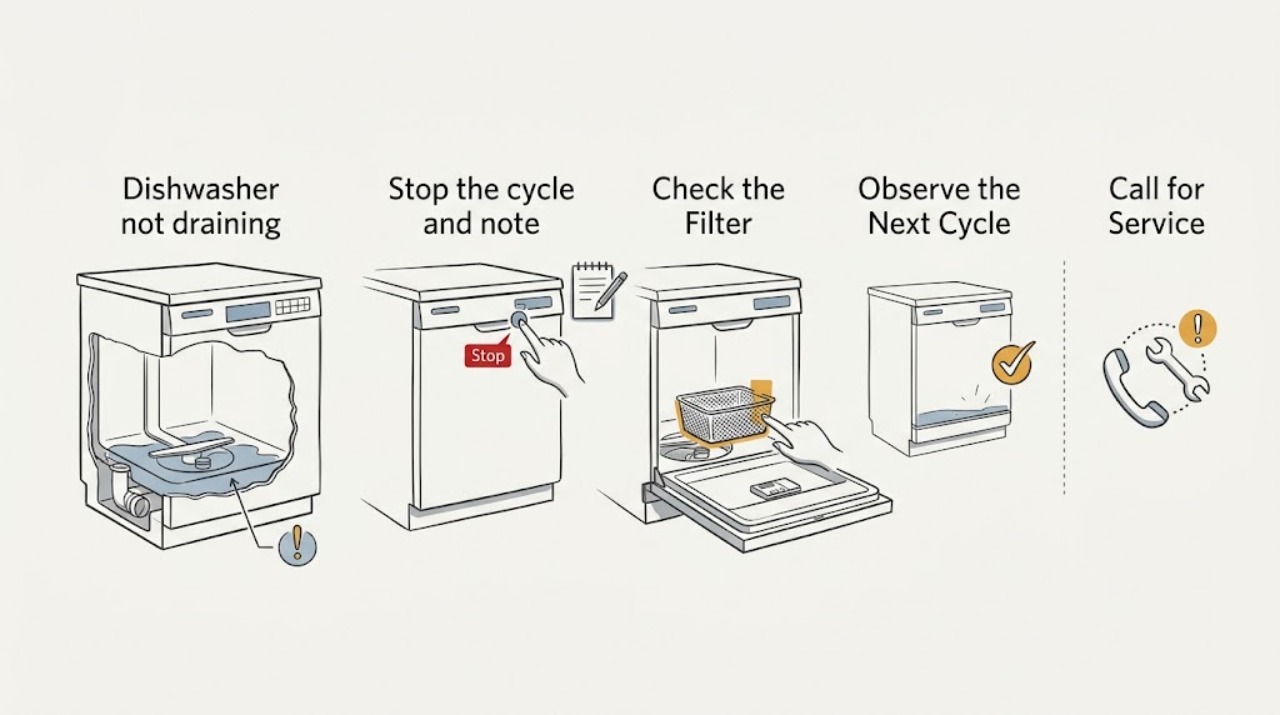
If a Bosch dishwasher leaves water in the tub, first note how much remains and whether the sink or disposer also drains poorly. Turn the dishwasher off and follow the model manual before removing the filter or pump cover. Clean the accessible filter, then check the pump area for standing water and loose debris, taking care because sharp objects may be present. Under the sink, look for a kinked or damaged drain hose, a blocked air gap, a loose siphon connection, or a garbage-disposal knockout plug left in place after installation. Error E24 commonly points to a blocked drain filter, but the code does not identify one failed part by itself. If the pump area is clear and the hose, sink, and connections are normal but water still will not drain, or if there is a leak, damaged hose, electrical concern, or recurring error, leave the dishwasher off and arrange qualified service.
Before you begin
Safety first
- Homeowner-safe checks are recording the water level and code, cleaning an accessible filter and pump area only with power isolated as the model manual directs, inspecting visible hose routing, observing sink drainage, and performing one model-approved reset or rinse test. Electrical work, live testing, internal pump diagnosis, plumbing disconnection, moving the dishwasher, and damaged-component replacement belong to qualified professionals.
Work through in order
Diagnostic checks
Use only checks that match the exact appliance or system and its official guide.
-
Check 1
Stop the cycle and note the water level at the bottom of the Bosch dishwasher, whether the water is clear or full of food debris, and whether the problem occurs with an E24 or another drain/overflow indication, humming, or unusual noise.
Expected result: Only a small amount remains in the sump, a large pool covers the tub floor, the issue follows installation or a disposer change, E24 appears, or the pump is silent or humming.
Next step: Record the exact code and model number. If there is a large pool, a leak, water near electrical parts, or an active overflow, leave the dishwasher off and isolate water or power only when safe before inspecting.
Why this matters
Why: A small residual amount can be normal, while a large pool confirms incomplete pumping. Timing, codes, and pump sounds help separate a blocked filter or hose from an installation problem or internal pump/control fault.
-
Check 2
With the dishwasher off and isolated as the model manual directs, remove the accessible filter and wash it with soap and a soft brush under running water; inspect the filter opening for food, paper, glass, bones, or other objects without reaching blindly.
Expected result: The filter is packed with debris, the filter is clean, the filter is damaged or missing, or sharp material is trapped below it.
Next step: Reinstall a clean filter fully according to the manual. Do not run the dishwasher without its filter, pry at sharp objects, or continue if the filter will not seat or the obstruction cannot be safely reached.
Why this matters
Why: Bosch identifies food debris in the filter as a common reason a dishwasher stops draining. A missing, damaged, or unsafe filter condition can allow debris into the pump and should not be bypassed.
-
Check 3
Only if the exact Bosch manual permits access, remove the pump cover beneath the filter and use a sponge to remove standing water; inspect the pump opening for loose debris, a loose cover, or an object blocking the impeller area, taking care with sharp fragments.
Expected result: Debris or standing water is present, the pump cover is loose or will not lock into place, the area is clear, or access requires force or a panel removal.
Next step: Clean only loose, safe-to-handle debris and refit the cover until the manual’s required secure position is reached. Stop for broken glass, a damaged cover, resistance, or any need to open panels, and arrange service.
Why this matters
Why: A blocked pump or an improperly seated cover can stop the dishwasher from pumping. A clear accessible area shifts attention to the external drain path or an internal pump, wiring, or control problem.
-
Check 4
Under the sink, inspect the visible dishwasher drain hose and its connection for a kink, crush point, sharp bend, damage, loose clamp, or an incorrect siphon/air-gap or high-loop arrangement; do not disconnect the hose from a built-in unit.
Expected result: The hose is kinked or damaged, the connection is loose, the air gap or siphon is blocked, the hose routing changed recently, or the visible path looks correct.
Next step: Correct only an obvious safe routing issue according to the Bosch installation instructions and local rules. Use plumbing or appliance service for a damaged hose, inaccessible connection, blocked air gap, or any need to pull the dishwasher out.
Why this matters
Why: An external restriction or connection problem can prevent the pump from moving water even when the filter is clean. A damaged hose or normal visible routing makes an internal drain fault more likely.
-
Check 5
Run water in the connected sink and observe whether the sink drains normally; if the dishwasher was recently connected to a garbage disposal, verify from the accessible connection or installation record that the dishwasher knockout plug was removed.
Expected result: The sink backs up, the disposer is blocked, the connection is new and the knockout plug may remain, or the sink and disposer drain normally.
Next step: Use a plumber for a sink or disposer blockage. Do not disassemble a disposal or disconnect a pressurized or hard-to-reach dishwasher line as a casual check; use the installation guide or qualified service.
Why this matters
Why: A household plumbing blockage or an unremoved disposer plug can make the dishwasher appear not to drain. Normal sink drainage and a confirmed open connection shift attention back to the dishwasher drain path.
-
Check 6
After the filter, pump-cover, hose, and sink checks are complete and no active leak or electrical hazard is present, follow the Bosch manual’s reset or cancel procedure once and observe a short rinse or drain operation from outside the cabinet.
Expected result: The water drains fully, the code clears but returns, water remains, the pump hums without moving water, or the breaker trips.
Next step: Stop after one controlled retry. Leave the dishwasher off and arrange qualified service for persistent water, recurring codes, a humming/noisy pump, or a breaker trip rather than repeatedly resetting it.
Why this matters
Why: A successful drain after clearing a blockage supports an obstruction or connection issue. A recurring code or standing water after the drain path is clear indicates that the pump, wiring, control, or another model-specific component needs diagnosis.
-
Check 7
If the dishwasher still will not drain, document the model, code, water level, filter and pump findings, hose routing, sink result, and any leak or noise; do not measure live voltage or replace the pump based only on the symptom.
Expected result: The pump area and external drain path are clear, the drain pump is suspected, the water is leaking from under the tub, or access requires electrical or internal disassembly.
Next step: Keep the appliance off and arrange qualified Bosch appliance service, or plumbing service for a household drain problem. Provide all recorded observations so the technician can test the correct path.
Why this matters
Why: Standing water alone cannot distinguish a failed pump from a control, wiring, seal, hose, or plumbing fault. Further diagnosis may involve energized or concealed components and is not a safe guess-and-replace task.
Use your observations
Decision map
Find the observation that best matches what you see, then follow the next safe action.
-
PATH 01Next step
What you see
Only a small amount of water remains in the sump, the cycle completes, and there is no error, unusual noise, or worsening water level.
Do this next
Use the Bosch manual to confirm the expected residual level and monitor the next cycle. Investigate further if the amount increases, an error appears, or drainage becomes slow.
Why this path and its safety boundary
Why it matters: The observed water may be normal residual water rather than a failed drain.
-
PATH 02Next step
What you see
A large pool of water is present and the filter or pump opening contains food, paper, glass, or another loose object.
Do this next
Isolate the appliance as directed, clean the filter and accessible pump area from the exact manual, reseat the pump cover, and stop for sharp or inaccessible debris.
Why this path and its safety boundary
Why it matters: A filter or pump blockage is more likely than a failed control.
-
PATH 03Next step
What you see
The filter and pump area are clear, but the hose is kinked, the air gap or siphon is blocked, the sink backs up, or the disposer connection is new.
Do this next
Correct only a safe visible routing issue, use a plumber for a sink or disposer blockage, and have a professional handle damaged or inaccessible dishwasher connections.
Why this path and its safety boundary
Why it matters: The external drain path or household plumbing is more likely than a dishwasher pump failure.
-
PATH 04Next step
What you see
E24 returns after the filter, pump cover, hose, siphon, and disposer connection have been checked, or the pump hums while water remains.
Do this next
Leave the dishwasher off and arrange qualified Bosch appliance service with the code and all completed checks. Do not keep forcing resets or open internal panels.
Why this path and its safety boundary
Why it matters: A persistent restriction, loose pump cover, failing drain pump, wiring, or control issue remains possible; E24 does not identify one replacement part by itself.
-
PATH 05Next step
What you see
Water leaks under the appliance, a hose is damaged, water reaches electrical equipment, the breaker trips, smoke or burning appears, or sharp debris cannot be safely removed.
Do this next
Stop use. Close the water supply and disconnect power only if safe and without contacting water or energized equipment; arrange qualified appliance or plumbing help, and leave for smoke, fire, or immediate danger.
Why this path and its safety boundary
Why it matters: An active water, electrical, fire, or injury hazard is present and ordinary drain cleaning should stop.
Helpful context
Understand the symptom
A little residual water is different from a failed drain
A small amount of water in the sump can be normal on some Bosch models, while a large pool covering the tub floor indicates that water is not being pumped out. Record whether the problem began after installation, follows a new garbage-disposal connection, or appears with E24, another code, humming, or unusual pump noise. Those patterns change whether the next safe check is the filter, pump, external drain path, or professional service.
Start with the filter and pump area, not a guessed replacement
Bosch places the filter and pump at the bottom of the dishwasher, where food scraps and hard objects can block drainage. Follow the exact owner's manual for filter and pump-cover access, isolate the appliance as directed, and use a sponge for standing water. Sharp debris may be present. A clean pump area does not prove that the pump motor, wiring, control, or external hose is good, so do not choose a replacement part from standing water alone.
The household drain can be the real blockage
The dishwasher drain hose connects to plumbing under or beside the sink. A kink, crush point, blocked air gap, loose siphon connection, missing high loop where required, or an unremoved disposer knockout plug can prevent proper drainage. Check only visible routing and accessible sink behavior against the Bosch installation instructions and local plumbing requirements; disconnecting a built-in appliance or altering wiring belongs to a qualified professional.
Safety boundary
Stop conditions
- Do not reach into the pump or filter opening when glass, bones, metal, or another sharp object may be present. Do not operate the dishwasher with the filter or pump cover missing, damaged, or improperly seated.
- Do not remove electrical covers, test live voltage, alter wiring, or work on an energized dishwasher. Internal electrical and pump diagnosis belongs to a qualified professional.
- Do not pull out a built-in dishwasher alone, disconnect a hidden drain or water connection, cut a hose, or alter the drain installation without the exact manual and appropriate help.
- Stop for a leak under the tub, damaged hose, household drain backup, water near electrical equipment, repeated E24 or other drain errors, a breaker trip, or a pump that hums without draining. Isolate water or power only when safe.
- For smoke, fire, arcing, or immediate danger, leave the area and use emergency assistance from a safe location.
Only after diagnosis
Potential parts
- dishwasher drain pump
Consider this only after a qualified diagnosis finds the filter, pump opening, pump cover, hose, siphon, and household drain clear but the pump still cannot move water; standing water alone does not prove pump failure.
Pump geometry, electrical connector, seals, and control compatibility vary by Bosch model. Confirm the complete model number and manufacturer fit information before ordering or installing. - dishwasher drain hose
Consider this only when the hose is visibly kinked beyond correction, cracked, crushed, or leaking and diagnosis separates the hose from a blocked siphon, air gap, disposer, or household drain.
Connection ends, clamps, routing, and local high-loop or air-gap requirements vary by model and installation. Confirm fitment from the exact manufacturer information. - dishwasher filter or pump cover
Consider this only when the exact model’s filter or pump cover is cracked, missing, warped, or will not secure after cleaning; an E24 code does not by itself justify replacing it.
Filter mesh, locking features, cover shape, and model fit vary. Confirm the Bosch model number and the manufacturer’s parts information before ordering or installing.
When checks do not resolve it
Need a professional?
Safety scope: Homeowner-safe checks are recording the water level and code, cleaning an accessible filter and pump area only with power isolated as the model manual directs, inspecting visible hose routing, observing sink drainage, and performing one model-approved reset or rinse test. Electrical work, live testing, internal pump diagnosis, plumbing disconnection, moving the dishwasher, and damaged-component replacement belong to qualified professionals.
Common questions
FAQ
Why is my Bosch dishwasher not draining?
Food or hard debris in the filter or pump, a loose pump cover, a kinked or blocked drain hose, an air-gap or siphon problem, a garbage-disposal knockout plug, a household drain backup, or an internal pump/control fault can all leave water in the tub. Start with the model-approved filter and visible drain checks.
Is a small amount of water in a Bosch dishwasher normal?
Bosch says a small amount of leftover water can be normal, while a large amount remaining after a cycle indicates the dishwasher is not pumping water out. Compare the observed level with the exact model manual and investigate any increasing water level, error, noise, or incomplete cycle.
What does E24 mean on a Bosch dishwasher?
Bosch describes E24 as a drain problem commonly associated with a blocked drain filter. Its troubleshooting also checks the pump cover, drain hose, siphon connection, and a garbage-disposal plug, so the code does not identify one failed part by itself.
Can I clean the Bosch dishwasher pump myself?
Only follow the exact owner's manual for your model. With the appliance isolated as directed, Bosch’s guidance allows cleaning the filter and checking the pump area for standing water and loose debris, but sharp objects may be present. Stop if access requires force, a panel removal, electrical work, or handling dangerous debris.
Can a garbage disposal cause a Bosch dishwasher not to drain?
Yes. Bosch specifically lists an unremoved dishwasher knockout plug at a new disposer connection as an E24 or drain-path possibility. Check the accessible installation connection or records, but use plumbing or appliance service rather than disconnecting a built-in line as an improvised test.
When should a Bosch dishwasher that will not drain be serviced?
Arrange service when the filter, pump area, visible hose routing, sink, and disposer connection are clear but water remains, E24 returns, the pump only hums, or a leak-protection or other error appears. Stop immediately for leaks, water near electrical parts, repeated breaker trips, smoke, or sharp debris that cannot be safely removed.
Read the exact guide
Official sources
- Dishwasher Troubleshooting: Clogged DishwasherBosch Home Appliances Support US · Bosch dishwasher clog guidance; exact filter and pump access depends on the model.
- Bosch Dishwasher Owner SupportBosch Home Appliances Support US · Bosch owner-support overview; model-specific manuals and service procedures take precedence.
- Bosch Dishwasher Error Code E24Bosch Home Appliances Support US · Bosch E24 guidance; codes, hose routing, and disposer connections vary by model and installation.
- Cleaning Your Dishwasher Pump: Check for Debris EasilyBosch Home Appliances Support US · Bosch dishwasher pump-cleaning guidance; filter and pump-cover access varies by model.
Community feedback
Share a repair observation
Share a plain-text repair observation. Accepted observations are published automatically; this page may take a moment to update.