
On this page
Start here
Quick answer
Water remaining across a dishwasher tub after the cycle usually means the drain path is restricted or the pump is not moving water. Possible points include the filter, sump, pump inlet, drain hose, air gap, disposer connection, or sink plumbing; an electrical, latch, motor, or control fault is more likely when the dishwasher reaches the drain portion but the pump is silent. First distinguish a model-allowed small amount in the filter area from water covering the tub floor, then disconnect power before removing water or inspecting the filter. Clean only the filter and visible sump as directed by the manual, check accessible hose routing and an air gap or disposer connection, and test once. Do not use chemical drain opener, reach into a disposer, force sharp tools into a hose, or open energized panels. If water remains after these checks, returns from the sink, leaks, smells hot, makes grinding noises, or the pump and controls need access, arrange qualified appliance service.
Before you begin
Safety first
- A qualified technician should diagnose and access the drain pump, motor, impeller, internal hoses, valves, door switch or latch, wiring, control, and hidden plumbing connections. Homeowner checks should remain limited to power-safe water removal, the model-directed filter and sump, visible hose routing, accessible air-gap or sink observations, and documentation.
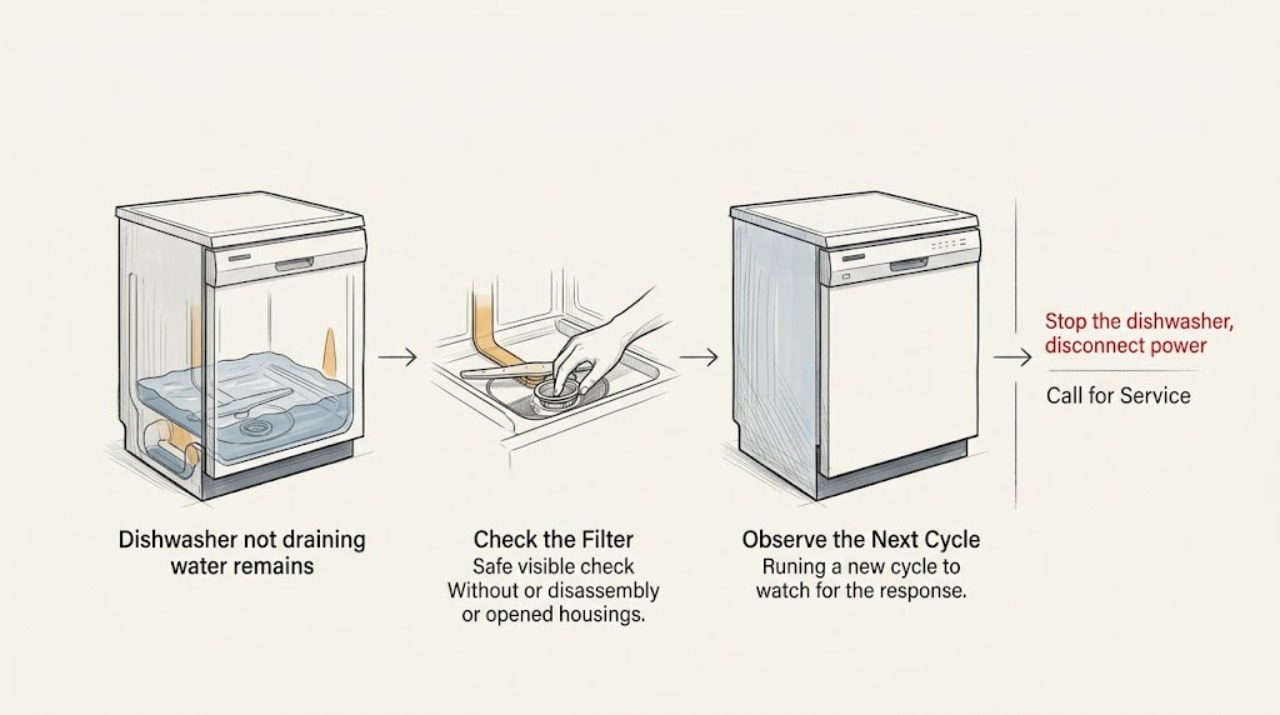
Work through in order
Diagnostic checks
Use only checks that match the exact appliance or system and its official guide.
-
Check 1
Stop the dishwasher, disconnect power at the breaker or accessible disconnect, and close its water-supply valve if you need to remove standing water or inspect the tub or under-sink connections; place towels and a shallow container at the front.
Expected result: Water is contained in the tub, or there is a leak, water near wiring, a burning odor, damaged insulation, a repeated breaker trip, or a damaged door or tub.
Next step: For any electrical or active-leak warning, keep power off and arrange qualified appliance service. Otherwise bail out only accessible water with a cup, sponge, or hand pump; do not use chemical drain opener.
Why this matters
Why: A contained tub can be inspected after power is isolated. A leak near electrical parts, heat, damaged wiring, or repeated breaker trips is not a routine clog and can create shock, fire, or water-damage risk.
-
Check 2
Compare the remaining water with the level shown in the model’s owner manual and note whether it covers the tub floor, reaches the door, is confined to the filter well, or returns after the sink or disposer is used.
Expected result: Only a small documented filter-area amount remains, the entire tub is covered, water is near the door, or water returns from the sink after appearing to drain.
Next step: If the level is documented as normal, reinstall the filter and monitor the next cycle. If the tub is full or backflows, continue only with power isolated and perform the filter and external-path checks below; save any error code.
Why this matters
Why: A small model-allowed sump level may be normal. Tub-wide or door-level water supports incomplete drainage. Return from the sink keeps backflow, air-gap, high-loop, disposer, and sink-plumbing issues in consideration.
-
Check 3
Following the owner manual, remove and rinse the accessible filter with water and a soft brush, then inspect the visible sump for food, paper, labels, bones, seeds, toothpicks, or glass; wear gloves and do not force a pump cover.
Expected result: The filter is coated or blocked, debris is visible in the sump, a sharp object is present, the filter was missing or not seated, or the filter and sump are clear.
Next step: Remove only loose, reachable debris without reaching into an unseen impeller. Reinstall the filter exactly as directed and run one short rinse or drain test. If water remains, disconnect power again and continue with the hose and sink-path check.
Why this matters
Why: A blocked or improperly seated filter can restrict the pump inlet or allow debris toward the pump. Sharp hard debris may jam or damage an impeller. A clear area makes the hose, air gap, plumbing, pump, latch, wiring, or control more likely.
-
Check 4
Inspect the visible drain hose under the sink or at an accessible connection for a kink, crush, sag, disconnection, or leak, and verify the model’s required high loop or air-gap arrangement without pulling out the dishwasher or cutting the hose.
Expected result: The hose is kinked, crushed, sagging below the connection, loose, visibly blocked, routed without the required high loop, or appears correctly routed.
Next step: Correct only an obvious safe routing issue supported by the installation manual. Do not detach a hidden or pressurized connection, force sharp tools through the hose, or pull out the appliance; arrange service for a blocked, damaged, or inaccessible hose.
Why this matters
Why: A kink, low loop, loose connection, or blockage can stop flow or let dirty sink water return. Correct routing depends on the installation instructions; an apparently sound hose can still contain an internal restriction.
-
Check 5
If installed, inspect and clean the sink air gap according to its instructions, and inspect the dishwasher connection at the disposer or sink tailpiece; never put hands into the disposer and note any recent disposer replacement.
Expected result: The air gap overflows or contains debris, the hose from the air gap is blocked, the sink or disposer is slow, the disposer inlet was recently changed, or the downstream path is clear.
Next step: Clean only accessible air-gap parts and use normal safe sink maintenance. Do not reach into the disposer or remove a knockout plug unless its installation instructions provide a safe, model-appropriate procedure; if the path remains restricted, arrange appliance or plumbing service.
Why this matters
Why: Air-gap overflow or a slow sink/disposer points downstream of the dishwasher outlet. A retained disposer knockout plug can block a newly connected dishwasher. A clear path makes the internal pump, motor, latch, wiring, or control more likely.
-
Check 6
From a dry, safe position, run one model-supported drain or rinse test and listen for the pump while watching the outlet or air gap; note strong flow, a hum with no movement, grinding, no pump sound, brief flow, or backflow.
Expected result: Water exits strongly, the pump hums but water does not move, grinding occurs, there is no pump sound, water exits briefly then stops, or water backs up into the sink or tub.
Next step: Stop for grinding, leaks, no flow, or repeated backflow and disconnect power. Arrange qualified service for the pump, motor, internal hose, latch, wiring, control, or plumbing rather than repeatedly cycling the dishwasher.
Why this matters
Why: Strong flow with a normal documented residual level may be normal. A hum without flow suggests a blockage or jammed impeller; grinding suggests hard debris; silence keeps electrical or control faults in consideration; brief flow or backflow supports a partial restriction or downstream routing problem.
-
Check 7
Record the model, cycle and timing, whether the tub was full or only the filter well contained water, filter and sump findings, pump sound, outlet or air-gap flow, hose routing, recent disposer or plumbing work, detergent used, error codes, and any leaks before requesting service.
Expected result: The problem began after installation or disposer work, appeared after repeated filter cleaning, is intermittent, or has no clear trigger.
Next step: Provide the record and model manual to a qualified appliance technician. Request complete drain-path and control diagnosis before ordering a pump, motor, valve, or board; do not keep running a full, leaking, or electrically suspect dishwasher.
Why this matters
Why: Post-installation onset raises high-loop, air-gap, hose, disposer knockout, and connection issues. Recurrence after cleaning raises an internal restriction, failing pump, latch, wiring, or control problem. Intermittent behavior makes timing and sound documentation especially useful.
Use your observations
Decision map
Find the observation that best matches what you see, then follow the next safe action.
-
PATH 01Next step
What you see
Water covers the tub floor, the filter or sump contains food or hard debris, and the pump hums or grinds during drain.
Do this next
Disconnect power, remove only safe visible debris according to the manual, reseat the filter, and test once. If flow does not return or grinding remains, arrange pump and internal drain-path service.
Why this path and its safety boundary
Why it matters: A filter, sump, pump-inlet, or impeller obstruction is more likely than a control that never requested drain.
-
PATH 02Next step
What you see
The dishwasher drains briefly, the air gap overflows, or water returns from the sink or disposer after the tub appears to empty.
Do this next
Power off and inspect only accessible air-gap, hose, disposer, and sink connections. Correct an obvious safe routing issue or clean the air gap; persistent return flow needs appliance or plumbing service.
Why this path and its safety boundary
Why it matters: A partial downstream restriction, blocked air gap, kinked or low hose, disposer connection, or sink-plumbing problem is more likely than a completely failed pump.
-
PATH 03Next step
What you see
The cycle ends with the tub full, there is no pump sound, and the filter, sump, visible hose, air gap, and sink path appear clear.
Do this next
Keep power off if panels or live tests would be required and arrange qualified appliance service. Do not bypass the latch or test live voltage.
Why this path and its safety boundary
Why it matters: A door latch or switch, pump motor, wiring, control, or model-specific drain-control fault is more likely than a simple blockage.
-
PATH 04Next step
What you see
Only a small amount remains in the documented filter or sump area, the tub floor is otherwise clear, and the next cycle drains normally.
Do this next
Keep the filter seated and follow the model’s routine cleaning guidance. If water rises across the tub, produces odor or leaks, or the manual says the level is abnormal, stop and arrange service.
Why this path and its safety boundary
Why it matters: The residual water may be normal for that dishwasher design rather than a blocked drain.
-
PATH 05Next step
What you see
The tub remains full after safe filter and accessible drain-path checks, or the dishwasher has a leak, burning odor, damaged wiring, repeated breaker trip, grinding, or an inaccessible obstruction.
Do this next
Leave the dishwasher powered off and arrange qualified appliance service. Give the technician the water level, pump sound, cycle timing, hose and air-gap observations, and model information; do not use chemical drain opener or keep cycling the unit.
Why this path and its safety boundary
Why it matters: An internal pump, motor, hose, valve, latch, wiring, control, or hidden plumbing fault cannot be safely separated by visual checks.
Helpful context
Understand the symptom
A full tub is different from water in the filter well
Some dishwashers retain a small amount of water in the filter or sump area to protect seals, while the acceptable level varies by design. Water spread over the tub floor or near the door after a completed cycle is incomplete drainage. Check the exact owner manual before treating any residual water as a fault, and note whether the level rises between cycles or returns from the sink.
Where the water path can fail
The drain pump sends water from the sump through an internal outlet and drain hose to an air gap, high loop, sink tailpiece, or garbage disposer. Food debris can block the filter or pump inlet; a kinked hose, clogged air gap, blocked sink connection, or an unremoved disposer knockout plug can restrict the downstream path. A pump, latch, wiring, or control fault can leave the tub full even when the path is clear.
Use pump sound and water movement together
A steady hum with no flow suggests an obstruction or jammed impeller, while grinding can indicate hard debris. No pump sound during a drain call keeps electrical, door-latch, motor, or control causes in consideration. Water that drains briefly and then returns points more toward a partial restriction, backflow, air gap, high-loop, or sink connection than a completely failed pump.
Keep the inspection power-safe
Disconnect power before reaching into the tub, filter, or pump area, and follow the model manual for filter or pump-cover access. Remove only visible debris that can be reached safely; some objects may be sharp. Never use drain cleaner in the dishwasher, reach into a disposer, test live wiring, bypass the door latch, or remove hidden panels just to make the tub drain.
Safety boundary
Stop conditions
- Disconnect power and arrange service for a burning odor, damaged or wet wiring, repeated breaker trips, a leak near electrical parts, grinding, a pump that does not run, or water that reaches the door or floor.
- Do not reach into a garbage disposer, handle an unseen impeller or sharp glass, open energized panels, bypass a door latch, apply live-voltage tests, or pull the dishwasher out to access hidden parts unless qualified and following the model instructions.
- Do not use chemical drain cleaner, sharp tools, improvised compressed-air flushing, or repeated forced cycles; these can damage the hose or components and create a safety hazard.
- Arrange qualified appliance or plumbing service when the filter, sump, hose, air gap, disposer connection, and sink path are clear but the tub still does not drain, drains and backflows, or the correct model-specific repair is uncertain.
Only after diagnosis
Potential parts
- dishwasher filter or filter assembly
Consider this only when the model manual and inspection confirm a cracked, missing, damaged, or permanently blocked filter; cleanable residue alone does not prove replacement is needed.
Match the exact dishwasher model, filter shape, locking arrangement, mesh, and manufacturer instructions before ordering. - dishwasher drain pump or pump motor
Consider this only after a technician confirms the pump or motor fails under a drain call or is damaged after the filter, sump, hose, air gap, and downstream path are checked.
Verify the exact model, pump design, connector, seal, voltage, and control arrangement; pump removal involves water and electrical access. - dishwasher drain hose or connection
Consider this only when the hose is kinked, punctured, blocked, improperly routed, or its connection leaks and the installation instructions call for replacement rather than safe rerouting.
Match the exact appliance, hose length and fittings, high-loop or air-gap arrangement, clamps, and applicable installation instructions. - dishwasher door switch, latch, or control
Consider this only after professional testing shows the dishwasher reaches drain but does not energize or sustain the pump because of a latch, switch, wiring, or control fault.
Confirm the exact model, control generation, connector, and safety-interlock arrangement; do not bypass or substitute an unverified part.
When checks do not resolve it
Need a professional?
Safety scope: A qualified technician should diagnose and access the drain pump, motor, impeller, internal hoses, valves, door switch or latch, wiring, control, and hidden plumbing connections. Homeowner checks should remain limited to power-safe water removal, the model-directed filter and sump, visible hose routing, accessible air-gap or sink observations, and documentation.
Common questions
FAQ
Why is water remaining in my dishwasher tub after the cycle?
Tub-wide standing water usually means the drain path is restricted or the drain pump is not moving water. Check the model-directed filter and visible sump, then the accessible hose, air gap, disposer connection, and sink path with power isolated. If the pump is silent, grinding, or the path is clear but water remains, arrange service.
Is water in the dishwasher filter area normal?
Some designs retain a small amount in the filter or sump area to keep seals from drying. The accepted level varies by model. Water across the tub floor or near the door is different, so compare the level with the owner manual rather than assuming any visible water is a failure.
What does a humming dishwasher drain pump mean?
A hum with no water movement keeps a blocked sump, pump inlet, or jammed impeller in consideration. Disconnect power and remove only safe visible debris according to the manual. Stop for grinding or sharp debris and arrange service if the pump still hums without draining; do not force the impeller or open live panels.
Can a drain hose, high loop, or air gap leave water in the tub?
Yes. A kinked or low hose, blocked air gap, missing high loop, or restricted sink or disposer connection can stop flow or allow wastewater to return. Inspect only visible routing and accessible air-gap parts under the model instructions. Do not pull the appliance out or force a sharp tool into a hidden hose.
Should I use drain cleaner in a dishwasher that has standing water?
No. Manufacturer guidance warns against drain-opening chemicals in the dishwasher because they can damage components and create a safety hazard. Remove accessible water safely, inspect the model-directed filter and visible drain path, and arrange service for an internal or inaccessible blockage.
When does a dishwasher with water in the tub need service?
Arrange service when water remains after the filter, sump, visible hose, air gap, disposer connection, and sink checks, or when there is no pump sound, grinding, a leak, damaged wiring, a burning odor, a repeated breaker trip, or backflow. Pump, motor, latch, wiring, control, hidden hose, and inaccessible plumbing work require model-specific diagnosis.
Read the exact guide
Official sources
- Newly Installed Dishwasher Not DrainingWhirlpool Product Help · Whirlpool identifies installation-related hose routing, missing loops or air gaps, and an unremoved disposer knockout plug as causes of a newly installed dishwasher not draining.
- Dishwasher - Not DrainingGE Appliances · GE lists model-dependent normal water levels and checks for filter, sump, hose kinks, sink or disposer restrictions, air gaps, knockout plugs, detergent, high loops, and unresolved service needs.
- Dishwasher Not DrainingWhirlpool Product Help · Whirlpool explains the drain path and gives checks for standing water, filter and sump debris, hose routing, disposer connections, pump sounds, and professional service.
- Dishwasher - Cleaning the Air GapGE Appliances · GE explains that an air gap is plumbing, not part of the dishwasher, and provides a limited cap, passage, and downstream-hose cleaning procedure.
- Dishwasher not drainingBosch Home Appliances · Bosch identifies food debris in the filter or pump as common causes, directs owners to the model manual, and warns that sharp debris requires caution before service if drainage remains poor.
- Not Draining - Water Remain at End of Cycle - DishwasherWhirlpool Product Help · Whirlpool distinguishes normal water in the filter area from tub-wide standing water and explains air-gap, disposer, obstruction, and excess-suds clues.
Community feedback
Share a repair observation
Share a plain-text repair observation. Accepted observations are published automatically; this page may take a moment to update.