
On this page
Start here
Quick answer
If a Frigidaire dishwasher is not draining, stop adding water and first confirm that the cycle actually finished rather than being paused or interrupted. From a dry, safe position, note the water level and inspect only accessible parts: the glass trap and filter for food or broken pieces, the visible drain hose for kinks or a moved connection, and any countertop drain air gap or garbage-disposal connection. A newly installed unit can have an incorrect drain route or a disposal knockout plug still in place. Follow the exact model manual for cleaning and any cycle-reset control; do not open the sump, remove panels, pull out the appliance, or use chemical drain cleaner. Some water below the filter can be normal, but water covering the filter, returning after draining, or remaining with a completed cycle needs drainage troubleshooting and service if the visible checks do not resolve it.
Before you begin
Safety first
- This article supports dry, ordinary-access observation and model-approved cleaning or control use only. It does not authorize cabinet or sump access, concealed plumbing work, live electrical testing, chemical drain treatment, or operation of a hazardous appliance.
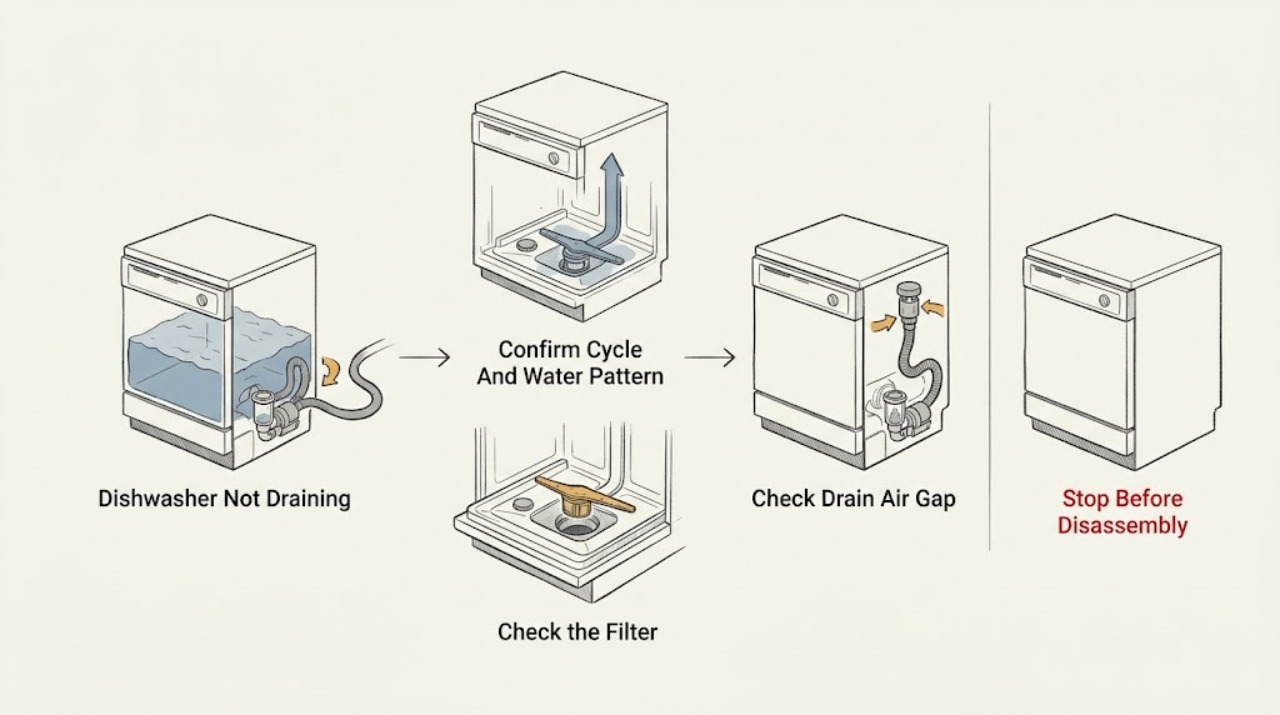
Work through in order
Diagnostic checks
Use only checks that match the exact appliance or system and its official guide.
-
Check 1
Stop adding water and, from a dry and stable position, confirm whether the selected cycle completed, is paused, stopped in the middle, or shows an indicator or error. Note whether water is only below the filter, covers the filter, returns after a drain attempt, or is backing up outside the dishwasher.
Expected result: The controls show a paused or incomplete cycle; the cycle completed with a small amount below the filter; the filter is covered; or water is returning, overflowing, or reaching the floor.
Next step: Use the exact model manual for the normal cancel or drain control if the machine is safe and the cycle is merely incomplete; otherwise leave it off and continue only with the accessible checks below.
Stop if: Do not run another cycle after overflow, water near electrical parts, smoke, a burning odor, a damaged cord, or an active leak.
Why this matters
Why: A paused or interrupted cycle can explain why a drain step did not occur. A small amount below the filter can be normal, while water covering the filter or returning after a drain attempt supports a drainage problem. Overflow or water near electrical parts is a stop-and-service condition.
-
Check 2
With the dishwasher stopped and the tub safe to handle, follow the exact Frigidaire model instructions to inspect the accessible glass trap, coarse filter, and cylinder or fine filter for food soils, broken pieces, or a filter that is not seated correctly. Rinse only the parts identified as removable by the manual.
Expected result: A filter or glass trap is clogged, contains broken material, is missing or mis-seated, or is clear and correctly installed; or access would require tools or force.
Next step: Clean and replace only model-approved removable parts, keeping sharp debris away from bare hands; if the filter cannot be safely accessed or water remains after the correction, arrange service.
Stop if: Do not reach into a concealed sump, remove a pump cover, pick up broken glass with bare hands, or use chemical drain cleaner.
Why this matters
Why: Food or broken material can restrict the drain path, and a mis-seated filter can prevent the system from working as designed. Clear, correctly installed accessible filters make a hidden restriction, hose problem, pump issue, or connected-plumbing issue more likely.
-
Check 3
If the installation has a countertop drain air gap or a sink-side garbage-disposal connection, inspect the visible component from a dry position for debris or an uncertain connection. For a new disposal, compare the inlet arrangement with the installation instructions to verify that the dishwasher knockout plug was removed; do not dismantle plumbing.
Expected result: The drain air gap is visibly blocked, the sink or disposer is also backing up, the disposal connection is new or its knockout plug is unverified, or the sink-side path looks clear.
Next step: Clean only an accessible air-gap component as the model or installation instructions permit; have an installer or plumber correct an uncertain disposal connection or a shared drain backup.
Stop if: Do not remove the disposal, cut or disconnect a drain hose, work in pooled water, or pour drain chemicals into the dishwasher or sink.
Why this matters
Why: A blocked air gap or shared sink/disposer restriction can make the dishwasher appear to have a failed internal drain. An unremoved knockout plug can prevent a newly connected dishwasher from draining. A clear sink-side path shifts attention back to the dishwasher hose and internal drain system.
-
Check 4
If the dishwasher was recently installed or moved, inspect only the visible drain-hose route under the sink for a kink, pinch, obstruction, or a connection that has shifted. Compare the route with the Frigidaire installation instructions and do not pull the dishwasher forward to reach a hidden section.
Expected result: The visible hose is kinked or pinched, its routing or high loop is uncertain, it was recently bumped, or it appears correctly routed and secure.
Next step: Have the installer or a qualified appliance technician correct an uncertain or inaccessible hose route; if a safe visible alignment is clearly described by the manual, document the before-and-after condition and proceed only to a supervised model-approved drain test.
Stop if: Do not loosen fittings, disconnect the hose, move the appliance, or test a wet connection by hand.
Why this matters
Why: A restricted or incorrectly routed hose can leave water in the tub after a cycle. A route that looks correct makes a concealed blockage, drain pump, sump, or control problem more likely, particularly when filters and sink-side drainage are clear.
-
Check 5
Read the exact model manual for the dishwasher's cancel, drain, and indicator behavior. If the unit stopped mid-cycle and there is no active leak or electrical hazard, use only the documented control sequence; do not assume a generic reset or interrupt power as a substitute for diagnosis.
Expected result: The manual identifies a normal way to cancel or drain, the controls remain paused or unresponsive, a model-specific indicator is present, or the model guidance is unavailable.
Next step: Record the control display and selected cycle, follow the manual only when safe, and arrange service if the dishwasher will not begin or complete its documented drain sequence.
Stop if: Do not bypass a door or overflow safety, open the control console, perform live electrical testing, or repeatedly power-cycle an appliance with standing water or a safety symptom.
Why this matters
Why: A control state can prevent the drain phase without proving that the pump or hose is faulty. A persistent indicator, unresponsive control, or missing model procedure needs technician or manufacturer guidance rather than repeated resets.
-
Check 6
Only after a clearly visible filter, air-gap, hose, disposal, or control-state issue has been corrected according to the model instructions and no safety hazard remains, run one model-approved drain or short cycle while staying nearby and watching the water level and sink-side connection.
Expected result: The tub drains normally, drains slowly, stops with water covering the filter, backs up into the sink, or remains unchanged after the documented drain attempt.
Next step: Stop at the first recurrence, leave the dishwasher off, and arrange qualified appliance or plumbing service with the recorded water level, timing, and control state.
Stop if: Do not perform this test after overflow, an electrical symptom, an active leak, a cracked hose, smoke, burning odor, or a door that cannot close securely.
Why this matters
Why: Normal drainage after a visible correction supports that correction as the cause but does not prove every internal component is sound. Slow or absent drainage after the accessible checks points toward a concealed hose, pump, sump, valve, control, or connected-plumbing fault.
Use your observations
Decision map
Find the observation that best matches what you see, then follow the next safe action.
-
PATH 01Safety boundary
What you see
Only a small amount of water remains below the filter after a completed cycle, with no water covering the filter, backing up, or reaching the floor.
Do this next
Monitor the water level and the next completed cycle; consult the model manual or arrange service if the water increases, covers the filter, becomes dirty or stagnant, or appears outside the tub.
Why this path and its safety boundary
Why it matters: Frigidaire says some water at the bottom after a wash can be normal, so this observation alone does not establish a failed drain.
Safety stop: Do not insert tools into the sump or add drain chemicals to remove normal residual water.
-
PATH 02Safety boundary
What you see
Water covers the filter and the accessible glass trap or filter contains food residue, broken material, or is not seated correctly.
Do this next
Clean and reinstall the model-approved accessible parts, then use one supervised model-approved drain test. If the level does not improve, stop and request service.
Why this path and its safety boundary
Why it matters: A restricted or mis-seated filter system is a plausible first cause and is more actionable than replacing a pump based only on standing water.
Safety stop: Do not reach into a concealed sump, handle broken glass bare-handed, or use chemical drain cleaner.
-
PATH 03Safety boundary
What you see
The problem began after installation, moving the dishwasher, or adding a garbage disposal, and the drain hose is kinked, routing is uncertain, or the disposal knockout plug is unverified.
Do this next
Have the installer or a qualified technician check the hose route, high loop, disposal inlet, and shared drain without repeated cycles or self-disassembly.
Why this path and its safety boundary
Why it matters: A drain-path installation issue is more likely than an internal pump failure when the timing and visible connection pattern match.
Safety stop: Do not pull out the dishwasher, remove the disposal, disconnect plumbing, or cut the hose to change its route.
-
PATH 04Safety boundary
What you see
The dishwasher and sink or disposer back up together, or an accessible drain air gap contains debris.
Do this next
Clean only the accessible air-gap component as instructed and arrange qualified plumbing service for a shared drain backup or any blocked section beyond ordinary access.
Why this path and its safety boundary
Why it matters: A shared sink-side restriction or air-gap problem can prevent the dishwasher from discharging even when its filter is clean.
Safety stop: Do not pour chemical drain cleaner into the appliance or sink and do not disassemble the shared plumbing.
-
PATH 05Safety boundary
What you see
The dishwasher stopped mid-cycle or remains paused, and the model manual documents a cancel or drain sequence but no active leak or electrical hazard is present.
Do this next
Follow only the exact model control sequence, record any indicator, and stop for service if the documented drain sequence fails or the controls remain unresponsive.
Why this path and its safety boundary
Why it matters: The drain phase may not have run, so standing water does not yet prove a blocked hose or failed pump.
Safety stop: Do not bypass the door or overflow safety, open the console, or use a generic reset repeatedly.
-
PATH 06Safety boundary
What you see
The cycle completes, accessible filters and sink-side connections are clear, the visible hose route is correct, and the dishwasher still cannot drain or immediately returns water.
Do this next
Leave the appliance off and arrange qualified appliance service; provide the model, water level, cycle state, any indicator, and the results of the accessible checks.
Why this path and its safety boundary
Why it matters: A concealed hose restriction, drain pump, sump, valve, control, or connected-plumbing fault is more likely than a user-serviceable filter issue.
Safety stop: Do not open the cabinet or sump, perform live electrical testing, or order a pump solely from the symptom.
Helpful context
Understand the symptom
Separate normal residual water from a failed drain
A small amount of water below the filter after a completed cycle is not automatically a fault. The more useful questions are whether water covers the filter, returns after the dishwasher tries to drain, backs up from the sink or disposer, or remains at a level that affects the next cycle. Also note whether the controls show a paused or incomplete cycle. This pattern determines whether to start with an accessible filter and drain-path check or stop for service.
Clean only the accessible filter system
Food debris, broken pieces, and residue can collect in the glass trap and filters. With the dishwasher stopped and safe to handle, use the exact model instructions to remove only the user-serviceable filter parts, rinse them, and replace them so they sit correctly. A drain air gap, when installed, is a separate countertop component that can also affect drainage. Do not reach into an unknown sump, pick up broken glass with bare hands, or pry apart a cover.
Installation and disposal connections can block drainage
If the problem began after installation, moving the dishwasher, or adding a garbage disposal, inspect the visible hose route and connection against the installation guide. A kink, a moved hose, an unsuitable high-loop arrangement, or a disposal knockout plug left in place can prevent water from reaching the drain. Keep the appliance in place and do not loosen a wet fitting; an installer or qualified technician should correct an uncertain connection.
Persistent standing water points beyond the first checks
If the filter and visible drain path are clear but the dishwasher still leaves water after a completed cycle, the restriction or fault may be in a concealed hose, pump, sump, valve, control, or connected plumbing. A model-specific indicator or error can help a technician, but it does not authorize cabinet access. Record the cycle, water level, control state, and when the drain attempt stops, then arrange service rather than repeating an unsafe test.
Safety boundary
Stop conditions
- Stop immediately for overflow, water near electrical components, smoke, burning odor, a damaged cord, a cracked hose, or an active leak.
- Do not move the dishwasher, open panels or the sump, disconnect plumbing, or perform live electrical testing.
- Do not use chemical drain cleaner, mix cleaning products, or repeatedly run cycles with standing water.
- Do not bypass a door or overflow safety feature or force a filter, hose, air-gap cover, or connection.
- Stop testing and arrange qualified appliance or plumbing service when accessible checks and the model-approved drain sequence do not restore drainage.
Only after diagnosis
Potential parts
- dishwasher drain pump assembly
Consider this category only when qualified diagnosis finds that the drain path and accessible filters are clear but the dishwasher's drain pump does not move water as designed.
Confirm the complete Frigidaire model and revision and the pump's exact fit information; do not order or open the sump based only on standing water. - dishwasher drain hose or drain-path assembly
Consider this category only when inspection confirms a damaged, obstructed, or incorrectly routed hose that cannot be corrected by the installation instructions.
Verify exact model, routing, connection requirements, and installation guidance with the installer or qualified technician before replacement. - dishwasher sump or drain seal
Consider this category only when a technician isolates the persistent drainage or underside condition to a sump seal or associated model-specific assembly.
Confirm exact model and revision and use qualified installation; do not dismantle the sump or cabinet as a user troubleshooting step.
When checks do not resolve it
Need a professional?
Arrange qualified appliance service when the dishwasher still will not drain after the model-approved accessible filter and drain-path checks, the source is beneath the tub or behind a panel, the controls are unresponsive, or a pump, sump, valve, or concealed hose may be involved. Contact the installer or a qualified plumber when the problem follows installation, moving, a new garbage disposal, or a shared sink-side backup. Seek urgent help for overflow, electrical exposure, smoke, burning odor, a damaged cord, or water damage.
Safety scope: This article supports dry, ordinary-access observation and model-approved cleaning or control use only. It does not authorize cabinet or sump access, concealed plumbing work, live electrical testing, chemical drain treatment, or operation of a hazardous appliance.
Common questions
FAQ
Why is my Frigidaire dishwasher not draining?
Common first checks are a paused or incomplete cycle, food or broken material in the accessible glass trap or filter, a kinked or moved drain hose, a blocked drain air gap or shared sink path, and a garbage-disposal knockout plug left in place after installation. Persistent drainage failure can involve a concealed hose, pump, sump, valve, control, or connected plumbing.
Is some water in the bottom of a Frigidaire dishwasher normal?
Frigidaire says some water below the filter after a completed wash can be normal. Water covering the filter, backing up, returning after a drain attempt, or reaching the floor is a different pattern and needs drainage checks.
Can a dirty dishwasher filter stop it from draining?
Yes. Food residue or broken material can clog the glass trap or filter. Follow the exact model instructions to rinse accessible filter parts and replace them correctly; do not reach into a concealed sump or handle broken glass bare-handed.
Why does a new Frigidaire dishwasher leave water in the tub?
Check whether the drain hose was kinked, moved, or routed incorrectly, and whether a new garbage disposal still has its dishwasher knockout plug. Compare the visible installation with the model guide and have the installer correct an uncertain connection.
What should I do if my dishwasher shows a drainage code?
Record the exact code and consult the model manual. Frigidaire's i20 guidance points to the disposer connection, unrestricted drain hose, correct routing, and a clear glass trap or filter, but reset controls vary by model and a code does not authorize cabinet or pump access.
When should I stop troubleshooting a dishwasher that will not drain?
Stop for overflow, water near electrical components, smoke, burning odor, a damaged cord or hose, or any active leak. Also stop when filters and visible connections are clear but drainage still fails; leave the appliance off and arrange qualified appliance or plumbing service rather than repeating cycles or using drain chemicals.
Read the exact guide
Official sources
- Dishwasher Error Code i20 - Unit did not drain properlyFrigidaire · Official Frigidaire support article for models displaying i20; its drainage checks are useful context but the code is not assigned to this topic.
- Why is water in the dishwasher after it runs?Frigidaire · Official Frigidaire owner-support article for water remaining after a dishwasher cycle; it distinguishes some normal bottom water from water covering the filter.
- What can I do if my dishwasher is not draining?Frigidaire · Official Frigidaire owner-support article for dishwasher drainage; exact model instructions control access and controls.
- Dishwasher Glass Trap and Filter GuideFrigidaire · Official Frigidaire owner-support cleaning guide for dishwashers; use the exact model manual for differences in filter design and access.
Community feedback
Share a repair observation
Share a plain-text repair observation. Accepted observations are published automatically; this page may take a moment to update.