
On this page
Start here
Quick answer
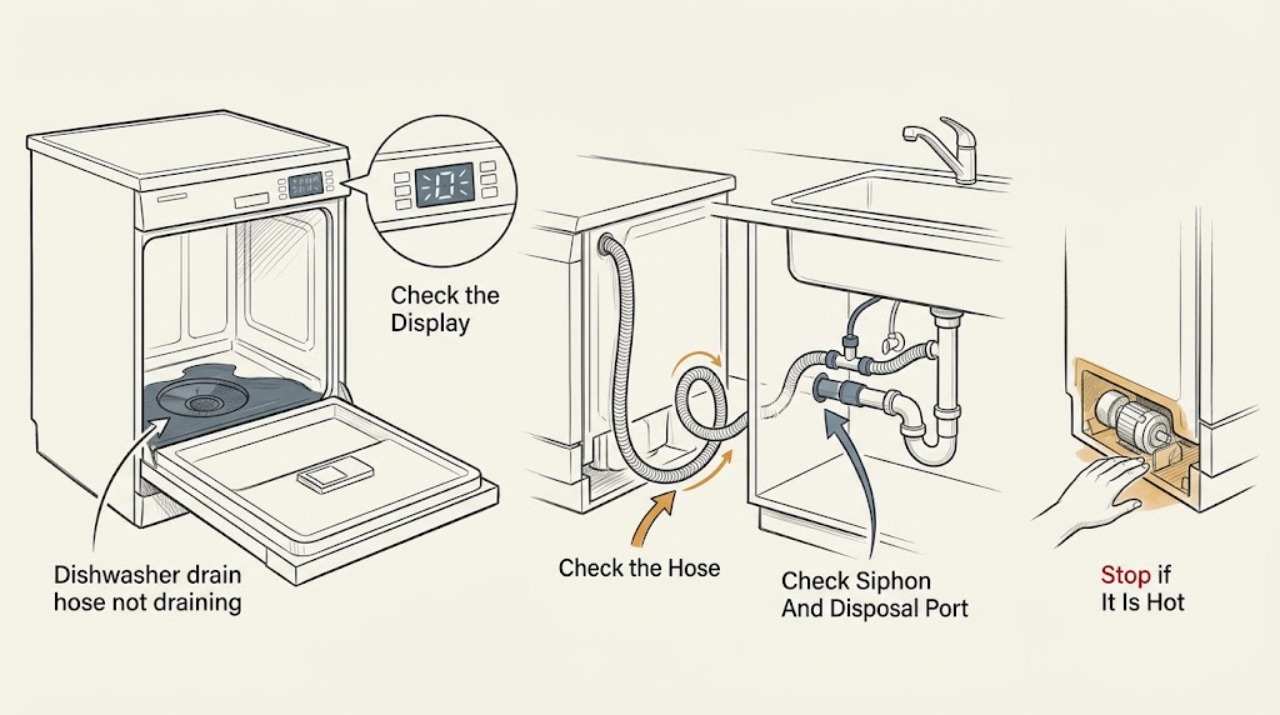
Turn the Bosch dishwasher off and identify whether water is standing in the tub, whether the drain hose is kinked or crushed, and whether an error code is present. From safe, ordinary access, check the hose routing and its connection to the sink siphon, air gap, or garbage disposal; a new disposal installation can still have its drain-port knockout plug in place. Clean the filter and pump area only as the exact Bosch owner manual allows, using a sponge for standing water and avoiding sharp debris. E15 or evidence of water in the base means stop the water inflow and arrange service; repeated E23, E24, or E25, a damaged hose, a loose pump cover, or water that remains after the permitted checks also needs qualified appliance service.
Work through in order
Diagnostic checks
Use only checks that match the exact appliance or system and its official guide.
-
Check 1
With the dishwasher controls off and the floor dry enough to stand safely, record whether water is standing in the tub, whether the unit leaked underneath, whether a drain-pump sound was heard, and the exact displayed code if any.
Expected result: Classify the result as no standing water, standing water with no code, E22, E23, E24, E25, E15, or an active leak or wet base area.
Next step: If E15, an active leak, or water near an electrical outlet is present, stop and follow the safety boundary. Otherwise continue with the visible hose and connection inspection, keeping the code and symptom pattern for service if the check does not resolve it.
Stop if: Do not run another cycle to test an active leak, wet base, burning smell, damaged cord, or water near electrical components.
Why this matters
Why: Standing water confirms that the drainage path or pump has not completed its job. E22 points toward the filter, E23 toward a drain-pump issue, E24 toward the drainage path, and E25 toward a blocked pump or pump-cover problem; E15 is a water-in-base safety condition rather than a routine hose-cleaning prompt.
-
Check 2
From the cabinet or other ordinary safe access, trace the visible Bosch drain hose from the dishwasher connection to the sink siphon, air gap, or garbage-disposal inlet; do not pull the appliance out or disconnect a wet fitting.
Expected result: Look for a sharp kink, crushed section, sag that can hold water, loose clamp or connection, hose rubbing on a cabinet edge, a blocked air-gap path, or a disposal connection that was recently changed.
Next step: Photograph the route and connection, and restore only an obviously displaced external routing or secure connection when the model and plumbing instructions make that safe; otherwise leave it in place for a qualified appliance or plumbing technician.
Stop if: Stop if the hose is split, hardened, leaking at the fitting, inaccessible without moving the appliance, or connected to a wet or damaged plumbing assembly.
Why this matters
Why: A visible kink, crush, or loose connection makes a hose or installation restriction more likely than an internal pump fault. A clean, open-looking route does not prove the hose is clear because an obstruction can be inside the hose or at the siphon connection.
-
Check 3
Inspect the drain-hose termination at the sink siphon, air gap, or garbage disposal without dismantling the trap or forcing the hose; if a disposal was installed or replaced recently, verify from its installation documentation whether the dishwasher inlet knockout plug was removed.
Expected result: Record whether the hose enters the intended inlet, the connection is open and secure, the air-gap or siphon path is visibly blocked, or the disposal port may still contain its knockout plug.
Next step: Use the appliance and plumbing installation instructions or ask a qualified plumber to correct a connection or knockout-plug issue; do not drill into a connected disposal or open a trap full of wastewater as a trial repair.
Stop if: Stop for wastewater leakage, an inaccessible disposal connection, a damaged trap, or any need to cut, drill, or replace plumbing without the correct installation instructions.
Why this matters
Why: A blocked siphon or air-gap path, a wrong or loose connection, or an intact disposal knockout plug can stop a Bosch dishwasher from draining even when the hose itself is not kinked. A normal-looking connection shifts attention back to the filter, pump cover, or internal pump.
-
Check 4
Only with the dishwasher switched off and only as the exact Bosch owner manual permits, remove the filter and inspect the pump area; use a sponge to remove standing water and clear visible debris, and reinstall the filter and pump cover exactly as instructed.
Expected result: Note food debris or glass-like sharp material, a blocked filter, a loose or missing pump cover, a clear pump area, or a cover that will not release or reseat without force.
Next step: After safe reassembly, perform one controlled drain test if the manual allows and no leak or safety condition is present; if the area is inaccessible, damaged, or still blocked, arrange service instead of reaching deeper.
Stop if: Do not reach blindly, handle sharp debris bare-handed, force the pump cover, use drain chemicals, or work on wiring or the pump motor.
Why this matters
Why: Bosch identifies filter and pump debris as common no-drain causes. A loose or missing pump cover fits Bosch's E25 guidance, while a clear and correctly reassembled area makes a hose, siphon, drain-pump, or other internal fault more likely.
-
Check 5
With the hose connection, filter, and pump cover restored and no leak present, run only the model-approved drain or short test procedure and observe the outlet connection, water movement, unusual noise, and whether the code returns.
Expected result: Record complete drainage with no leak, partial drainage or backflow, a returning E23/E24/E25, a new leak, or a pump that is silent or unusually noisy.
Next step: Stop testing after one failed controlled check, save the code and photos, and request qualified appliance service; include the hose route, connection type, filter or pump observations, and any recent disposal or plumbing work.
Stop if: Stop immediately for E15, any leak, water in the base, electrical or burning odor, loud grinding, or a test that requires moving the appliance or opening live electrical parts.
Why this matters
Why: A complete, leak-free drain after a permitted obstruction correction supports the hose or connection as the cause. Persistent water, backflow, a returning code, or abnormal pump behavior points to an internal drain-pump, wiring, installation, or plumbing fault that should not be guessed at.
Use your observations
Decision map
Find the observation that best matches what you see, then follow the next safe action.
-
PATH 01Safety boundary
What you see
The visible drain hose has a sharp kink, crushed section, sag, or loose connection at the sink-side termination.
Do this next
Restore only the model-approved route or secure accessible connection without forcing the appliance; otherwise have the hose and connection corrected by a qualified technician, then perform one controlled test.
Why this path and its safety boundary
Why it matters: The external drainage path is the leading suspect, although an obstruction may remain inside the hose or siphon.
Safety stop: Stop for a split hose, active leak, inaccessible connection, or a need to pull the dishwasher through water.
-
PATH 02Safety boundary
What you see
The hose is connected to a garbage disposal or air gap and the issue began after plumbing work, or the air-gap or siphon path is visibly restricted.
Do this next
Use the installation instructions or qualified plumbing service to correct the inlet, air-gap, siphon, or knockout-plug condition before testing again.
Why this path and its safety boundary
Why it matters: A connection or installation restriction can mimic a failed Bosch drain hose; a disposal knockout plug is a specific possibility after disposal replacement.
Safety stop: Do not drill, cut, open a wastewater trap, or dismantle a wet disposal connection as a trial repair.
-
PATH 03Safety boundary
What you see
The hose route is reasonable, but the filter or pump area contains debris, standing water, or a loose or missing pump cover.
Do this next
Clean and reinstall only through the exact owner-manual procedure, then make one controlled test if there is no leak or safety concern.
Why this path and its safety boundary
Why it matters: Bosch's no-drain guidance makes filter or pump obstruction plausible, and a cover problem aligns with E25; this is distinct from a hose kink.
Safety stop: Stop for sharp debris, a cover that needs force, damaged parts, or any need to work on the pump motor or wiring.
-
PATH 04Safety boundary
What you see
The display shows E15, the base area is wet, or water is leaking beneath the dishwasher.
Do this next
Turn off the water inflow, keep the dishwasher out of service, and arrange qualified service to locate the leak and inspect the base condition.
Why this path and its safety boundary
Why it matters: Bosch treats E15 as a safety-switch detection of water in the base, not as a routine drain-hose obstruction.
Safety stop: Do not run another cycle, repeatedly reset the unit, or reach around wet electrical parts.
-
PATH 05Safety boundary
What you see
E23, E24, or E25 returns after the visible route and the permitted filter or pump-cover check are complete.
Do this next
Stop repeating resets and request qualified Bosch appliance service with the exact code, model identity, photos, and checks already completed.
Why this path and its safety boundary
Why it matters: A persistent drain-pump, blocked drainage path, pump-cover, or internal installation fault is more likely than a simple visible kink.
Safety stop: Do not substitute a pump, bypass a safety switch, or open electrical panels based only on the code.
-
PATH 06Safety boundary
What you see
The hose, sink-side connection, filter, and pump area appear clear and correctly restored, but water still remains or backflows.
Do this next
Leave the dishwasher off and have a qualified appliance technician or plumber determine whether the fault is in the appliance or the building drain connection.
Why this path and its safety boundary
Why it matters: The remaining possibilities include an internal drain pump or wiring fault, a concealed hose obstruction, or a plumbing restriction that needs instrumented diagnosis.
Safety stop: Do not keep cycling the appliance, inject drain chemicals, or pull it out without controlling water and electrical connections.
Helpful context
Understand the symptom
Start with the hose, connection, and symptom pattern
A drain hose problem is not always a blockage inside the hose. A kink, crushed section, poor routing, loose siphon connection, air-gap restriction, or a disposal knockout plug can prevent the dishwasher from emptying or let water flow back. Note how much water is left, whether the pump is heard, whether water appears under the unit, and any displayed code before moving the appliance or disconnecting plumbing.
Use Bosch's filter and pump guidance only within the model manual
Bosch directs owners to check the filter and pump area for food debris, remove the filter as described in the owner manual, and use a sponge for standing water. The pump cover should be removed only by the model-specific procedure, then reinstalled with the filter and cover secure. Sharp debris may be present, so do not reach blindly or force a cover.
Treat error codes and leaks as decision points
Bosch lists E22 for a blocked filter, E23 for a drain-pump issue, E24 for a drainage-path problem, and E25 for a blocked pump or loose or missing pump cover. E15 indicates that a safety switch detected water in the base; turn off the water inflow and contact service. A code that returns after the permitted check is evidence to stop repeating resets and arrange diagnosis.
Safety boundary
Stop conditions
- Stop immediately and turn off the water inflow for E15, an active leak, or water in the dishwasher base; arrange qualified service.
- Keep the dishwasher off if water is near an outlet, cord, control, or other electrical part, or if there is a burning smell, smoke, or damaged wiring.
- Do not use drain chemicals, solvents, compressed air, sharp tools, or force on the drain hose, pump cover, filter, disposal, or siphon connection.
- Do not pull the dishwasher through standing water or disconnect a wet plumbing or electrical connection as a test.
- Stop and request service when the hose is split, the pump cover will not reseat, a code returns, or water remains after the model-approved checks.
Only after diagnosis
Potential parts
- dishwasher drain hose or connection kit
Consider only when the hose is split, crushed, leaking, or cannot be routed correctly after the connection is diagnosed.
Match the exact Bosch model and installation instructions; do not assume a generic hose or clamp is compatible. - dishwasher pump cover or filter
Consider only when the model manual identifies the part as damaged, missing, or unable to seat after debris is removed.
Confirm the exact Bosch model before ordering; a loose cover should not be replaced by guesswork. - dishwasher drain pump
Consider only after the hose, sink-side connection, filter, and pump-cover checks are clear and a qualified diagnosis identifies the pump.
Drain-pump fit and electrical compatibility are model-specific and should be confirmed by a qualified technician.
When checks do not resolve it
Need a professional?
Arrange qualified appliance service when E15 or a leak is present, the drain hose is damaged or inaccessible, E23/E24/E25 returns, the filter and pump area cannot be safely inspected, the pump is silent or grinding, or the dishwasher still holds or backs up water after the visible hose and model-approved checks. Include the exact model, code, water level, hose route, sink-side connection, recent disposal work, and photos.
Common questions
FAQ
Can a Bosch dishwasher drain hose cause standing water?
Yes. A kink, crushed section, blocked connection, poor routing, or a restriction at the siphon, air gap, or disposal inlet can prevent drainage. A clear-looking hose does not rule out an internal obstruction or pump problem, so persistent water needs service after the model-approved checks.
What should I do if E15 appears while the dishwasher will not drain?
Treat E15 as a water-in-base safety condition: turn off the water inflow, keep the dishwasher out of service, and arrange qualified service. Do not keep running cycles or reach around wet electrical parts.
Should I replace the drain pump when the Bosch dishwasher does not drain?
Not based on the symptom alone. Check the visible hose and connection and use the exact owner-manual procedure for the filter and pump-cover area first. A replacement pump is conditional on a qualified diagnosis, especially when E23 or another code returns.
Read the exact guide
Official sources
- Bosch Dishwasher Error Code E24: How to Fix & ResetBosch · Bosch dishwasher E24 drainage-path troubleshooting, drain hose, siphon connection, pump cover, and disposal connection
- Dishwasher Troubleshooting: Dishwasher is not drainingBosch · Bosch dishwasher no-drain troubleshooting, filter and pump inspection, and service boundary
- Bosch Dishwasher Error Codes: Troubleshooting GuideBosch · Bosch dishwasher error codes E15, E22, E23, E24, and E25
- Dishwasher Troubleshooting: Dishwasher not pumping properlyBosch · Bosch dishwasher standing water and not-pumping troubleshooting
Community feedback
Share a repair observation
Share a plain-text repair observation. Accepted observations are published automatically; this page may take a moment to update.