
On this page
Start here
Quick answer
For a Frigidaire FDSH4501AS3A that shows iF0/i20 and later i30, do not start by replacing or bypassing a pressure switch. Frigidaire's opened manufacturer guide groups iF0 with i20 as clogged filters or a restricted drain line, while i30 means a leak or overflow has been detected in the bottom pan. That makes the sequence important: first preserve the exact code order and whether water was left in the tub; once i30, water under the dishwasher, or a continuously running drain pump is present, stop the cycle, close the dishwasher water supply, and isolate power only from a safe dry location. With power isolated and without tilting or opening the base, check only the accessible filter/glass-trap area, visible drain-hose routing, cycle-complete status, and disposer knockout-plug situation if applicable. A clear filter or a pump that sounds normal in one test cannot prove that a pressure switch, pump, valve, or control is good or bad. If the sequence returns, request a model-specific diagnosis that distinguishes drain restriction, low water/foam, overflow protection, and an actual leak before any part is selected.
Before you begin
Safety first
- Disconnect electrical power and close the dishwasher water supply before service when safe to do so. Do not tilt the unit, remove the bottom pan, bypass a pressure or float device, open water connections under pressure, enter service mode, probe live wiring, or operate with enclosure panels removed. Stop for i30, overflow, water beneath the unit, smoke, sparks, burning odor, or wet electrical parts.
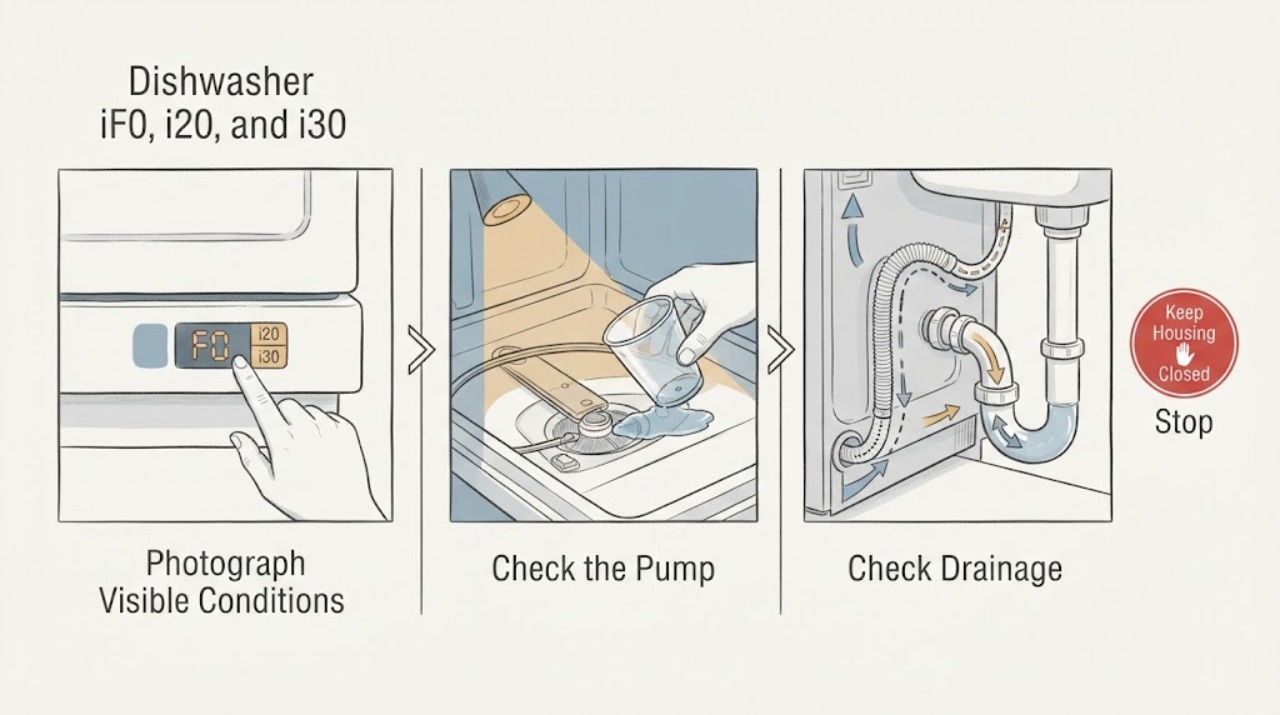
Work through in order
Diagnostic checks
Use only checks that match the exact appliance or system and its official guide.
-
Check 1
Stop the dishwasher and photograph or transcribe the complete display in order: iF0, i20, i30, any repeated code, and whether the characters are lowercase i, uppercase I, or a numeral 1. Record the full rating-label model FDSH4501AS3A, the cycle stage, and whether the code appeared during filling, washing, draining, or after the door was opened.
Expected result: The sequence is clear and matches FDSH4501AS3A, or the code/model/order is uncertain.
Next step: Use Frigidaire's exact model support/manual route and give the photo, model, code order, and cycle stage to service. Preserve the sequence rather than repeatedly resetting it.
Stop if: Do not enter diagnostic or calibration mode, generate more codes, or open the door while the tub may be overfilled or the pump is running continuously.
Why this matters
Why: A sequence can separate an earlier drain symptom from a later leak-protection event. An uncertain character or suffix is not enough to select a pressure switch or apply another model's code table.
-
Check 2
Before touching water or filters, check the safety state from outside: is water on the floor or beneath the unit, is the tub near the door lip, is the drain pump humming continuously, or is there a burning smell, sparking, or wet electrical area? If any of these are present, close the dishwasher water supply and isolate power only from a safe, dry location.
Expected result: Water is under the dishwasher or near the door, the pump runs continuously, the tub is unusually full, or there is no leak/electrical hazard visible.
Next step: Keep the dishwasher off and arrange qualified service for i30, standing water under the unit, continuous drain operation, or any electrical hazard. If no hazard is present, continue only with the permitted external drain-path checks.
Stop if: Do not tilt the dishwasher to empty a pan, remove the toe-kick or bottom pan, touch wet wiring, or reset and rerun a leaking unit.
Why this matters
Why: i30 is the manufacturer leak/overflow branch, and the exact-model case also describes water reaching the door lip before i30. A leak or flood-protection event takes priority over determining whether a pressure switch or pump is involved.
-
Check 3
With the dishwasher idle and power isolated as the exact manual allows, check the accessible glass trap/filter area for obvious food soil and confirm the owner-removable filter is seated. Do not reach into a hidden pump opening, dismantle the sump, or use a tool to probe the drain path.
Expected result: Food soil or a mis-seated accessible filter is visible, the filter area is clear, or there is standing water that prevents a safe check.
Next step: Clean and refit only the accessible filter as documented for FDSH4501AS3A; if water is present in a way that makes the check unsafe, leave the unit off and call service. Do not use the filter result to order a pressure switch.
Stop if: Do not remove the pump, open the sump, insert a wire, dismantle the pressure-sensing path, or run the dishwasher with a filter or enclosure part missing.
Why this matters
Why: Frigidaire links i20 and iF0 in the opened guide to clogged filters or a restricted drain line. A clear visible filter does not prove that the pump, hose interior, pressure sensing, or control is working, and standing water can also be part of a leak or overflow event.
-
Check 4
From outside the appliance, trace only the visible drain installation: look for a plainly kinked or crushed hose, an obvious disconnection, an absent disposer knockout plug when the hose enters a new disposer, or a changed hose route. Do not pull the dishwasher out or disconnect a water or drain fitting.
Expected result: A visible hose restriction, disconnection, or disposer connection issue is present, or the external route looks normal.
Next step: Correct only a plainly visible routing issue if it can be done without moving the appliance or opening a connection; otherwise provide the observation to service. If i30 or water under the unit is present, do not run a test cycle.
Stop if: Do not pull out the built-in dishwasher, detach a pressurized water line, open the pump area, or substitute a pressure-switch diagnosis for a drain-path check.
Why this matters
Why: Frigidaire's i20 guidance identifies hose obstruction, pinching, hose height, and a disposer knockout plug as drain checks. A normal exterior does not rule out a hidden restriction, pump issue, foam/level condition, or a leak into the bottom pan.
-
Check 5
Separate the three conditions in the service record: water remains in the tub after a completed cycle; water rises during the cycle or spills at the door; or water is found beneath the dishwasher while the tub level does not explain it. Also record whether excess suds were visible and whether the event followed a detergent, loading, installation, or drain-plumbing change.
Expected result: Only residual tub water is present, the tub is actively overfilling or foamy, or water is in the bottom pan/floor area.
Next step: Use the matching branch: perform only the documented accessible drain checks for residual water, stop and close water for overfill or i30, and arrange service for water under the appliance or recurring mixed codes.
Stop if: Do not add water, detergent, or a cleaner to reproduce the fault, and do not run repeated cycles after overflow, foam, or leakage.
Why this matters
Why: Residual water supports the i20/iF0 drain-restriction branch; active overfill or foam can change the water-level behavior; i30 or water below the tub is a leak/overflow-protection branch. None of these observations proves a pressure switch is the failed component.
-
Check 6
After one exact-manual-permitted external correction, record whether the display clears, whether the same code returns at the same stage, whether the code order changes from iF0/i20 to i30, and whether the tub drains without a leak. Do not use service mode, a calibration cycle, or repeated resets as an owner test.
Expected result: The unit completes without a code, i20/iF0 returns with residual water, i30 returns or the pump runs continuously, or a different code appears.
Next step: Keep the dishwasher off for recurrence, i30, continuous pumping, or any leak. Give service the complete timeline and ask for a model-specific diagnosis before authorizing a pressure switch, pump, valve, or board.
Stop if: Do not bypass a pressure switch, short wiring, open the base, tilt the appliance, or run a cycle with an active leak or bottom-pan water.
Why this matters
Why: A cleared one-time visible restriction supports a drain-path condition. A recurring i20/iF0 leaves restriction, pump, water-level/foam, and control possibilities open; a later i30 adds a leak/overflow branch and must not be treated as the same fault.
Use your observations
Decision map
Find the observation that best matches what you see, then follow the next safe action.
-
PATH 01Next step
What you see
iF0 and i20 appear first, with water left in the tub but no water beneath the dishwasher, and the accessible filter or visible drain hose has an obvious restriction.
Do this next
Correct only the documented accessible filter, hose-routing, or disposer-knockout condition with power isolated; if the code returns, arrange service without selecting a part by code.
Why this path and its safety boundary
Why it matters: This matches the manufacturer drain-restriction category for iF0/i20 more closely than a leak-protection event, but it still does not identify a pressure switch or drain pump as the failed part.
-
PATH 02Safety boundary
What you see
i30 appears, the tub overflowed or reached the door lip, water is under the dishwasher, or the drain pump runs continuously.
Do this next
Close the water supply, isolate power from a safe dry location, do not tilt or open the base, and arrange qualified service to find and correct the leak or overflow cause before any reset.
Why this path and its safety boundary
Why it matters: This is the leak/overflow bottom-pan branch identified by the manufacturer, regardless of whether an earlier iF0/i20 restriction contributed to the event. The safety condition is more urgent than the pressure-switch question.
Safety stop: Do not rerun, clear the pan by tilting, bypass the float or pressure device, or touch wet electrical parts.
-
PATH 03Next step
What you see
The drain pump can empty the tub in one isolated observation, but i20/iF0 returns during a normal cycle or the sequence later becomes i30.
Do this next
Provide the stage-by-stage timeline to service and request assessment of the full drain, water-level/foam, overflow, and control paths. Do not replace a pressure switch or board solely because the pump ran once.
Why this path and its safety boundary
Why it matters: A pump that operates in one context does not prove correct timing, flow, hose routing, water-level behavior, or leak protection during the complete cycle. The exact-model community report describes this pattern without a confirmed repair.
-
PATH 04Next step
What you see
The model suffix, display characters, code order, or water location cannot be confirmed, or the display is a different i-code.
Do this next
Stop using this code sequence as a diagnosis, capture the rating label and display, and obtain the exact manual or model-specific service support.
Why this path and its safety boundary
Why it matters: The evidence no longer supports a combined iF0/i20/i30 interpretation. Frigidaire directs owners to the matching Owner's Manual for other message codes, and similar-looking characters can belong to different conditions.
-
PATH 05Safety boundary
What you see
Smoke, sparking, burning odor, a hot or damaged cord, water near electrical parts, or a repeated breaker trip accompanies any code.
Do this next
Leave the dishwasher off, close the water supply, isolate power only if safely accessible from a dry location, and obtain urgent qualified appliance/electrical help. Seek emergency help for active fire or shock injury.
Why this path and its safety boundary
Why it matters: The event has crossed the ordinary drain-check boundary into an electrical, fire, or water-damage hazard; code interpretation is no longer the first decision.
Safety stop: Do not reset the breaker repeatedly, touch wet wiring, open the panel, tilt the appliance, or run another cycle.
Helpful context
Understand the symptom
The useful clue is the order, not the number of parts someone can name. On the opened Frigidaire manufacturer guide for the FDSH4501AS platform, iF0 and i20 are grouped under clogged filters or a restricted drain line; i30 is a separate leak-or-overflow condition in the bottom pan. The guide does not print the full FDSH4501AS3A suffix, so confirm the rating label and the manual returned for that exact suffix before treating the code table as a perfect match.
A matching public case for FDSH4501AS3A reports iF0 and i20 during a cycle with water overflowing through the door, then i30 after the machine was run again. The poster later reported that a pump could drain in a diagnostic observation while the normal cycle still failed. This is a timeline to document, not proof of a pressure-switch or control-board failure, and the community's suggestions to bypass or open the pressure switch are not safe owner instructions.
When checks do not resolve it
Need a professional?
Call qualified Frigidaire appliance service for a recurring iF0/i20 sequence, any i30, continuous drain-pump operation, standing water that does not clear through documented owner checks, or any need to distinguish restriction, foam/level sensing, leak protection, pump, valve, or control behavior.
Safety scope: Disconnect electrical power and close the dishwasher water supply before service when safe to do so. Do not tilt the unit, remove the bottom pan, bypass a pressure or float device, open water connections under pressure, enter service mode, probe live wiring, or operate with enclosure panels removed. Stop for i30, overflow, water beneath the unit, smoke, sparks, burning odor, or wet electrical parts.
Have this ready
- Provide FDSH4501AS3A, serial/rating-label details, exact display characters, code order, cycle stage, tub and floor water location, pump sound, filter and visible hose observations, disposer connection, detergent/foam history, and every reset or repair already attempted.
Common questions
FAQ
Do iF0 and i20 mean the pressure switch is broken?
No. Frigidaire's opened guide groups iF0 and i20 with clogged filters or a restricted drain line. That can involve the filter, sump, hose, disposer connection, flow, or other parts of the drain/level system; the code does not prove that the pressure switch is the failed component.
What does i30 add after iF0 or i20?
The manufacturer guide treats i30 separately: leak or overflow water has been detected in the bottom pan. If i30 appears or water is beneath the machine, close the water supply, isolate power safely, do not tilt or open the base, and arrange service.
The pump worked once in a test. Does that rule out the pump or control?
No. A pump that empties water in one observation does not prove that the complete normal cycle has correct drain timing, flow, hose routing, water-level behavior, or leak protection. The exact-model public case reports this same distinction without a confirmed repair.
Can I bypass or test the pressure switch myself?
No. Do not short, bypass, remove, bench-test, or probe the pressure-sensing circuit. Those suggestions appear in the community thread but are not manufacturer-approved owner steps and can defeat overflow protection or create electrical and water damage risks.
Read the exact guide
Official sources
- Dishwasher Use & CareFrigidaire · Opened manufacturer guide routed from the FDSH4501AS product-support family. The PDF does not print the full AS3A suffix, so match it to the exact rating label before treating it as the final model manual; its iF0/i20/i30 table is used for the platform-level code distinction with that limitation stated.
- What do I do if my dishwasher is showing a message code?Frigidaire · Opened official Frigidaire message-code article; used only to distinguish status/instruction displays from unknown model-specific codes and to route unresolved codes to the Owner's Manual.
- Frigidaire dishwasher - is my pressure switch broken?Reddit r/appliancerepair · Exact public report matching FDSH4501AS3A and the iF0/i20 then i30 sequence. It is community evidence only and does not establish pressure-switch, pump, control-board, or other component failure; unsafe bypass/disassembly suggestions are explicitly excluded.
- Frigidaire 24'' Built-In Dishwasher with EvenDry™ System Stainless Steel-FDSH4501ASFrigidaire Canada · Opened official product-support page for the FDSH4501AS platform; use the exact FDSH4501AS3A rating label and returned manual to confirm suffix applicability before applying any code-specific instruction.
- Dishwashers - Not DrainingFrigidaire · Opened official Frigidaire dishwasher support article; used for high-loop/kink, filter, disposer knockout, and stop-service guidance, not for selecting a pressure switch or pump.
- Dishwasher Error Code i20 - Unit did not drain properlyFrigidaire · Opened official Frigidaire support article for dishwashers; used for the documented external drain checks, not for pressure-switch or part identification on FDSH4501AS3A.
Community feedback
Share a repair observation
Share a plain-text repair observation. Accepted observations are published automatically; this page may take a moment to update.