
On this page
Start here
Quick answer
Grit on items after a Smeg DIC6 cycle is not enough to identify one failed part. First describe the material: soft tablet fragments point toward detergent dissolution, hard white or chalky marks toward water hardness or softener settings, and brown or food-like particles toward leftover food or an obstructed accessible filter path. Smeg says 4-in-1 and 5-in-1 tablets can leave residue and dissolve better on a higher-temperature program, and that hard water may require separate powder, dishwasher salt, and rinse aid. Scrape large food residue, keep items from blocking the spray arms, and inspect only the user-accessible filter or parts named by the DIC6 manual. A model-specific hidden-filter removal procedure was not verified in the opened official sources, so do not disassemble the sump or order a part from the symptom alone.
Work through in order
Diagnostic checks
Use only checks that match the exact appliance or system and its official guide.
-
Check 1
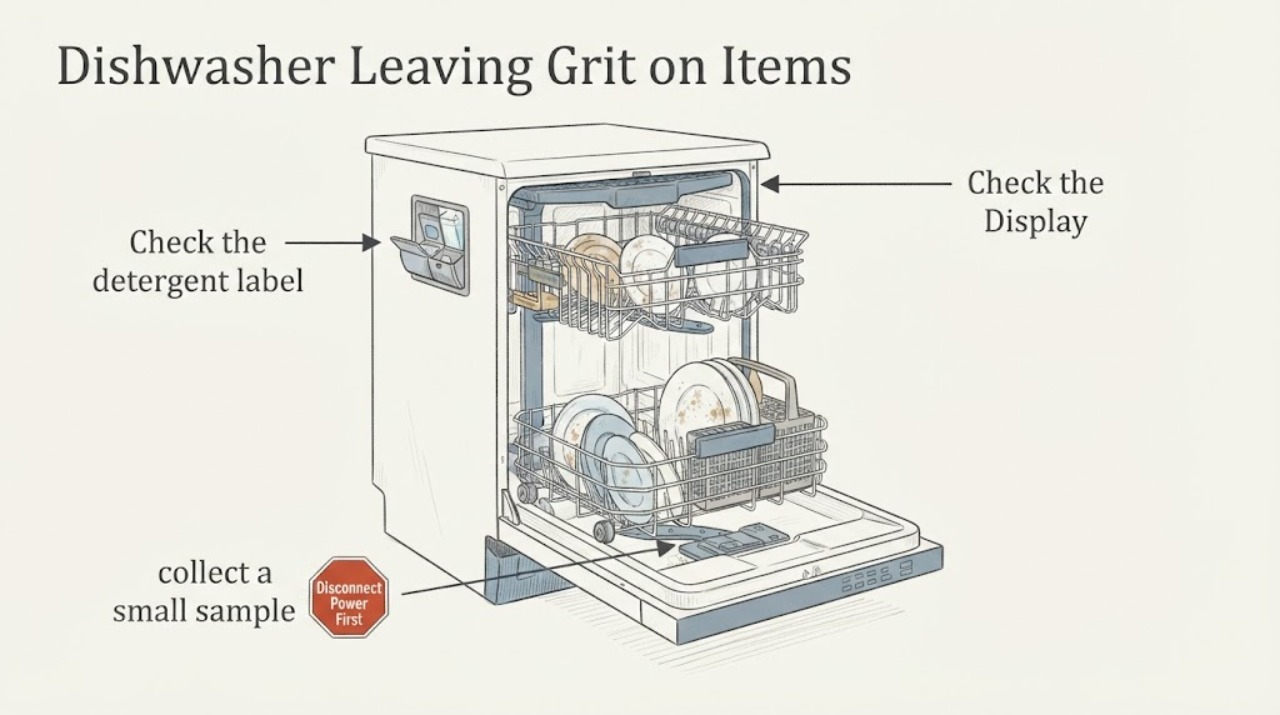
After the cycle has finished and the load is cool enough to handle, collect a small sample of the grit on a white, damp paper towel and note its color, hardness, whether it feels waxy or sandy, and whether it is concentrated on one rack or across the load. Do not rub abrasive particles across glassware or painted surfaces.
Expected result: The material is soft or tablet-like, hard and white/chalky, or brown/green/food-like; it is localized or spread across most items.
Next step: Follow the matching detergent, water-hardness, or food/filter branch below. If the material is sharp, metallic, or accompanied by damaged glass, stop using the dishwasher and arrange service.
Why this matters
Why: Soft fragments make detergent dissolution more likely, chalky material makes minerals or softener settings more likely, and food-like particles make soil or filter-path carryover more likely. Distribution also helps distinguish a loading/spray pattern from a whole-machine residue pattern, but none of these observations identifies an internal part failure.
-
Check 2
Check the detergent label and the DIC6 instructions for the permitted product and dispenser use. If the residue is soft or a tablet remains partly intact, avoid assuming an all-in-one tablet is suitable for the local water; use the exact manual's program and dosage guidance, and choose a higher-temperature program only when the DIC6 documentation allows it.
Expected result: A 4-in-1 or 5-in-1 tablet is partly intact, the tablet instructions exclude this water condition, or the detergent is fully dissolved but grit remains.
Next step: Correct only the product, dosage, and program choices supported by the DIC6 manual. Do not add extra detergent, mix products, or run repeated empty cycles to compensate for an unknown cause.
Why this matters
Why: Smeg says newer multi-function tablets can leave residue and dissolve better at a higher temperature. A fully dissolved detergent with persistent hard or food-like grit points away from tablet dissolution and toward hardness, food carryover, or the accessible wash path.
-
Check 3
Check the salt and rinse-aid indicators, identify the household water-hardness information for the installation, and compare the DIC6 softener setting with the exact manual. Refill only with special dishwasher salt and the specified rinse aid; do not put table salt, cooking salt, rock salt, sea salt, or vinegar in the rinse-aid dispenser.
Expected result: The salt or rinse-aid indicator is on, the water is hard or the softener setting is unknown, the wrong salt was used, or the settings and products match the manual.
Next step: Correct a refill or setting only according to the DIC6 manual and local hardness information, then assess a normal compatible cycle. If hard white grit continues despite the documented settings, stop guessing at the softener or sump and request service.
Why this matters
Why: Smeg says hard water may require separate powder, dishwasher salt, and rinse aid, and that salt maintains the resin softener and prevents limescale. Rinse aid is intended to reduce smears and uneven drying; it does not by itself prove that loose grit is a rinse-aid problem.
-
Check 4
With the dishwasher off, empty, and cool, scrape large food residue from dishes, arrange items so they do not touch or cover one another, and confirm that each spray arm can move freely. Inspect and clean the filter only if the DIC6 manual identifies it as user-removable; do not reach into the sump or remove a hidden cover by trial and error.
Expected result: Bones or food were present, items or a utensil blocked a spray arm, the accessible filter contains soil, or those external/loading checks are clear.
Next step: Correct the visible loading or accessible-filter condition and monitor one compatible cycle. If the filter cannot be identified from the DIC6 instructions, leave it assembled and use service rather than borrowing a procedure from another Smeg dishwasher.
Why this matters
Why: Smeg says large food leftovers can block the filter, while its guide links free spray-arm movement and unobstructed loading to wash coverage. A clean accessible filter and clear spray path do not prove that a pump, circulation motor, or internal filter housing is healthy.
-
Check 5
If grit remains after the model-permitted detergent, hardness, loading, spray-arm, and accessible-filter checks, stop collecting repeated cycles and record the DIC6 model marking, program, detergent and salt/rinse-aid products, water-hardness information, residue description, and where it appeared. Photograph the sample before cleaning the load.
Expected result: Residue persists across compatible cycles, the spray arm does not move or spray normally, the accessible filter is damaged or cannot be safely removed, or there is leakage, unusual noise, or damaged glass.
Next step: Leave the dishwasher out of service if there is leakage, damaged glass, unusual noise, or a blocked spray path, and arrange qualified Smeg service. Do not disassemble the sump, bypass a safety device, perform live electrical tests, or order a guessed part.
Why this matters
Why: Persistent residue after the documented external checks needs a model-specific diagnosis. The opened official sources do not support naming a failed pump, filter housing, heater, or circulation component from this symptom alone.
Use your observations
Decision map
Find the observation that best matches what you see, then follow the next safe action.
-
PATH 01Next step
What you see
The residue is soft, waxy, or a partly intact tablet is found in the tub after a cycle.
Do this next
Use the DIC6 manual and the tablet instructions to select a compatible product, dosage, and permitted program. If the tablet fully dissolves but grit remains, move to the hardness or food/filter branch rather than adding more detergent.
Why this path and its safety boundary
Why it matters: Detergent dissolution or tablet suitability is more likely than mineral scale or a confirmed failed component. Smeg specifically notes residue from newer multi-function tablets and better dissolution at higher temperature.
-
PATH 02Next step
What you see
The residue is hard, white, or chalky and appears on many items, especially where water dries.
Do this next
Check local hardness and the DIC6 softener setting, refill with special dishwasher salt if the manual calls for it, and use the documented rinse-aid and detergent arrangement. Escalate if the documented settings do not change the residue.
Why this path and its safety boundary
Why it matters: Mineral residue or an incorrectly supplied or set water softener is more plausible. Smeg ties salt and softener efficiency to water hardness and warns against ordinary salt.
-
PATH 03Next step
What you see
The particles look like food or soil and are concentrated near the lower rack, filter area, or items shielded from spray.
Do this next
Scrape large leftovers, correct loading, confirm free spray-arm movement, and clean only the filter the DIC6 instructions identify as user-removable. Do not remove a hidden cover or sump component by guesswork.
Why this path and its safety boundary
Why it matters: Food carryover, an accessible filter that needs cleaning, or blocked spray coverage is more likely than a detergent or limescale explanation. Smeg says large leftovers can block the filter and the guide requires free spray-arm movement.
-
PATH 04Next step
What you see
The residue persists after the DIC6-documented checks, or the dishwasher leaks, damages glass, has unusual noise, or has a spray arm or filter that cannot be safely checked.
Do this next
Stop using the appliance as appropriate and arrange qualified Smeg service with the model, residue sample or photo, program, product settings, hardness information, and checks already completed. Do not order a pump, heater, circulation motor, or filter housing solely from the symptom.
Why this path and its safety boundary
Why it matters: The opened official material does not support a specific internal diagnosis or hidden-filter procedure for this exact model. Continuing to run cycles can spread debris or expose the user to broken glass or a leak.
Helpful context
Understand the symptom
The texture is the first useful clue
Do not treat every mark as the same residue. A damp, soft fragment or partly intact tablet points to dissolution; a hard white film or chalky grains point toward minerals and the softener; brown, green, or food-like pieces point toward soil that remained in the wash path. A smear or water spot is a different symptom from loose grit. Smeg says rinse aid helps water dry evenly and avoid smears, but that does not prove a rinse-aid fault when the material is granular.
Use detergent and water-hardness guidance within the DIC6 manual
Smeg's regional FAQs describe family-level detergent, salt, and rinse-aid behavior rather than a DIC6-specific hidden-filter procedure. Where the local water is hard, Smeg recommends following the manual's softener setting and using separate powder, dishwasher salt, and rinse aid rather than assuming an all-in-one tablet is sufficient. Use the DIC6 instructions for the actual dispenser, program, and setting sequence; do not transfer a setting or access method from another Smeg model.
Food soil and loading can change what reaches the items
Smeg says pre-rinsing is unnecessary, but larger bones and food leftovers should be scraped away because they can block the filter. The opened Smeg user guide also says items should not touch or cover one another and that the spray arms must move freely. These checks can explain grit on one rack or on items shielded from spray without establishing a failed pump, filter housing, or circulation component.
When checks do not resolve it
Need a professional?
Arrange qualified Smeg service when grit persists after the exact DIC6 detergent, water-hardness, loading, spray-arm, and user-removable-filter checks; when a filter or spray path cannot be safely identified; or when there is leakage, unusual noise, damaged glass, or a suspected internal fault. Do not disassemble the sump or choose a replacement part from the symptom alone.
Common questions
FAQ
Why is my Smeg DIC6 leaving sandy or gritty particles on dishes?
The texture matters. Soft or partly dissolved tablet material points toward detergent dissolution; hard white grit points toward water hardness or softener settings; brown or food-like particles point toward soil or the accessible filter and spray path. Smeg's official family guidance supports those checks but does not identify a DIC6 internal part from the symptom alone.
Should I add more detergent or use table salt to stop the residue?
No. Use the DIC6 instructions and the detergent label for product and dose. Smeg says hard water may require separate powder, special dishwasher salt, and rinse aid, and warns that table, cooking, rock, and sea salts can clog or increase hardness. More detergent or the wrong salt can make the result worse.
Can I remove a hidden filter or open the sump on my Smeg DIC6?
Only follow a filter-removal step that the DIC6 manual explicitly identifies as user maintenance. The opened official sources support scraping large food residue, free spray-arm movement, and model-permitted accessible-filter cleaning, but they do not verify a DIC6 hidden-filter or sump-disassembly procedure. Use qualified service for anything beyond that boundary.
Read the exact guide
Official sources
- Dishwasher User Guide 2024Smeg UK · Family-level guide, not a verified DIC6-specific manual; it supports general maintenance and loading boundaries only.
- Dishwasher FAQSmeg Canada · Official Smeg family-level guidance; use the DIC6 manual for model-specific controls, settings, and removable-part procedures.
- DishwashersSmeg Australia · Official Smeg family-level guidance; regional wording and units differ, so the DIC6 manual and local water-hardness information control.
- Dishwasher FAQSmeg USA · Official Smeg family-level FAQ; no DIC6-specific hidden-filter procedure was verified.
Community feedback
Share a repair observation
Share a plain-text repair observation. Accepted observations are published automatically; this page may take a moment to update.