
On this page
Start here
Quick answer
Treat sparks together with a burning smell from a Smeg dishwasher as an electrical and fire-safety event. Stop the cycle, switch the appliance off and unplug it only if the plug and surrounding area are safe to reach; otherwise isolate the circuit from a safe location. Do not run another test cycle, open the dishwasher, or replace a part by guesswork. After the appliance is cool and isolated, record the exact model, visible cord/plug or outlet damage, any water nearby, and when the sparking occurred, then contact Smeg or a qualified appliance/electrical technician.
Before you begin
Safety first
- Do not run another cycle, repeatedly reset power, open the dishwasher, probe wiring, bypass a safety device, pull out a built-in unit around a hot/wet connection, or fit an unverified part.
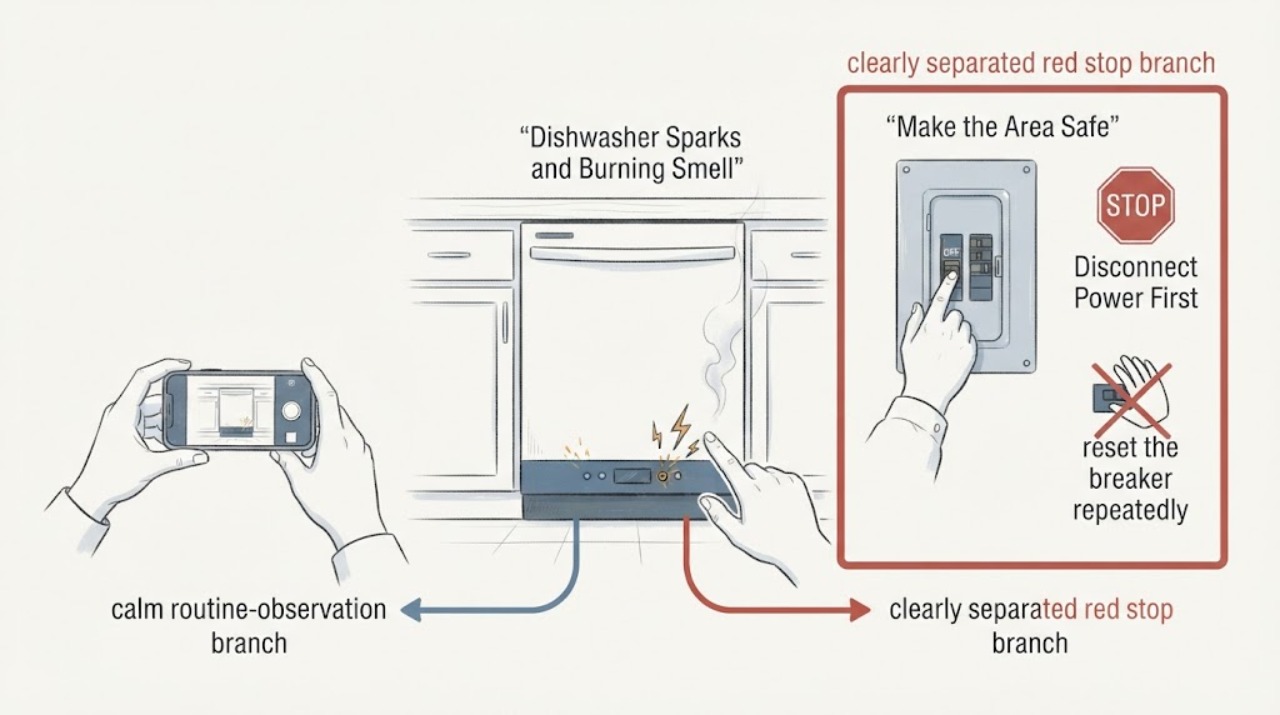
Work through in order
Diagnostic checks
Use only checks that match the exact appliance or system and its official guide.
-
Check 1
Stop the dishwasher and switch it off. Unplug it only if the plug, socket and floor are dry, cool and safe to reach; if not, isolate the circuit from a safe location without pulling the built-in appliance out.
Expected result: Sparking, smoke, flame, a hot plug, wet electrical area or burning odor is present, or the appliance is now quiet and isolated.
Next step: If smoke or flame continues, leave the area and contact emergency services. Otherwise keep the circuit/appliance off and continue only with cool external documentation.
Why this matters
Why: CPSC treats smoke/sparks near an appliance and an overheating plug with smoke or odors as a stop-use and qualified-repair condition; an active fire or inaccessible supply is not a user inspection task.
-
Check 2
Do not run another cycle, reset the breaker repeatedly, or operate the dishwasher to reproduce the spark.
Expected result: The dishwasher remains isolated, or someone is considering a second test because the first event stopped.
Next step: Leave it out of service and arrange qualified appliance/electrical assessment. Do not bypass a safety device or remove panels.
Why this matters
Why: A one-time spark can still indicate damaged electrical parts or a supply fault; the absence of a second event does not prove the appliance is safe.
-
Check 3
When the unit is cool and power is isolated, photograph or note only visible scorch marks, melted plastic, damaged insulation, a loose plug, outlet discoloration, or the location of the odor/spark.
Expected result: Damage is visible at the cord, plug or receptacle, damage is visible at the dishwasher exterior, or no external damage can be seen.
Next step: Do not touch or repair the damaged area. Give the observations and photographs to a qualified technician; if the receptacle is hot, charred or loose, have an electrician assess it before reuse.
Why this matters
Why: CPSC identifies damaged insulation, sparking/smoking at the plug and overheating odors as electrical hazards. No visible damage does not rule out an internal fault.
-
Check 4
Look from a dry, safe position for water on the floor or under the dishwasher, and close the appliance water valve only if it can be reached without entering a wet electrical area.
Expected result: Water is present near the appliance, or the area is dry.
Next step: Keep power off, avoid wet electrical surfaces, and report the water timing and location to service. Do not remove the kick plate or investigate a leak while energized.
Why this matters
Why: Water can add shock and damage risk. Smeg describes Total Aquastop as a model-dependent water-leak protection system that can shut off the supply when a leak is detected; it does not make a sparking appliance safe to run.
-
Check 5
Read the Smeg product code only after the appliance is safely isolated, retrieve the matching manual, and contact Smeg or a qualified technician with the model, serial number, fault description and breaker history.
Expected result: The exact product code and service information are available, or the label cannot be reached safely.
Next step: If the label is inaccessible, leave the unit in place and tell service that fact. Do not guess a component or purchase a generic replacement.
Why this matters
Why: Smeg’s manual lookup requires the product code, and Smeg customer service requests model/serial and a clear fault description; without that identity, parts and internal procedures cannot be scoped.
Use your observations
Decision map
Find the observation that best matches what you see, then follow the next safe action.
-
PATH 01Next step
What you see
Smoke, flame, repeated arcing or a rapidly heating plug/socket is present.
Do this next
Leave the area, keep others away, contact emergency services, and do not re-enter or handle the appliance until it is declared safe.
Why this path and its safety boundary
Why it matters: This is an active fire or electrical hazard, not a dishwasher troubleshooting state.
-
PATH 02Next step
What you see
The dishwasher is off, but the plug, cord or wall receptacle is hot, scorched, melted, loose or visibly damaged.
Do this next
Do not reuse that outlet or appliance connection; arrange qualified electrical inspection and Smeg/appliance service as appropriate.
Why this path and its safety boundary
Why it matters: CPSC treats damaged insulation and an overheating or sparking plug as a shock/fire hazard requiring qualified repair.
-
PATH 03Next step
What you see
Water is present near the dishwasher or the spark occurred together with a leak.
Do this next
Keep power isolated, avoid wet electrical surfaces, close the water valve only if safely accessible, and arrange service.
Why this path and its safety boundary
Why it matters: Water increases shock risk and may indicate a separate installation or appliance fault; the water-protection feature cannot be assumed without the model.
-
PATH 04Next step
What you see
The appliance is isolated and cool, but no external damage can be seen.
Do this next
Do not test-run it. Use the exact Smeg product code and fault history for a qualified diagnosis.
Why this path and its safety boundary
Why it matters: A clean exterior does not clear an internal electrical fault or prove that the original event was harmless.
Helpful context
Understand the symptom
Stop the dishwasher before investigating
Sparks and a burning smell are not a normal dishwasher operating sound or odor. Stop the programme and switch the dishwasher off. If the plug, socket and floor are dry and visibly safe to reach, unplug it without touching damaged or hot material. If the plug area is smoking, wet, sparking or inaccessible behind a built-in unit, do not pull the appliance out or reach into the area; isolate the circuit only from a safe location and call emergency or electrical help if smoke or fire continues.
Do not restart to see whether it happens again
Once power is isolated, leave the dishwasher out of service. A second cycle could re-energize a damaged cord, plug, receptacle or internal part. Do not open the door panels, remove the base, bridge a safety device, probe wiring, or use a replacement part without the full model and an appropriate repair procedure.
Make a cool, external record only
After the appliance and plug have cooled and power is isolated, look from the outside for scorch marks, melted plastic, a loose or damaged cord, discoloration at the plug or receptacle, and water on the floor or under the unit. Do not touch a charred connector, remove a cover, or handle a wet electrical connection. These observations can help a technician distinguish a supply-side warning from an appliance fault, but they do not identify a failed component.
Check the water situation without touching electrics
If water is present near the dishwasher, keep hands away from plugs, sockets and wet appliance surfaces. Close the dishwasher water supply only if it can be reached safely without entering the wet electrical area, and tell the technician whether the water appeared before or after the spark. Smeg describes Total Aquastop leak shutoff on its dishwasher FAQ, but the exact water-protection arrangement still depends on the model and installation.
Use the exact Smeg model for service
This topic has no model number, so a precise part or internal diagnosis cannot be made. Read the product code from the appliance label after it is safe to do so, use Smeg’s manual lookup to obtain the matching documentation, and give Smeg or a qualified technician the model, serial number, purchase details, fault description, whether the breaker tripped, and the location of the sparks or odor. Keep the appliance isolated until they advise otherwise.
When checks do not resolve it
Need a professional?
Contact emergency services for active smoke or flame. For any spark or burning smell that has stopped, keep the dishwasher isolated and contact Smeg or a qualified appliance/electrical technician before using it again.
Safety scope: Do not run another cycle, repeatedly reset power, open the dishwasher, probe wiring, bypass a safety device, pull out a built-in unit around a hot/wet connection, or fit an unverified part.
Have this ready
- Provide the exact Smeg product code, serial number, purchase details, when the spark occurred, whether the dishwasher was running, where the spark/odor came from, any visible cord/plug/outlet damage, water nearby and whether the breaker tripped.
Common questions
FAQ
Can I run the Smeg dishwasher once more to see whether the spark returns?
No. A stopped spark does not establish that the cord, receptacle or internal electrical parts are safe. Keep the appliance isolated and have it assessed before reuse.
What if I cannot reach the plug because the Smeg dishwasher is built in?
Do not pull the dishwasher out around a hot, wet or sparking connection. Isolate the circuit only from a safe location, keep away from the appliance if smoke or flame continues, and call qualified electrical or emergency help.
Can I order a replacement pump, heater or control board without a model number?
No. Smeg’s manual lookup requires the product code, and the symptom does not identify a particular component. Give the exact model and the isolated fault history to Smeg or a qualified technician instead.
Read the exact guide
Official sources
- FAQ DishwasherSmeg · Opened Smeg’s official dishwasher FAQ. It explains Total Aquastop as an electronic water-inlet protection that detects leaks and switches off the water supply; the exact feature and installation still need confirmation against the product manual.
- Appliance and Electrical Fire SafetyU.S. Fire Administration · Opened the official U.S. Fire Administration page. It provides general appliance fire-safety guidance, including direct wall connection for major appliances, avoiding extension cords and replacing cracked or damaged appliance cords. It does not diagnose the Smeg dishwasher.
- Home Electrical Safety ChecklistU.S. Consumer Product Safety Commission · Opened the official CPSC checklist. It says a shock from a large appliance requires not touching it and turning power off at the breaker until an electrician checks it; it also treats smoke, sparks and unusual noises as signs of damaged electrical parts and a shock/fire hazard.
- Smeg Customer ServiceSmeg Belgium · Opened Smeg’s official regional customer-service page. It directs owners to technical support/repair and asks for the model, serial number, purchase date and clear fault description. Contact details and warranty terms are region-specific and are not reproduced as universal advice.
- Guide to Home Wiring HazardsU.S. Consumer Product Safety Commission · Opened the official CPSC PDF. It supports stopping use and qualified repair when appliance cords or plugs spark, smoke, overheat or give off odors; it is general electrical safety guidance, not a diagnosis of a Smeg dishwasher component.
- Smeg User ManualsSmeg USA · Opened Smeg’s official manual lookup page. It instructs owners to enter the product code shown on the appliance label, choose a language and download the matching manual. No dishwasher model was supplied for this topic, so the page is used only to establish the correct identity/documentation path.
Community feedback
Share a repair observation
Share a plain-text repair observation. Accepted observations are published automatically; this page may take a moment to update.