
On this page
Start here
Quick answer
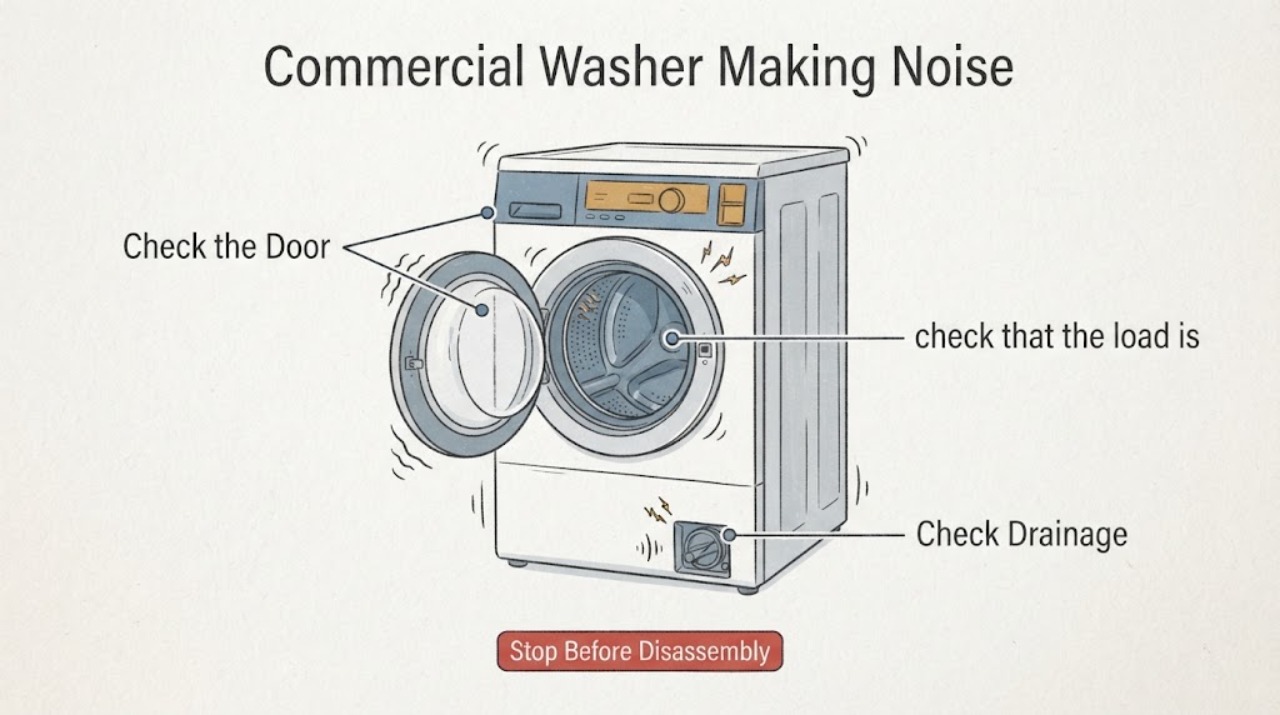
A Speed Queen commercial washer can click during door locking or balance action, but a persistent or new noise should be classified by cycle phase and load. Listen for fill, drain, balance, or spin sounds, check that the washer is level, and note whether the load is unbalanced. Speed Queen’s guide links noisy operation and vibration to levelness, load balance, and normal operating sounds; grinding or a noise with leaks needs service.
Work through in order
Diagnostic checks
Use only checks that match the exact appliance or system and its official guide.
-
Check 1
Listen from outside and note whether the sound occurs during fill, wash, drain, door locking, or spin.
Expected result: The sound is a brief click, pump/drain sound, fill sound, rhythmic balance noise, or grinding/scraping.
Next step: Do not reach into the washer. Stop the cycle using the normal control if a grinding or scraping sound appears.
Why this matters
Why: Cycle phase helps distinguish documented operating sounds from mechanical noise.
-
Check 2
After the washer stops safely, check that the load is not severely unbalanced and that the machine sits on a solid, level floor.
Expected result: The noise changes after balancing, or it remains with a balanced load and level installation.
Next step: Redistribute the load only when safe; do not move a commercial machine alone or alter internal mounts.
Why this matters
Why: Speed Queen states that imbalance and uneven leveling can cause vibration and noise. Persistent noise with those conditions normal needs service.
-
Check 3
Check the visible drain path for a foreign object, kink, or blockage if the noise occurs while draining.
Expected result: A drain obstruction is visible, or the path is clear but the pump is noisy.
Next step: Clear only an accessible external obstruction and arrange service for pump access or repeated noise.
Why this matters
Why: A foreign object or drain restriction can make pump noise; a clear path with pump noise may indicate service need.
-
Check 4
Record whether the noise is accompanied by leaking, failure to drain, error code, smoke, or a burning smell.
Expected result: Noise is isolated and cycle-dependent, or it has a functional or safety symptom.
Next step: Keep the washer out of use for grinding, leaks, electrical odor, repeated codes, or persistent empty-load noise.
Why this matters
Why: An isolated normal-phase sound differs from noise with a fault or hazard.
Use your observations
Decision map
Find the observation that best matches what you see, then follow the next safe action.
-
PATH 01Next step
What you see
Noise is brief, tied to fill/drain/door locking, and the cycle completes normally.
Do this next
Monitor the next cycle and keep the load balanced.
Why this path and its safety boundary
Why it matters: A normal operating sound is more likely.
-
PATH 02Next step
What you see
Noise persists with a balanced load and level machine or occurs with grinding.
Do this next
Stop operation and arrange qualified commercial-laundry service.
Why this path and its safety boundary
Why it matters: A pump, bearing, mount, or drive issue is possible.
-
PATH 03Next step
What you see
Noise is accompanied by leaking, standing water, burning odor, smoke, or a code.
Do this next
Stop using the washer and obtain qualified service.
Why this path and its safety boundary
Why it matters: The symptom is not explained by normal operation alone.
Helpful context
Understand the symptom
A Speed Queen commercial washer can click during door locking or balance action, but a persistent or new noise should be classified by cycle phase and load. Listen for fill, drain, balance, or spin sounds, check that the washer is level, and note whether the load is unbalanced. Speed Queen’s guide links noisy operation and vibration to levelness, load balance, and normal operating sounds; grinding or a noise with leaks needs service.
When checks do not resolve it
Need a professional?
Provide the exact model and the observed pattern to the manufacturer or a qualified technician.
Common questions
FAQ
What should I check first?
A Speed Queen commercial washer can click during door locking or balance action, but a persistent or new noise should be classified by cycle phase and load. Listen for fill, drain, balance, or spin sounds, check that the washer is level, and note whether the load is unbalanced. Speed Queen’s guide links noisy operation and vibration to levelness, load balance, and normal operating sounds; grinding or a noise with leaks needs service.
Read the exact guide
Official sources
- User's GuideSpeed Queen · Speed Queen commercial washer troubleshooting for not starting, not draining, cycle stopping, noise, and error displayed
Community feedback
Share a repair observation
Share a plain-text repair observation. Accepted observations are published automatically; this page may take a moment to update.