
On this page
Start here
Quick answer
First identify what is stuck on the Thermador gas cooktop: the removable burner cap, the heavy grate, the control knob, or the burner base. Turn the cooktop off, remove cookware, and wait until everything is completely cool. Thermador says cooled burner caps can be washed with hot soapy water and a soft cloth, while burner bases are cleaned in place; it also says knobs pull straight forward. Try only a gentle, straight lift of a cooled cap or the model-approved grate removal. If a cap will not lift without prying, the burner base or gas fitting moves, the grate is bonded by damage, or there is gas odor, stop and arrange qualified Thermador service rather than using pliers, penetrating oil, heat, or a tool under the burner.
Before you begin
Safety first
- Owner work is limited to turning the cooktop off, waiting for complete cooling, identifying the part, carefully removing a grate or cap only in its normal direction, pulling a knob straight forward, and cleaning accessible surfaces as Thermador directs. Do not loosen burner bases, gas fittings, regulators, igniter wiring, or panels; do not pry, heat, oil, or test live circuits.
Work through in order
Diagnostic checks
Use only checks that match the exact appliance or system and its official guide.
-
Check 1
Turn every burner knob fully to OFF, turn off the cooktop, remove cookware and loose utensils, and wait until the grates and burner area are completely cool. Before touching anything, identify whether the stuck item is a knob, grate, cap, or the burner base. Stop without handling the appliance if you smell gas, hear hissing, see smoke or arcing, or find water near controls.
Expected result: The item is a removable-looking cap or grate, a control knob, a fixed burner base, or there is a gas, fire, electrical, or water warning.
Next step: Use the matching check below only for a cool, hazard-free cooktop. For gas odor, leave ignition sources and switches alone, shut off the main gas supply only if safely reachable, leave if needed, and obtain qualified gas-appliance help. For smoke, arcing, or water near controls, keep the cooktop off and arrange qualified service.
Stop if: Do not light a burner to loosen a part, operate a control near a gas odor, touch wet electrical parts, or continue removal after a safety symptom.
Why this matters
Why: The part identity determines the safe boundary. Thermador's cleaning steps differ for caps, grates, knobs, and bases; a hazard takes priority over removal. A fixed base or fitting is part of the gas appliance rather than a loose cleaning piece.
-
Check 2
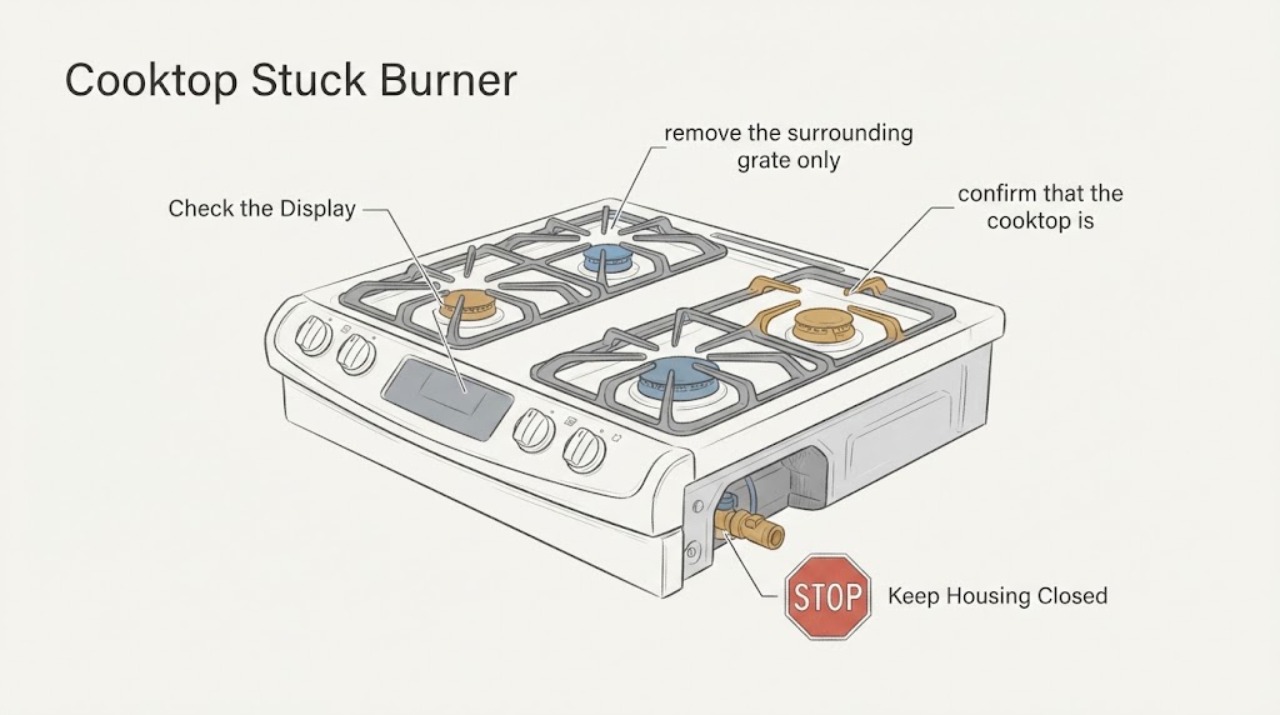
If the stuck item is a cooled burner cap, remove the surrounding grate only if it lifts in the normal direction for your model, then try to lift the cap straight up with dry hands and no tool. Do not twist against the burner, pry at the edge, or pull on the igniter. If the cap does not release with gentle pressure, stop.
Expected result: The cap lifts normally, the cap is held by baked-on residue but moves slightly, or the cap will not move without force or the burner assembly moves with it.
Next step: Wash a released cap with hot soapy water and a soft cloth, do not soak it, rinse and dry it thoroughly, then replace it in the model's locating position. For a cap that remains stuck or moves the base, leave it in place and arrange qualified service.
Stop if: Do not use metal tools, pliers, chemicals, flame, hot water on a hot part, or force that could bend the burner or igniter.
Why this matters
Why: A cap that lifts is the removable cleaning part described by Thermador. Slight movement from residue is not permission to lever it loose; movement of the burner base or gas assembly indicates that the wrong part is being disturbed.
-
Check 3
If the item is a heavy grate, confirm that the cooktop is off and fully cool, remove all cookware, and lift the grate carefully as a separate piece. Do not drag it across the surface or use a tool to wedge it up. If it is fused by a spill, cracked, or cannot be lifted without bending the cooktop, stop.
Expected result: The grate lifts cleanly, a spill or residue is holding it, the grate is damaged, or lifting it also moves the burner base or cooktop surface.
Next step: Clean a safely removed grate with mild cleaner and a soft cloth, rinse and dry it, then reinstall it only in its original position. For damage, persistent bonding, or movement below the grate, leave the cooktop off and arrange service.
Stop if: Do not clean a grate in a self-cleaning oven, use abrasive force, lift a hot grate, or pry against the burner or cooktop surface.
Why this matters
Why: Thermador permits careful grate removal after cooling, but a grate that is bonded by damage or causes the burner assembly to move is outside routine cleaning. Dragging or levering can damage the enamel and gas-burner alignment.
-
Check 4
If the part that feels stuck is a control knob, make sure the knob is at OFF and pull it straight forward, without twisting sideways or using a tool. If it will not pull forward normally, or the shaft or panel moves with it, stop and leave the control in place.
Expected result: The knob pulls straight off, the knob is greasy or dirty, the knob is stuck, or the control shaft or panel moves.
Next step: Wash a released knob with hot soapy water and a soft cloth, rinse and dry it, and reinstall it only after the shaft and knob are dry. Arrange service for a knob or shaft that remains stuck, turns abnormally, or will not reliably return to OFF.
Stop if: Do not spray cleaner into the control panel, pull wiring, turn a burner on to free the knob, or keep operating a control that does not return to OFF.
Why this matters
Why: Thermador's care guidance says knobs pull straight forward, so side-loading or prying is unnecessary. A stuck shaft can be a control or mounting issue, not a burner-cap problem.
-
Check 5
If the suspected stuck item is the burner base, do not try to remove or loosen it. With the cooktop completely cool, clean only the accessible base and port openings in place using hot water, mild detergent, a soft cloth, and a stiff nylon toothbrush as Thermador directs; do not scratch or gouge the ports.
Expected result: The base has accessible residue, the ports are clogged, the base or fitting rocks, or cleaning cannot be done without opening the appliance.
Next step: Clear only accessible residue, rinse and dry the area thoroughly, and restore the cap and grate. If the base moves, remains blocked, leaks, ignites abnormally, or needs tools or panel removal, leave the cooktop off and arrange qualified service.
Stop if: Do not loosen a burner base, remove a gas line or regulator, probe a jet deeply, test live wiring, or use flammable cleaner.
Why this matters
Why: Thermador's instructions distinguish a burner base from a cap: the base is cleaned in place. Movement, a loose fitting, damaged port, or an access point requiring disassembly can affect gas flow or ignition and is not a safe owner-removal problem.
-
Check 6
After a cap or grate has been cleaned and is fully dry, put each part back in its original position and verify that the cap's tabs fit the burner-base notches. From a normal standing position, make one controlled ignition check only if there is no gas odor or other hazard; then observe whether the flame is prompt, stable, and even.
Expected result: The cap seats correctly and the burner lights with a stable flame, the cap will not seat, ignition is delayed, the flame is uneven or too high, or clicking continues after OFF.
Next step: Turn the knob OFF. Correct only an obvious cap seating issue after cooling. If ignition is delayed, gas odor persists, the flame is unstable or unusually high, clicking continues, or the same part sticks again, stop using the cooktop and arrange qualified service.
Stop if: Do not repeat ignition after a whoosh or lingering gas odor, adjust the regulator, bypass ignition, or use the cooktop with a loose cap, abnormal flame, or unreliable OFF control.
Why this matters
Why: Thermador identifies cap alignment, dry ports, dry igniters, and drafts as relevant to ignition and flame behavior. A part that cannot seat or a flame that remains abnormal indicates that cleaning did not resolve the condition and may involve the gas or ignition system.
Use your observations
Decision map
Find the observation that best matches what you see, then follow the next safe action.
-
PATH 01Next step
What you see
The stuck item is a cool burner cap and it lifts straight up with gentle dry-hand pressure, while the burner base stays still.
Do this next
Clean the cap without soaking it, dry it fully, and reseat its tabs in the base notches. Stop and call service if it will not reseat or the burner behaves abnormally afterward.
Why this path and its safety boundary
Why it matters: This matches the removable cap boundary rather than a seized gas assembly.
-
PATH 02Next step
What you see
The cap will not lift, the base or gas fitting moves, or removal requires a screwdriver, pliers, a knife, heat, or force.
Do this next
Leave the cooktop off and arrange qualified Thermador service. Do not attempt to free the part or continue operating that burner.
Why this path and its safety boundary
Why it matters: The task has crossed from cleaning a removable cap into disturbing a gas appliance or a damaged assembly.
-
PATH 03Next step
What you see
The grate lifts after the cooktop is cool, or the knob pulls straight forward with the control at OFF.
Do this next
Clean and dry the released part, reinstall it correctly, and stop for a loose shaft, damaged grate, or control that will not reliably return to OFF.
Why this path and its safety boundary
Why it matters: The part is following Thermador's ordinary cleaning/removal direction; sideways prying or twisting is unnecessary.
-
PATH 04Next step
What you see
The suspected part is the burner base, the ports remain blocked after accessible cleaning, or the base moves with the cap or grate.
Do this next
Keep the cooktop off and arrange qualified gas-appliance service for the burner, igniter, gas connection, or mounting condition. Do not select or replace a gas part from the symptom alone.
Why this path and its safety boundary
Why it matters: The base is an in-place gas-burner assembly and the fault is beyond safe owner removal.
-
PATH 05Next step
What you see
There is a strong or lingering gas odor, hissing, delayed ignition with a whoosh, smoke, arcing, a burning smell, water near controls, or repeated electrical tripping.
Do this next
Do not operate switches or create a flame. If gas odor persists, shut off the main gas supply only if safely reachable, leave if needed, and obtain emergency or qualified gas help. For smoke, arcing, water, or electrical symptoms, keep the cooktop off and arrange qualified service.
Why this path and its safety boundary
Why it matters: This is an immediate gas, fire, electrical, or water-safety event, not a stuck-part cleaning task.
Helpful context
Understand the symptom
On a Thermador gas cooktop, “stuck burner” can mean several different parts. A burner cap is the small top piece over the burner base; a grate is the heavy support under the pan; a knob is the control; and the burner base is the gas-and-ports assembly attached to the cooktop. Only the parts that Thermador's care instructions treat as removable should be handled by an owner. A base that seems stuck is not a cap that needs more force.
Do not use a screwdriver, knife, pliers, penetrating oil, heat, or a twisting force to free a burner. These can damage the burner, enamel, igniter, gas connection, or seal. If the part will not release with gentle hand pressure after the cooktop is fully cool, leave it in place and arrange service.
Only after diagnosis
Potential parts
- Thermador burner cap
A replacement cap is relevant only when the exact cap is cracked, warped, missing, or confirmed by a qualified technician after the removal and seating issue is identified.
Thermador's parts page requires the appliance model number for compatibility. A stuck-burner symptom does not establish the correct cap size or fit and does not justify replacing a burner base or gas component.
When checks do not resolve it
Need a professional?
Contact a qualified Thermador servicer for a stuck cap that needs force, a moving burner base or gas connection, a damaged grate or control shaft, persistent blocked ports, abnormal flame or clicking, or any removal requiring tools. Use emergency or qualified gas help for an unresolved gas odor and qualified electrical help for smoke, arcing, water near controls, or repeated trips.
Safety scope: Owner work is limited to turning the cooktop off, waiting for complete cooling, identifying the part, carefully removing a grate or cap only in its normal direction, pulling a knob straight forward, and cleaning accessible surfaces as Thermador directs. Do not loosen burner bases, gas fittings, regulators, igniter wiring, or panels; do not pry, heat, oil, or test live circuits.
Have this ready
- Provide the complete Thermador model and serial information, a photo of the stuck part and burner area if safe, the part identity (cap, grate, knob, or base), whether it moves at all, recent spill or cleaning context, and any ignition, flame, odor, clicking, or electrical observations.
Common questions
FAQ
How do I remove a stuck Thermador burner cap?
Turn the cooktop off, remove cookware, and wait until it is completely cool. Try only a gentle straight lift with dry hands. If it will not lift without a tool or force, or the burner base moves with it, leave it in place and arrange qualified service; do not pry or twist a gas assembly.
Can I remove the Thermador burner base to clean underneath it?
Not as a routine owner cleaning step. Thermador says to clean burner bases in place with mild detergent, a soft cloth, and a stiff nylon toothbrush for the ports. Do not loosen the base, gas line, regulator, or igniter wiring; arrange qualified service if access requires disassembly.
How do I remove a stuck Thermador cooktop knob?
With the knob at OFF and the cooktop cool, Thermador's care guidance says to pull the knob straight forward. Do not twist sideways, pry, spray cleaner into the panel, or operate a knob that will not reliably return to OFF; have a qualified servicer assess a stuck shaft.
Can I use oil or heat to free a stuck gas burner?
No. Do not use penetrating oil, flammable cleaner, heat, a knife, pliers, or a screwdriver around the burner. These can damage gas, ignition, or surface components. If gentle hand removal does not work after cooling, stop and arrange qualified service.
What if I smell gas after trying to remove the burner?
Do not ignite the cooktop or operate electrical switches. If the odor persists, Thermador says to turn off the main gas supply and schedule service; leave the area and use emergency or gas help from outside when appropriate. Do not continue removing parts.
Read the exact guide
Official sources
- 10005091 Burner cap | THERMADOR USThermador · Official Thermador parts page showing that burner-cap compatibility is checked by appliance model number (E-Nr.).
- Gas Cooktops & Rangetops - TroubleshootingThermador · Official Thermador troubleshooting and safety guidance for burner positioning, igniters, burner ports, flame behavior, gas odor, clicking, and qualified service.
- Gas Cooktops & Rangetops - Cleaning & CareThermador · Official Thermador care guidance for cooled grates, burner caps, burner bases, gas igniters, and control knobs.
- Owner Support ResourcesThermador · Official Thermador support hub for finding model manuals, model-based parts, and authorized service.
Community feedback
Share a repair observation
Share a plain-text repair observation. Accepted observations are published automatically; this page may take a moment to update.