
On this page
Start here
Quick answer
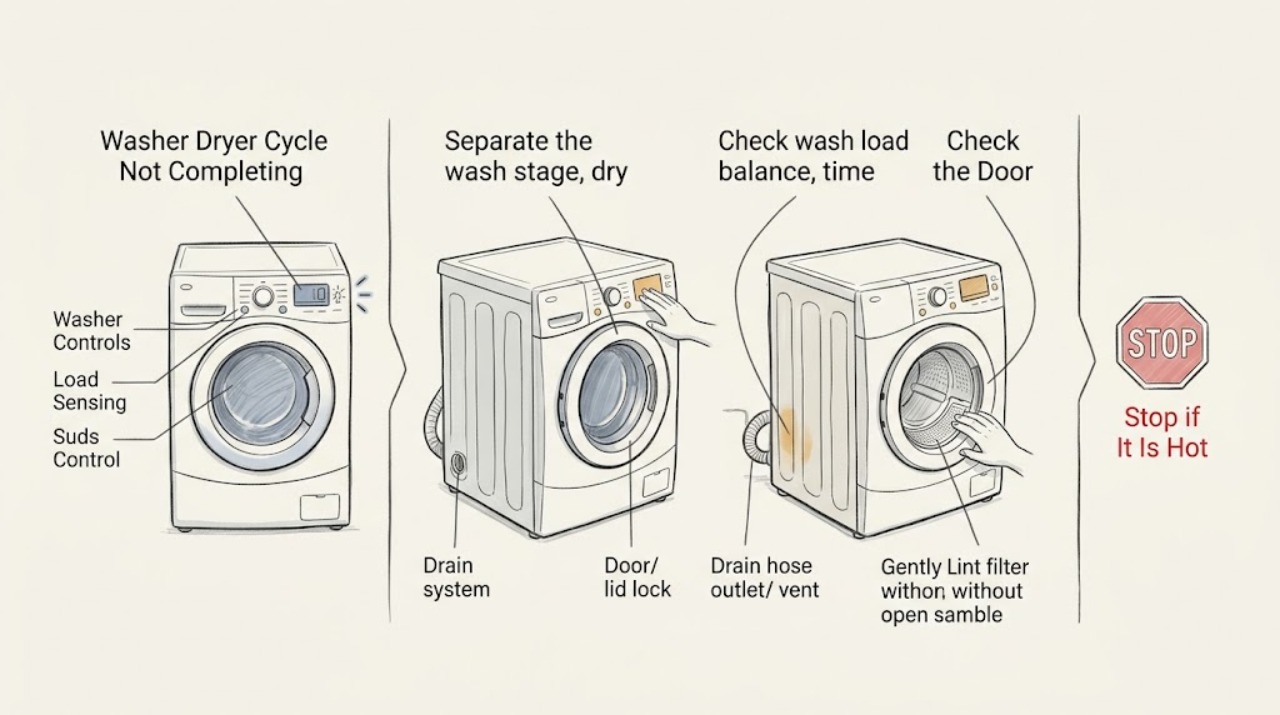
When a Whirlpool washer-dryer does not complete a cycle, first identify whether it is the wash portion, the dry portion, or the transition between them. A washer may spend extra time balancing a bulky load, reducing excess suds, heating water, or draining; its lid or door may also stay locked while water is present or while Dry Mode starts. A dryer may stop early on a sensor cycle when the load reaches its dryness target, or run for a long time because of an overloaded load, clogged lint filter, restricted vent, wrong cycle, or weak heat. Check the displayed code and exact model guide, redistribute a load, use only the specified HE detergent, confirm the washer door or lid latches, and inspect the dryer's lint filter and visible vent path only when the appliance is off and cool. Stop immediately for leaking water, overheat, a burning or gas odor, smoke, sparks, fire, a damaged cord, or a breaker that trips. Do not bypass a lock, reach into a moving drum, open gas or live electrical components, or keep restarting a hazardous appliance.
Work through in order
Diagnostic checks
Use only checks that match the exact appliance or system and its official guide.
-
Separate the wash stage, dry stage, and immediate hazards
From a safe position, note whether the machine is filling, washing, draining, spinning, waiting at the wash-to-dry transition, tumbling with heat, or displaying a completion state. Check for water outside the unit, a hot cabinet, burning or gas odor, smoke, sparks, fire, a damaged cord, or a breaker that has tripped. Do not open a moving drum or reach through a locked door or lid.
Expected result: The washer still contains water or will not spin; the door or lid remains locked at the transition; the dryer tumbles but clothes are warm and damp; the dryer stops early; or a leak, overheat, odor, smoke, spark, fire, damaged cord, or repeated trip is present.
Next step: For a leak, fire, smoke, sparks, burning or gas odor, severe heat, damaged cord, or repeated breaker trip, stop using the unit and obtain qualified or emergency help from a safe location. If no hazard exists, record the exact stage and continue with the matching wash or dry check.
Stop if: Stop immediately for leaking water near electricity, smoke, fire, sparks, a burning or gas odor, severe overheating, exposed wiring, a damaged cord, or a breaker that trips again.
Why this matters
Why: Water, the lock state, and a stalled wash stage identify a washer branch. Warm damp clothes or a long dry stage identify dryer airflow, load, sensor, or heat checks. Early dry completion may be normal on a sensor cycle. Any listed hazard overrides diagnosis.
-
Check wash load balance, time estimate, and suds
If the washer portion is stalled and there is no hazard, read the display for an error or Sud/Sd indication. Observe whether a single bulky item is bunched, the machine is shaking or repeatedly correcting balance, or excess foam is visible. Use only the specified HE detergent and the model's recommended amount on future loads; do not add more detergent to force a rinse.
Expected result: The load is unbalanced or overloaded; the time remaining is holding while the machine redistributes; Sud/Sd or visible excess foam is present; or the load and detergent appear normal.
Next step: When the drum is stopped and the model permits opening, redistribute or reduce the load and let the machine complete its suds-removal response. Do not interrupt repeatedly. If the cycle still cannot advance after the load and detergent check, record the code and arrange service.
Stop if: Stop if the tub is leaking, the machine shakes violently, a hot or burning odor appears, the breaker trips, or a moving drum or lock would need to be forced.
Why this matters
Why: Whirlpool says estimated time can extend for imbalance, load conditions, water heating, or excess suds. A suds lock can add water and rinses, while an unbalanced load can delay or reduce the final spin. Normal load and detergent results move the check toward door, water, drain, or component faults.
-
Verify water removal and the washer door or lid lock
With the drum stopped and no water hazard, verify that the door or lid is fully closed and that clothing, lint, detergent buildup, or a package is not blocking the latch or striker. Observe whether water remains in the tub and whether the drain hose is visibly kinked or obstructed. Clean only the accessible lock area with a soft damp cloth; do not bypass the lock, remove a pump cover, or pull a hose apart while full of water.
Expected result: The lock area was obstructed and the door or lid now latches; water remains and the washer cannot drain; the hose is visibly kinked; the display identifies a lock or drain fault; or the door or lid and visible drain path are normal.
Next step: Correct only an accessible obstruction or hose kink and select the model-approved drain or spin response once. If water remains, the lock will not operate, or the code returns, stop and arrange service. Never force the door or lid.
Stop if: Stop for a full tub that will not drain, a damaged latch, water leaking from the door or lid, a lock that must be bypassed, or any need to access energized or moving parts.
Why this matters
Why: Whirlpool requires a closed and latched door or lid for the washer to advance, and a lock may stay engaged when water remains to prevent flooding. A restricted drain can also prolong the cycle and keep the lock closed. If these external conditions are normal, an internal lock, pump, valve, or control fault is more likely.
-
Check dryer cycle selection, load size, and moisture sensing
If the wash portion has completed and the dryer stage is the concern, check whether the dryer stopped early or is running for a long time. Confirm the selected cycle matches the fabric and load, that the door is fully latched, that the lint screen is clean, and that items can tumble freely rather than forming one dense bundle. For a sensor cycle, compare the result with a similar load rather than restarting repeatedly.
Expected result: The cycle is Air Dry or low heat; the load is very small, very large, mixed, or bunched; the lint screen is coated; the dryer ends while items are still damp; or the cycle and load are appropriate.
Next step: Select the model-approved cycle, separate or reduce the load, clean and dry the lint screen, and make one supervised retest. If a sensor cycle repeatedly stops with damp clothing or the dryer does not heat, stop and arrange service rather than adding repeated cycles.
Stop if: Stop for a hot cabinet, burning or gas odor, smoke, sparks, fire, a damaged drum seal or cord, or any load that scorches.
Why this matters
Why: Whirlpool says Air Dry does not add heat, sensor cycles can stop when the target dryness is sensed, and overloaded or mixed loads can lengthen drying. A coated lint screen can reduce performance. If the selection and load are appropriate, inspect visible airflow next.
-
Inspect visible dryer airflow and apply one safe reset
With the dryer off, cool, and disconnected from power as the model instructions require, inspect only the visible lint screen, rear vent hose, and outside vent hood. Look for a crushed or kinked hose, lint at the wall connection, a hood flap that does not open during a normal supervised run, or weak airflow. For the washer-dryer control, use the model manual's documented cancel or power-reset procedure once; do not keep resetting an error or a tripped breaker.
Expected result: The vent path is visibly restricted; outside airflow is weak; the washer-dryer still shows a code; one documented reset restores a normal cycle; or airflow and controls are normal but the cycle still does not complete.
Next step: Clean only accessible lint and correct a visible kink without opening the appliance. If airflow remains weak, the code returns, the washer cannot drain or lock, or the cycle fails again, keep the unit out of service and arrange qualified Whirlpool service.
Stop if: Do not open the dryer cabinet, test live wiring, access a gas valve, remove a pump or lock assembly, or continue after smoke, odor, sparks, fire, overheat, leak, or repeated breaker trips.
Why this matters
Why: Whirlpool identifies restricted venting as a cause of long dry times and recommends service when long times, no heat, codes, or unusual noises persist. A reset can clear a temporary control state but does not repair a pump, lock, sensor, heater, motor, valve, or control fault.
Use your observations
Decision map
Find the observation that best matches what you see, then follow the next safe action.
-
PATH 01Next step
What you see
The washer is still balancing, removing suds, heating water, or showing an estimate that is not advancing, with no safety hazard.
Do this next
Allow the model-approved response to finish. Redistribute a stopped bulky load or reduce excess detergent on the next load; if the time remains stalled or a code returns, arrange service.
-
PATH 02Safety boundary
What you see
The washer door or lid will not unlock, and water remains in the tub or the unit is transitioning to Dry Mode.
Do this next
Do not force or bypass the lock. Use the model-approved drain or cancel procedure once; if water remains, the lock fault persists, or a code returns, arrange qualified service.
Why this path and its safety boundary
Safety stop: True
-
PATH 03Next step
What you see
The dryer stops early on a sensor cycle, or a load is dry in some areas but damp in others.
Do this next
Check the selected cycle, separate a small or mixed load, clean the lint screen, and make one supervised retest. Repeated early stops with damp clothes require service.
-
PATH 04Safety boundary
What you see
The dryer runs a long time, clothes are warm but damp, or airflow at the outside hood is weak.
Do this next
Stop the dryer, inspect only the visible lint screen and vent path while it is off and cool, and correct a visible restriction. If airflow remains weak or the vent requires disassembly, arrange qualified service.
Why this path and its safety boundary
Safety stop: True
-
PATH 05Safety boundary
What you see
A leak, overheat, burning or gas odor, smoke, sparks, fire, damaged cord, or repeated breaker trip occurs at any stage.
Do this next
Stop the appliance immediately if safe, leave a gas-odor area without operating switches, and obtain emergency or qualified help from a safe location. Do not restart to reproduce the symptom.
Why this path and its safety boundary
Safety stop: True
Helpful context
Understand the symptom
Start by locating the stalled stage
A combined washer-dryer can appear stuck when the washer is balancing, removing suds, draining, or waiting for a lock condition, even though the display time barely changes. It can also be in Dry Mode after the Wash portion, or a dryer sensor cycle may end before clothes feel uniformly dry. Record the stage, display message, water level, drum motion, and whether the load is wet or warm before selecting another cycle.
Wash delays and dry delays have different checks
For the wash side, load balance, excess suds, drain flow, water supply, and door or lid locking change whether the cycle can advance. For the dry side, cycle selection, load size, moisture sensing, lint, vent airflow, and heat determine whether the unit stops or keeps running. Do not apply a dryer vent fix to a washer that still contains water, or open a washer lock just because the dry portion has not started.
Safety overrides cycle completion
Water on the floor, a hot or smoking dryer, a burning or gas odor, sparks, fire, or a breaker that trips again can indicate a flood, fire, fuel, or electrical hazard. Turn the appliance off if this can be done without touching danger, leave a gas-odor area without operating switches, and arrange qualified help. A door or lid lock is a safety device and must never be defeated by force or a bypass.
Only after diagnosis
Potential parts
- washer drain pump or drain hose assembly
Consider this category only after a repeat no-drain or long-drain result remains with the visible hose path clear and qualified diagnosis confirms restricted or failed drainage.
Verify the complete Whirlpool model and approved fit information; do not remove a pump cover or open a water-filled system during owner checks. - washer door or lid lock
Consider this category only when the latch area is clear, the door or lid closes correctly, and qualified diagnosis confirms that the lock or its sensing circuit prevents cycle advance.
Confirm exact model information; never bypass, force, or substitute a lock based on appearance. - dryer moisture sensor or control
Consider this category only when a sensor cycle repeatedly ends with damp clothing or a control fault remains after the load, cycle, lint, and airflow checks.
Verify model-specific service information; a short cycle alone does not prove a failed sensor or control. - dryer blower, heater, or gas valve
Consider this category only after qualified testing distinguishes an internal airflow, electric-heating, or gas-heating fault from a blocked external vent and load problem.
Gas and electrical dryer components require qualified diagnosis and model verification; do not open the cabinet or gas path.
When checks do not resolve it
Need a professional?
Call qualified Whirlpool laundry service for a recurring incomplete wash or dry cycle, drain or lock fault, persistent Sud/Sd or other code, no heat, weak vent airflow, unusual noise, or any component that requires cabinet access. For leak, smoke, fire, sparks, gas odor, or repeated electrical trips, stop first and obtain help from a safe location.
Common questions
FAQ
Why does my Whirlpool washer-dryer pause and not complete the wash cycle?
The washer may be balancing a bulky load, removing excess suds, heating water, draining, or waiting for a door or lid lock. Check the display, load distribution, HE detergent amount, visible drain path, and latch area once, then arrange service for a recurring stall or code.
Why is the Whirlpool washer door still locked when the Wash portion ends?
Whirlpool identifies remaining water, a Tumble Fresh option, and Dry Mode as possible explanations. Do not force the door. Use the model-approved drain or cancel procedure once; a lock that remains closed with no normal explanation needs service.
Can too much detergent keep a Whirlpool washer-dryer from finishing?
Yes. Whirlpool says excess suds can make the washer add water and rinses, extending the cycle and sometimes reducing the final spin. Use only HE detergent and the model's specified amount; let a suds-removal response finish instead of restarting repeatedly.
Why does the Whirlpool dryer stop before my clothes feel dry?
A sensor cycle may stop when it reads the target dryness, while a small, mixed, bunched, or poorly contacting load can confuse the result. Check the cycle, load arrangement, and lint screen. Repeated early stops with damp clothing, no heat, or weak airflow require service.
Why does the dry portion take too long on a Whirlpool washer-dryer?
Whirlpool lists load size, cycle choice, lint, and restricted vent airflow among the checks. With the dryer off and cool, clean the lint screen and inspect the visible hose and outside hood for a kink or weak flow. Do not open the cabinet; persistent weak airflow or long cycles need service.
When should I stop troubleshooting an incomplete Whirlpool washer-dryer cycle?
Stop for a leak, water near electricity, overheat, burning or gas odor, smoke, sparks, fire, a damaged cord, violent shaking, a locked door that would need bypassing, or a breaker that trips again. Keep the appliance off and obtain qualified or emergency help from a safe location.
Read the exact guide
Official sources
- Door is Locked at the End of the Wash Cycle - All-In-One Washer DryerWhirlpool Product Help · Whirlpool guidance that remaining water, Tumble Fresh, or Dry Mode can explain a locked door after the Wash portion.
- Odor or Smell from a DryerWhirlpool Product Help · Whirlpool guidance about dryer odors and stopping normal operation to address fumes or odor sources.
- Lid Locking on a Top Load High Efficiency WasherWhirlpool Product Help · Whirlpool explanation of lid-lock requirements, obstructions, damp-cloth cleaning, and a documented control power cycle.
- Dryer is not Drying or Experiencing Long Dry TimesWhirlpool Product Help · Whirlpool checks for power or gas supply, load, cycle, lint filter, vent airflow, weak outside flow, and service escalation.
- Owner's ManualWhirlpool · Whirlpool owner manual guidance on washer sensing, lid lock, load distribution, detergent, draining, and dryer cycle and vent checks.
- Cycle Time is Not Advancing - Compact Front Load WasherWhirlpool Product Help · Whirlpool guidance on estimated time, load balance, heated cycles, and excess suds that can extend a wash cycle.
- Stops Mid Cycle- WasherWhirlpool Product Help · Whirlpool guidance on unbalanced loads, shaking, wet clothes, and a washer that stops during spin.
- Error Codes in Front Load Washers - Product HelpWhirlpool Product Help · Whirlpool error guidance for excess suds, drain time, lock conditions, reset behavior, and keeping the appliance out of service when faults persist.
Community feedback
Share a repair observation
Share a plain-text repair observation. Accepted observations are published automatically; this page may take a moment to update.