
On this page
Start here
Quick answer
A Samsung washer-dryer that does not complete a cycle may be pausing while it fills, drains, balances the load, dissipates suds, waits for a door-lock state, or responds to a power or control error. Note the exact stage and any code, keep the door closed if water remains, then check the external power, door, water, drain, load, and detergent conditions described for your model. On a Samsung Laundry Combo that stops at drying load sensing, check whether the exact model is covered by Samsung's software-update guidance. Do not force the door, bypass a lock, open electrical panels, or continue using the appliance after smoke, burning odor, a hot or damaged cord, flooding, or repeated breaker trips; arrange qualified service.
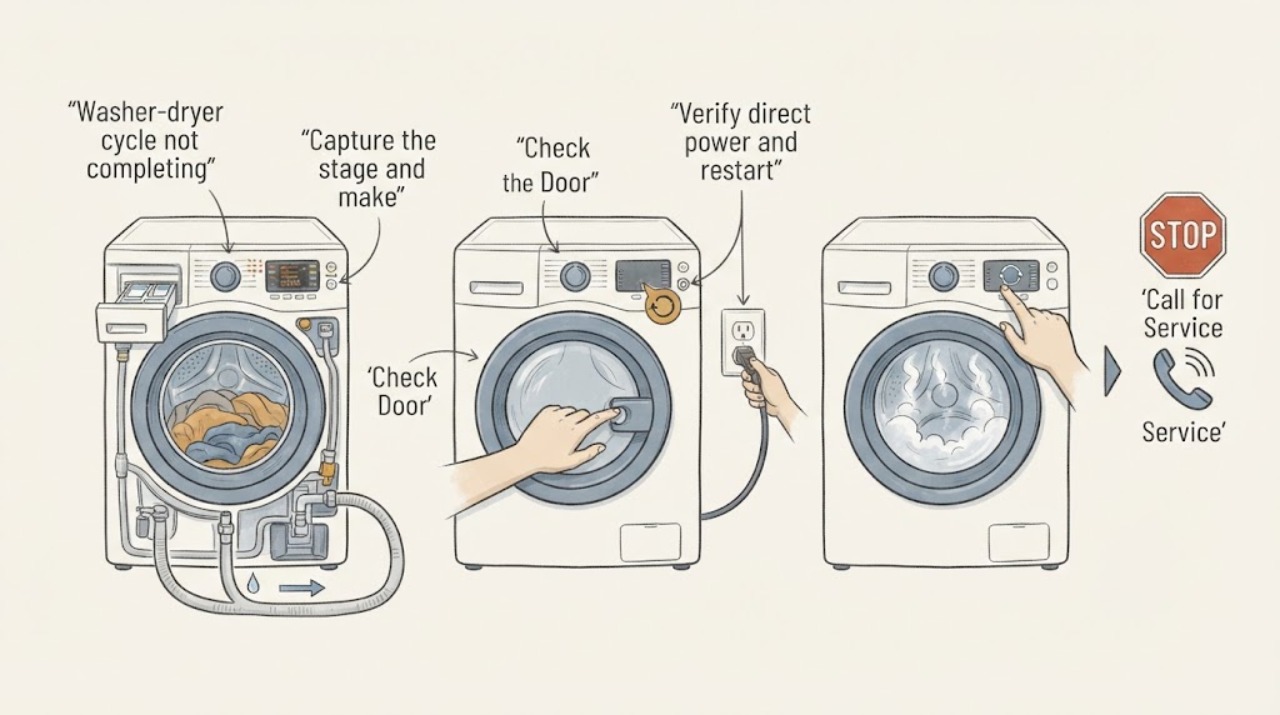
Work through in order
Diagnostic checks
Use only checks that match the exact appliance or system and its official guide.
-
Capture the stage and make the appliance safe
Stay with the appliance without opening panels. Note whether the display and controls are live, whether the drum is tumbling or stopped, whether water is visible through the door, whether the stop occurs during wash, spin, or drying, and the exact code or message. Keep the door closed if water remains.
Expected result: The appliance is either in a normal-looking pause with no hazard, stopped with water inside, stopped with a code or lock indication, or accompanied by leaking, smoke, burning odor, a hot cord, or a tripped breaker.
Next step: For a hazard, stop using the appliance and arrange qualified or emergency help as appropriate. Otherwise continue to the external power and control check, preserving the displayed code.
Why this matters
Why: A pause during balancing or suds management can extend the cycle, while water, a lock indication, or a code changes the next check. Smoke, burning, flooding, electrical damage, or repeated trips is a stop condition rather than a troubleshooting branch.
-
Verify direct power and restart the selected cycle once
If there is no hazard, check that the plug is fully seated in a suitable wall outlet, the cord and plug are not damaged, and the breaker has not tripped. Do not use a surge protector or extension cord for this check. Close the door firmly, select the intended cycle, and press Start/Pause once; if the controls are frozen, use the model's documented power-off and restart procedure rather than repeating resets.
Expected result: The display stays dead, the breaker trips again, the machine powers up and resumes, or it powers up but stops at the same point with a code or message.
Next step: Leave electrical repairs to qualified service. If power is stable, continue to check the door-lock, water, and drain conditions; do not force a locked door.
Why this matters
Why: A dead display or repeated trip points to an electrical supply or appliance fault. A successful restart suggests a transient control state, but recurrence at the same stage needs the code and model-specific diagnosis rather than repeated cycling.
-
Check the door, water supply, and drain state without dismantling
Confirm no clothing is caught in the door seal or latch area and close the door fully. Check that the water supply taps are open and the inlet hoses are not visibly kinked. Inspect the accessible drain hose for a kink or obvious blockage, and look for standing water or an error indicating that the door, fill, or drain step was not completed. Use only the exact model's emergency-drain instructions if water must be removed.
Expected result: The door is not being recognized, the inlet is restricted, the drum is full of water, the drain hose is visibly kinked, or all external conditions look normal.
Next step: Correct only the accessible condition, then run one appropriate test cycle. If water remains, the lock stays engaged, or the same fill/drain symptom returns, stop and arrange service rather than opening the cabinet.
Why this matters
Why: The control may be waiting for a secure door, a fill, or a completed drain before moving to the next part of the cycle. A door can remain locked while water is inside; a normal-looking hose does not rule out an internal pump, filter, valve, sensor, or control fault.
-
Separate load balance, suds, and program behavior
If the drum is empty of standing water and there is no electrical or leak hazard, pause safely and redistribute the load. Remove a single bulky item if it is causing an uneven load, avoid overloading, and use only the detergent type and amount specified for the model. Check whether the display is showing a balance or suds-related indication, and allow a normal sensing, soak, or suds-dissipation pause to finish before intervening again.
Expected result: The machine completes after the load is redistributed or suds are allowed to dissipate, repeatedly retries with an unbalanced-load indication, or stops with no balance or suds explanation.
Next step: If the adjusted load completes, use a smaller, evenly distributed load next time. If it repeats, record the stage and code and continue to the model-specific combo or service decision.
Why this matters
Why: Samsung says an uneven load can cause slow or interrupted spinning and extend a cycle, and excess suds can cause a temporary pause. If the same stop occurs with a balanced, correctly dosed load, the symptom is less likely to be a simple loading or detergent issue.
-
Apply the conditional combo check, then make one controlled retest
If the appliance is a Samsung Bespoke Laundry Combo and the drying phase stops specifically on load sensing after the wash phase, compare the full model on the rating label with WD53DBA900HZA1. Only for that exact model, open Settings, check the software-update state using Samsung's on-screen procedure, install an offered update, and restart the drying cycle. For every other model or failure stage, run one suitable cycle after the safe corrections above and record whether it completes.
Expected result: The exact affected model accepts an update and the drying cycle completes, the model is different or already current, or the same cycle stops again with a code, lock, no-drain, no-fill, or no-spin symptom.
Next step: If the controlled retest fails, stop using the appliance when appropriate and provide the service technician with the model, code, cycle stage, water state, power observations, and checks already completed.
Why this matters
Why: Samsung's load-sensing update guidance is limited to the named model and symptom. A repeat on another model, after an up-to-date device, or at a different stage is not evidence that more resets will help; it needs model-specific service diagnosis.
Use your observations
Decision map
Find the observation that best matches what you see, then follow the next safe action.
-
PATH 01Safety boundary
What you see
Smoke, burning odor, a hot or damaged cord or outlet, flooding, exposed electricity, or repeated breaker trips is present.
Do this next
Stop the cycle if it can be done without reaching through a hazard, keep clear, and arrange qualified electrical/appliance service or emergency help as appropriate. Do not restart to test it.
Why this path and its safety boundary
Safety stop: True
-
PATH 02Next step
What you see
The display shows a balance or suds-related pause and there is no water, leak, or electrical hazard.
Do this next
Allow the documented pause to finish; if safe to pause, redistribute the load or correct the detergent use, then run one appropriate retest. Repeated retries require service rather than more resets.
-
PATH 03Safety boundary
What you see
Water remains inside, the door is not recognized, or the appliance cannot finish its fill or drain step.
Do this next
Keep the door closed, use only the exact model's safe drain instructions, and arrange service if the lock, fill, or drain condition remains. Do not bypass the interlock or remove panels.
Why this path and its safety boundary
Safety stop: True
-
PATH 04Next step
What you see
A Samsung Bespoke Laundry Combo WD53DBA900HZA1 stops at drying load sensing after washing and its software is not current.
Do this next
Follow Samsung's on-screen Wi-Fi and Software Update procedure for that exact model, then restart the drying cycle once. If the update is current or the symptom persists, request qualified service.
-
PATH 05Safety boundary
What you see
The cycle stops again after stable power, a secure door, clear accessible hoses, a balanced load, correct detergent, and one controlled retest.
Do this next
Stop troubleshooting at the external-check boundary and arrange qualified Samsung appliance service. Preserve the code, cycle stage, water state, model, and observations for the technician.
Why this path and its safety boundary
Safety stop: True
Helpful context
Understand the symptom
A pause is not always a failed cycle
Record whether the drum is still tumbling, whether the display counts down or shows a message, whether water remains in the drum, and whether the stop occurs during wash, spin, or drying. Samsung documents temporary pauses for load balancing and suds management, so the stage and message are more useful than the original time estimate. Use the exact model manual when a control name or code differs.
Keep the safety boundary external
The checks below use the controls, plug, hoses, door area, and accessible load only. Do not reach through a locked door, defeat a door or lid interlock, remove panels, probe live wiring, or dismantle a pump or heater. If the machine leaks, smells of burning, trips power, or leaves water where it can reach electricity, stop and arrange qualified help.
Washer-dryer combo software is model-specific
Samsung has a separate support procedure for one identified Bespoke Laundry Combo model whose drying phase can remain on load sensing after washing. Treat that as a conditional model check, not a universal fix: confirm the full model on the rating label and follow the on-screen software procedure only if it matches. If the update is current or the symptom is different, use the service path instead of repeatedly restarting.
Only after diagnosis
Potential parts
- door-lock assembly
Consider this only after the door is cleanly closed, no laundry is caught, water-state and error checks are complete, and qualified diagnosis links the repeated stop to the lock circuit.
Confirm the complete Samsung model and manufacturer fit information before ordering; do not bypass or replace a lock from the symptom alone. - drain pump or inlet valve
A pump or valve is conditional on a qualified diagnosis after accessible hose, water, door, and error checks show that the machine cannot complete a drain or fill transition.
Confirm the complete Samsung model and exact manufacturer-compatible part information; internal water and electrical work should be performed by qualified service. - control or drying sensor component
Consider an internal control or sensor only when the cycle repeatedly stops at the same wash-dry transition after safe external checks and any model-specific software update, with qualified diagnosis supporting it.
Do not infer a component or fitment from the symptom; verify the complete model and manufacturer service information.
When checks do not resolve it
Need a professional?
Call qualified appliance service for a recurring incomplete cycle, persistent code, failed fill/drain/spin transition, door-lock problem, or a repeat of the same stop after one controlled retest. Use qualified electrical service when the outlet, cord, plug, or breaker is implicated.
Common questions
FAQ
Why does my Samsung washer-dryer stop before the cycle finishes?
Check the stage and display first. Samsung documents load-balance retries, temporary suds pauses, door detection, fill or drain waits, power interruptions, and error-code conditions that can all prevent normal completion. Correct only the matching external condition and arrange service if the same point returns.
Can I open a Samsung washer-dryer door when the cycle is incomplete?
Do not force it. If water remains or the machine is still running, the door may remain locked by design. Pause safely and follow the exact model's drain and unlock instructions; persistent locking needs qualified service.
What if the Samsung Laundry Combo stops on drying load sensing?
Samsung's published update procedure is limited to Bespoke Laundry Combo model WD53DBA900HZA1 for a drying cycle that gets stuck on load sensing after washing when AI Pattern is off. Confirm the complete model before using that procedure; for another model or a different stage, use the model manual and service path.
When should I stop troubleshooting a Samsung washer-dryer?
Stop for smoke, burning odor, a hot or damaged cord or outlet, flooding, exposed electricity, or repeated breaker trips. Also stop after one controlled retest fails following the safe external checks; record the model, stage, code, and water state for qualified service.
Read the exact guide
Official sources
- Washer Dryer Combo drying cycle gets stuck on load sensingSamsung Support · Samsung's model-specific update and restart procedure for a drying cycle stuck on load sensing after a wash cycle when AI Pattern is turned off.
- Samsung washing machine information and error codesSamsung Support · Samsung's error-code decision guidance for door, balance, suds, voltage, sensor, motor, and other washer conditions.
- Samsung washing machine will not start or fill with waterSamsung Support · Samsung's guidance on door-lock timing, water remaining in the drum, control-lock behavior, safe emergency-drain use, and service when the door remains locked.
- Samsung washing machine spins poorlySamsung Support · Samsung's guidance for unbalanced loads, interrupted or slow spinning, cycle extension, and recurring spin errors.
- Power issues with Samsung washing machineSamsung Support · Samsung's external power, direct-outlet, door, cycle restart, breaker, and service guidance for a washer that stops or loses power.
Community feedback
Share a repair observation
Share a plain-text repair observation. Accepted observations are published automatically; this page may take a moment to update.