
On this page
Start here
Quick answer
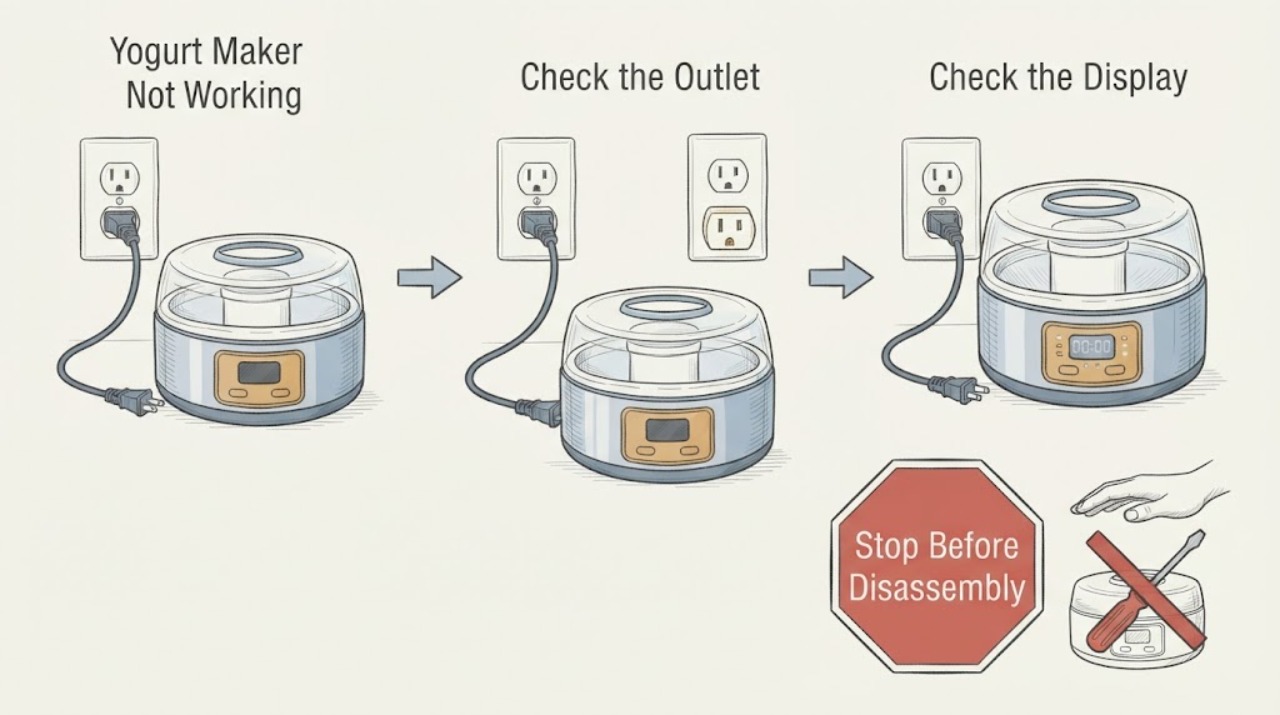
For a yogurt maker that is not working, separate a dead appliance from a running cycle with poor texture. Check the outlet and cord, confirm the container and lid are positioned as the manual shows, start the timed program correctly, and treat a power-loss or error indication as a food-safety event rather than simply restarting the batch.
Work through in order
Diagnostic checks
Use only checks that match the exact appliance or system and its official guide.
-
Check 1
Check the dry power connection: confirm the cord is seated, the outlet works, and the base is on a stable dry surface; inspect the cord without immersing or opening the base.
Expected result: Record the visible result of this check and whether the reported symptom changes.
Next step: If the result is normal, continue to the next check; if it is abnormal, correct only the documented condition or stop for service.
Why this matters
Why: This result separates an accessible operating condition from a fault that requires model-specific diagnosis.
-
Check 2
Check the program sequence: place the prepared container and lid correctly, press the model’s on control to enter standby, then use the documented start action and observe whether the timer counts down.
Expected result: Record the visible result of this check and whether the reported symptom changes.
Next step: If the result is normal, continue to the next check; if it is abnormal, correct only the documented condition or stop for service.
Why this matters
Why: This result separates an accessible operating condition from a fault that requires model-specific diagnosis.
-
Check 3
Check the batch conditions after the cycle: note whether the unit heated, the timer completed, the yogurt stayed thin or grainy, or the display flashed after an interruption.
Expected result: Record the visible result of this check and whether the reported symptom changes.
Next step: If the result is normal, continue to the next check; if it is abnormal, correct only the documented condition or stop for service.
Why this matters
Why: This result separates an accessible operating condition from a fault that requires model-specific diagnosis.
-
Check 4
If the display shows a power-loss or general error state, follow the manual’s food-safety and service instruction; do not taste or reuse a batch with uncertain temperature history.
Expected result: Record the visible result of this check and whether the reported symptom changes.
Next step: If the result is normal, continue to the next check; if it is abnormal, correct only the documented condition or stop for service.
Why this matters
Why: This result separates an accessible operating condition from a fault that requires model-specific diagnosis.
Use your observations
Decision map
Find the observation that best matches what you see, then follow the next safe action.
-
PATH 01Next step
What you see
The display is blank and the outlet, cord, and detachable connection are sound.
Do this next
Unplug the unit and contact the manufacturer; do not open the base.
Why this path and its safety boundary
Why it matters: A base, control, or internal power fault is more likely than an ingredient or timing problem.
-
PATH 02Next step
What you see
The timer runs but the yogurt remains thin, grainy, or fails to set.
Do this next
Follow the exact recipe and timing guidance for the model and refrigerate the batch as directed.
Why this path and its safety boundary
Why it matters: Program duration, milk temperature, starter, and cooling history affect the result; the motor or power system may still be working.
-
PATH 03Next step
What you see
The display flashes a power-loss or general error after the cycle was interrupted.
Do this next
Discard an interrupted batch when the manual requires it and contact service for a persistent error.
Why this path and its safety boundary
Why it matters: The manual treats the event as a safety or appliance fault, so a blind restart cannot establish that the food is safe.
Helpful context
Understand the symptom
Use the ordered checks below to separate normal operating states from a fault for this appliance.
When checks do not resolve it
Need a professional?
Stop for smoke, burning odor, damaged cord, liquid entering the base, repeated error display, or an interrupted food-safety cycle. Disconnect the appliance and use qualified service.
Common questions
FAQ
Can I restart yogurt after the power went out?
Follow the exact manual food-safety instruction. The Proctor Silex guide says a power-loss indicator requires discarding the yogurt, so do not assume a restarted timer makes it safe.
Why does the maker appear idle after pressing power?
Some models enter standby first and need a second documented start action. Confirm the timer is counting down before assuming the heater failed.
Can I wash the base in water?
No. Unplug it and wipe the base as directed; keep the cord, plug, and electrical base out of water.
Read the exact guide
Official sources
- Proctoc Silex Yogurt Maker (86300) - Use & CareHamilton Beach · electric yogurt maker operation, timing, food-safety error, and service troubleshooting
Community feedback
Share a repair observation
Share a plain-text repair observation. Accepted observations are published automatically; this page may take a moment to update.