
On this page
Start here
Quick answer
A yogurt maker making a brief crackle or expansion sound during heating may be normal on some models, but loud, continuous, grinding, electrical, or leak-related noise is not established as normal. Place it on a stable surface, do not move it while plugged in or operating, and check only the lid, jars, power cord, and visible moisture after unplugging and cooling. Arrange service if the noise persists or the unit cannot maintain safe temperature.
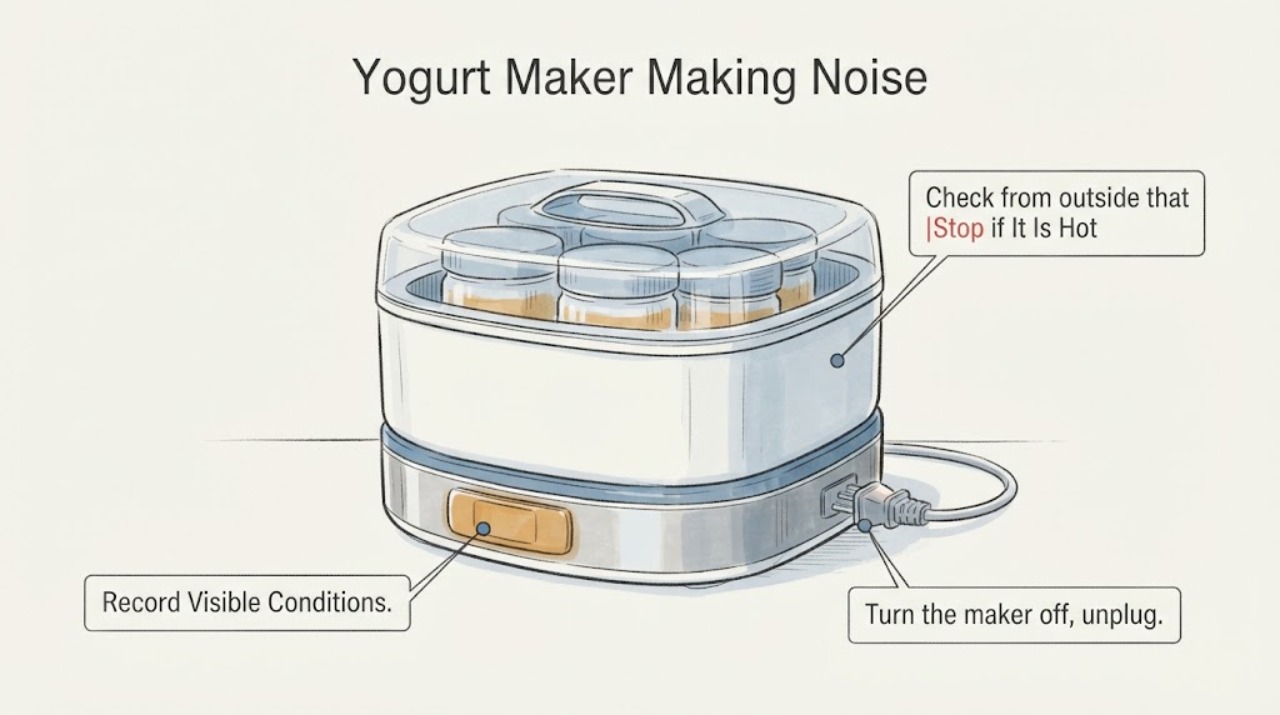
Work through in order
Diagnostic checks
Use only checks that match the exact appliance or system and its official guide.
-
Check 1
Listen from outside and record whether the sound is a brief crackle during heating, a repeated buzz/hum, a rattle from jars/lid, or a grinding/electrical sound.
Expected result: The sound is brief and heat-stage-linked, changes when the unit is moved, or continues regardless of the cycle.
Next step: Keep the maker still and continue only if there is no odor, leak, heat damage, or unsafe cord.
Stop if: Stop for smoke, burning odor, sparks, hot cord, cracked jar, or water near electrics.
Why this matters
Why: Brief expansion sounds may be normal; vibration/contact or continuous mechanical/electrical noise needs separation.
-
Check 2
Turn the maker off, unplug it, let it cool, and check that the lid and jars are seated without touching the housing or each other.
Expected result: A jar/lid was rattling or the assembly is clear.
Next step: Refit only accessible pieces and make one supervised cycle observation.
Stop if: Do not move a plugged-in or filled maker or force jars into place.
Why this matters
Why: External contact can amplify noise; a clear, correctly seated set with persistent sound needs service diagnosis.
-
Check 3
Check from outside that the appliance sits on a hard, stable, non-vibrating surface away from a refrigerator, dishwasher, or washer.
Expected result: The surface vibrates/rocks, or it is stable and clear.
Next step: Relocate only when unplugged, empty, cool, and safe; then monitor one cycle.
Stop if: Do not lift a hot or liquid-filled unit.
Why this matters
Why: Tefal identifies vibration and movement as conditions to avoid; a stable unit with persistent noise is less likely to be simple placement.
-
Check 4
After one safe correction, observe whether fermentation, temperature, and the sound remain normal through the program.
Expected result: The sound fades and yogurt production is normal, or noise persists/temperature is abnormal.
Next step: Unplug and arrange qualified small-appliance service for recurrence or abnormal temperature.
Stop if: Do not open the base or continue with a damaged appliance.
Why this matters
Why: A fading crackle with normal operation supports the documented expansion explanation; persistent noise or failed heating needs service.
Use your observations
Decision map
Find the observation that best matches what you see, then follow the next safe action.
-
PATH 01Next step
What you see
A brief crackle occurs during heating and fades while fermentation remains normal.
Do this next
Keep the maker stable and monitor for a change in character.
Why this path and its safety boundary
Why it matters: This matches the Tefal FAQ’s normal expansion/contraction explanation for applicable models.
-
PATH 02Next step
What you see
The sound is a rattle that changes when jars/lid touch or the surface vibrates.
Do this next
Unplug, cool, reseat, and use a stable surface for one observation.
Why this path and its safety boundary
Why it matters: External contact or placement is more likely.
-
PATH 03Next step
What you see
Noise is continuous, grinding, or paired with failed heating or leakage.
Do this next
Stop use and arrange service.
Why this path and its safety boundary
Why it matters: An internal mechanical, thermal, or electrical fault is more likely.
-
PATH 04Next step
What you see
Cord/plug is hot, damaged, or there is smoke/burning odor.
Do this next
Disconnect power if safe and seek qualified help.
Why this path and its safety boundary
Why it matters: This is an electrical/fire safety boundary.
Helpful context
Understand the symptom
What to check first
Tefal’s official yoghurt-maker FAQ says some crackling noises can come from expansion and contraction and may fade, while it also requires a stable, non-vibrating surface and warns against moving the unit while plugged in. The sound’s timing, character, and effect on fermentation matter more than the word “noise.”
When checks do not resolve it
Need a professional?
Arrange qualified appliance service when the safe checks do not resolve the symptom or when the exact model manual calls for service. Give the technician the model, observed pattern, and checks already completed. Do not open sealed, gas, high-voltage, or mains compartments.
Common questions
FAQ
Is crackling always a failure?
No. Tefal says brief crackling from expansion and contraction can be normal on applicable yoghurt makers when it fades and operation remains normal.
Can I move the yogurt maker during a cycle?
No. Keep it on a stable surface and do not move it while plugged in or operating.
What if noise affects fermentation?
Stop using it and arrange service if temperature is abnormal, the program fails, or the sound persists.
Read the exact guide
Official sources
- User manual and frequently asked questions LA YAOURTIERE 887241Tefal · Tefal yoghurt makers
Community feedback
Share a repair observation
Share a plain-text repair observation. Accepted observations are published automatically; this page may take a moment to update.