
On this page
Start here
Quick answer
Treat a water-damaged bathroom vanity as a source-and-extent problem before a cabinet replacement decision. From outside the cabinet or from an already open, safe access area, photograph active moisture, identify whether it is near the sink, drain, wall, floor, or a fixture, and note swelling, delamination, odor, visible growth, soft spots, door misalignment, or loss of stability. Do not loosen plumbing, open walls, disturb suspected mold, remove the vanity, or touch wet electrical equipment. Stop using the area and call an appropriate plumber, water-damage professional, or remodeling professional if water is active, the cabinet is unstable, the damage extends into the wall or floor, or visible growth is present.
Before you begin
Safety first
- The reader should limit work to dry, external observation and keeping people away from hazards. Do not disconnect plumbing, open walls, remove the vanity, disturb mold, demolish materials, or touch wet electrical equipment.
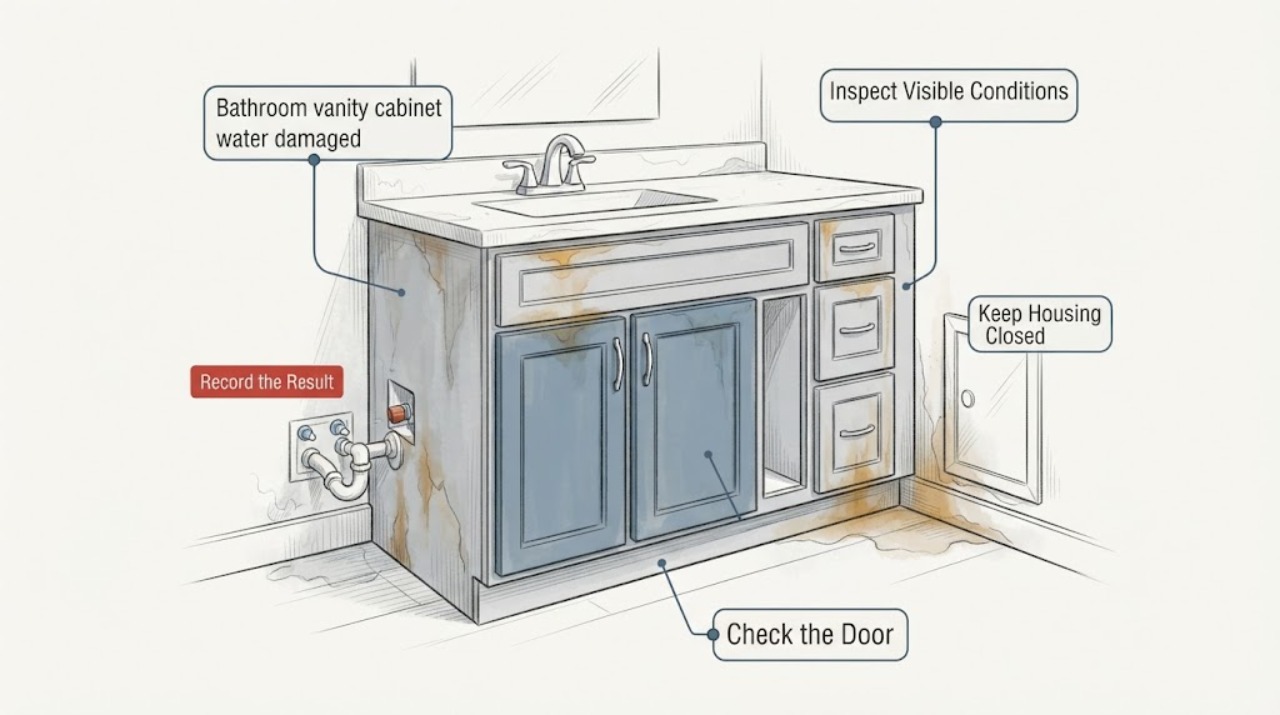
Work through in order
Diagnostic checks
Use only checks that match the exact appliance or system and its official guide.
-
Check 1
From a dry, stable position, look at the outside of the vanity and any already-open access area without loosening, tightening, or disconnecting a supply or drain connection.
Expected result: Record whether water is actively dripping or pooling, whether the wet point appears below the bowl or at a wall or floor edge, or whether no active water is visible.
Next step: Photograph the location and tell a plumber or water-damage professional exactly when the moisture appears and which fixture or edge is nearby.
Stop if: Stop immediately if water is spraying, the floor is slippery, the source is concealed, or water is near electrical equipment.
Why this matters
Why: Active water needs source control before cabinet repair. A dry moment does not rule out an intermittent leak, splash path, or hidden moisture behind the vanity.
-
Check 2
Inspect the visible cabinet base, side panels, doors, toe-kick, nearby baseboard, and floor edge without scraping, probing, or removing trim.
Expected result: Note swelling, bubbling or separating finish, staining, soft-looking board, odor, visible growth, floor discoloration, or damage that continues beyond the cabinet footprint.
Next step: Photograph each affected boundary and request a professional assessment that includes the cabinet, wall, floor, and the source path.
Stop if: Do not scrape, brush, sand, cut, or disturb visible growth or soft material.
Why this matters
Why: Damage limited to a dry-looking surface may still require a closer assessment. Spread into the floor, wall, baseboard, or concealed cavity suggests that a replacement-only quote may miss the moisture source or affected materials.
-
Check 3
Without loading the countertop or pulling the cabinet, observe whether the doors close normally and whether the cabinet appears square, anchored, and stable compared with its original position.
Expected result: The cabinet appears stable, a door or drawer is newly misaligned, the base looks bowed, or the unit shifts or leans.
Next step: Keep heavy items and people away from an unstable unit and tell the remodeling professional whether the change followed a leak or overflow.
Stop if: Stop using the vanity if it shifts, leans, separates from the wall, or could drop a sink or countertop. Do not brace, lift, or re-anchor it yourself.
Why this matters
Why: Misalignment or loss of stability can indicate material swelling or a wider installation issue. A stable appearance does not prove that hidden panels or flooring are dry.
-
Check 4
Compare the affected cabinet with an adjacent dry bathroom area and note the moisture timeline, recent overflow or leak, cleaning event, humidity episode, and whether the odor or staining returns after the surface seems dry.
Expected result: The issue followed a single event, recurs after use, persists without recent use, or cannot be linked to an event.
Next step: Give the professional the dates, fixture-use pattern, weather or ventilation context, and comparison photos; do not seal or paint over the affected area.
Stop if: Stop the inspection if odor, visible growth, respiratory irritation, or a worsening wet area appears.
Why this matters
Why: A recurring or unexplained pattern raises the priority for source tracing. Persistence after surface drying can mean that concealed materials or a continuing leak still need professional evaluation.
-
Check 5
Look from outside the vanity for any nearby receptacle, light, cord, or electrical accessory that may have been exposed to water, without touching the equipment or wet surfaces.
Expected result: No electrical equipment is nearby, the equipment is dry but close to the affected area, or water has reached or may have entered the equipment.
Next step: Keep people away and contact a qualified professional or follow the property's emergency electrical procedure; provide the location and photos without handling the equipment.
Stop if: Do not touch wet electrical equipment, cords, receptacles, switches, or breakers as part of this cabinet inspection.
Why this matters
Why: Water near electrical equipment changes the urgency and requires an electrical-safety decision before any drying, cabinet, or plumbing work continues.
Use your observations
Decision map
Find the observation that best matches what you see, then follow the next safe action.
-
PATH 01Safety boundary
What you see
Water is active or returns after sink or bathroom use.
Do this next
Stop using the affected fixture and arrange plumber or water-damage service to identify and control the source before a vanity replacement decision.
Why this path and its safety boundary
Safety stop: Do not loosen fittings, cut pipes, open the wall, or continue using the vanity to reproduce the leak.
-
PATH 02Safety boundary
What you see
Damage is limited to visible cabinet surfaces, with no active water, no odor or growth, and no stability change.
Do this next
Request a remodeling or cabinet assessment that verifies the cabinet material, surrounding floor and wall, and source history before choosing repair or replacement.
Why this path and its safety boundary
Safety stop: Do not cover swollen or damp material with paint, caulk, or a new panel before the moisture source is cleared.
-
PATH 03Safety boundary
What you see
Swelling, staining, odor, or visible growth extends into the floor, wall, toe-kick, or concealed cavity.
Do this next
Arrange qualified water-damage or mold-assessment service and a plumbing evaluation as needed; keep the area isolated until the scope is known.
Why this path and its safety boundary
Safety stop: Do not scrape, bleach, sand, demolish, or remove potentially affected materials yourself.
-
PATH 04Safety boundary
What you see
The vanity, countertop, or sink appears unstable, shifted, or separated.
Do this next
Restrict use and request urgent remodeling or plumbing assessment of the support, connections, and water-damaged materials.
Why this path and its safety boundary
Safety stop: Do not lift, brace, re-anchor, or place weight on the unit.
-
PATH 05Safety boundary
What you see
Water may have reached a receptacle, light, cord, or other electrical equipment.
Do this next
Keep clear and obtain qualified electrical-safety guidance before anyone touches the vanity, plumbing, or wet area.
Why this path and its safety boundary
Safety stop: No contact with wet electrical equipment or concealed wiring.
Helpful context
Understand the symptom
A vanity cabinet can be damaged by a small recurring sink leak, a supply or drain connection, water running over the counter edge, a bathroom humidity problem, or moisture that has reached the wall or floor. The visible swelling is not enough to identify the source or decide whether only a panel, the cabinet, or surrounding materials need attention.
Keep the inspection observational. Look from a dry, stable position, use a camera or flashlight without inserting it into a cavity, and do not loosen a fitting, pull the cabinet, scrape growth, or open a wall. If water is near a receptacle, light, cord, or other electrical equipment, do not touch the equipment or the wet area.
Moisture control comes before cosmetic work. Official building guidance notes that wet materials should be dried promptly and that leaks under a sink can affect cabinets and nearby walls. If the source is hidden or the affected area is broad, a professional needs to identify and stop the source before a replacement or finish repair is planned.
Use the checks below to make a safe service handoff. Do not turn a swollen vanity into a demolition, plumbing, mold-remediation, or electrical project for a homeowner.
Only after diagnosis
Potential parts
- moisture meter
Consider a meter only when a qualified professional selects it to map moisture in the cabinet, wall, or floor; a consumer reading cannot prove that hidden materials are dry or safe.
Confirm the meter's material modes, calibration, and professional interpretation before relying on a reading for replacement or remediation decisions. - sink drain repair kit
Consider a drain repair component only after the exact leak source and connection are identified by a qualified plumber and the fitting is confirmed serviceable without concealed work.
Match the existing drain configuration, materials, dimensions, and local installation requirements; do not cut or alter pipework based on appearance.
When checks do not resolve it
Need a professional?
Safety scope: The reader should limit work to dry, external observation and keeping people away from hazards. Do not disconnect plumbing, open walls, remove the vanity, disturb mold, demolish materials, or touch wet electrical equipment.
Have this ready
- Share the vanity location, fixture-use and moisture timeline, active or intermittent source observation, cabinet and wall or floor boundaries, odor or visible-growth observation, stability change, electrical proximity, and dated photos.
Common questions
FAQ
Should I replace a bathroom vanity as soon as the cabinet swells?
Not before the water source and surrounding extent are assessed. Swelling can follow an active or intermittent leak, splash path, humidity, or moisture in the wall or floor. Source control and a professional assessment should guide repair versus replacement.
Can I dry and paint a water-damaged vanity cabinet myself?
Limit yourself to safe external observation and keeping the area clear. Do not cover damp, swollen, or mold-affected material before the source is fixed and the affected materials are assessed.
What should I do if water is near the vanity's electrical outlet?
Do not touch the wet equipment, receptacle, cord, switch, or concealed wiring. Keep people away and obtain qualified electrical-safety guidance before plumbing, drying, cabinet, or remodeling work continues.
Read the exact guide
Official sources
- Interactive Mold House TourU.S. Environmental Protection Agency · Supports observing the moisture source and cabinet or wall extent, drying wet materials promptly, and involving a qualified professional for hidden leaks; it is not a vanity replacement specification.
- Why is mold growing in my home?U.S. Environmental Protection Agency · Supports the article's moisture-first sequence and professional escalation for recurring or concealed wet conditions; it does not diagnose the cabinet material or prescribe demolition.
- Homeowners and Renters Guide to Mold Cleanup After DisastersCenters for Disease Control and Prevention · Used to support stopping at observation and escalating visible or extensive mold and water damage rather than performing unprotected cleanup; the guide is disaster-focused and not a vanity repair manual.
Community feedback
Share a repair observation
Share a plain-text repair observation. Accepted observations are published automatically; this page may take a moment to update.