
On this page
Start here
Quick answer
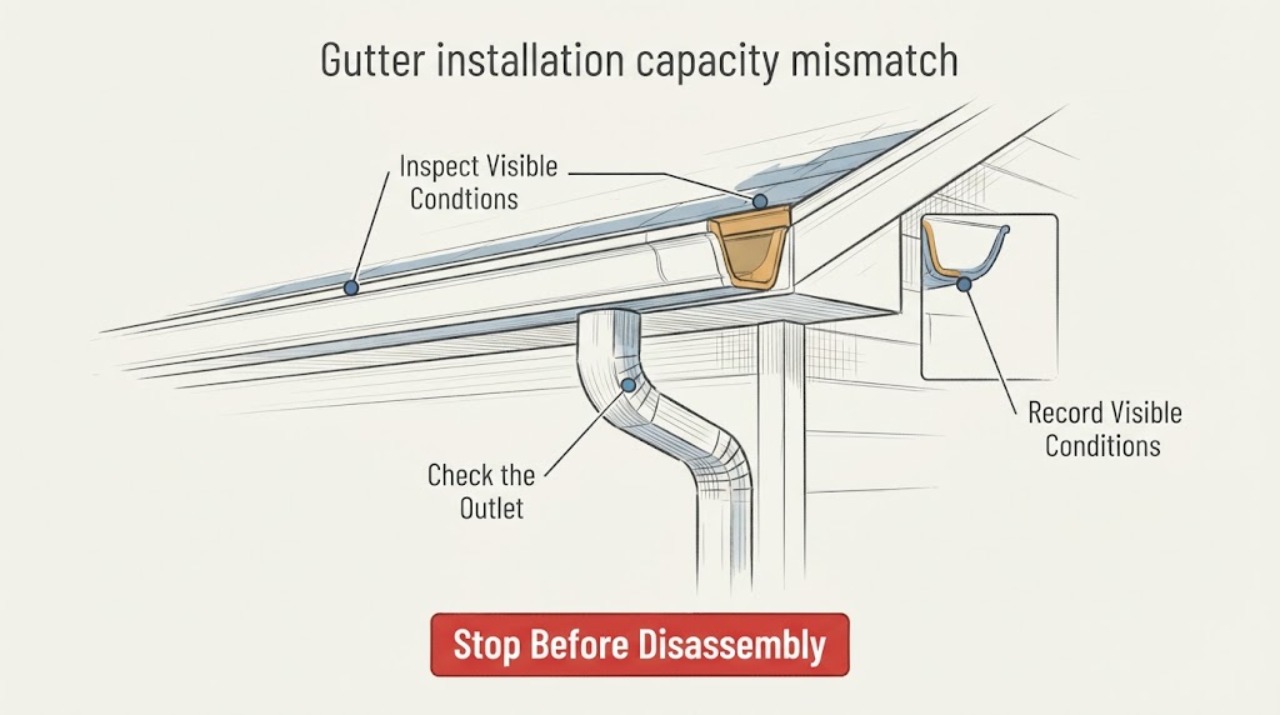
If a recently installed or replaced gutter system overflows during ordinary rain even when no obvious debris is present, the issue may be a capacity or layout mismatch rather than a simple cleaning problem. Observe the overflow pattern, visible downspout discharge, roof sections that feed the affected run, and any wetness or erosion at ground level. Do not climb onto the roof, take roof measurements, alter the gutter, or expose yourself to a storm. Give those observations and the installation history to a gutter professional who can assess the system as a whole.
Work through in order
Diagnostic checks
Use only checks that match the exact appliance or system and its official guide.
-
Check 1
From the ground or a safely accessible window, observe the gutter during or just after a normal rain event and identify where water first spills or bypasses the channel.
Expected result: Record whether overflow is along most of the run, limited to one end, concentrated below a roof valley or corner, or absent in lighter rain but present in heavier ordinary rain.
Next step: Photograph the pattern from a safe position and note the rain conditions for the professional assessment.
Stop if: Stop observing if lightning, high wind, falling debris, or fast-moving runoff makes the area unsafe; do not approach the gutter during a storm.
Why this matters
Why: A long or repeatable overflow pattern can point to a system-capacity or layout question, while a single-location spill can also involve a local obstruction, slope, connection, or trim condition.
-
Check 2
Watch each visible downspout outlet from a dry, ground-level position after rainfall, without touching the pipe or outlet.
Expected result: Note whether discharge is steady, absent, briefly surges and stops, or pours at a joint, and whether water pools or erodes the soil near the outlet.
Next step: Map the affected gutter run to its visible downspout and include the outlet behavior in the service request.
Stop if: Stop if water is flowing toward a doorway, electrical equipment, a steep slope, or an unsafe walking surface.
Why this matters
Why: Little or interrupted discharge can make a blockage or connection issue more likely; steady discharge with overflow above it can shift attention toward how much runoff the gutter run receives and how it is distributed.
-
Check 3
From ground level, use the building outline, accessible views, and any existing roof or installation records to identify which roof planes, valleys, or extensions appear to feed the affected gutter run.
Expected result: Record whether several roof sections converge into one visible run, whether a valley appears to discharge at the spill location, and how many downspouts are visibly associated with that run; do not measure the roof or access it.
Next step: Give the professional the roof-layout notes and any installation drawings, invoices, or before-and-after photos that are already available.
Stop if: Stop if confirming the layout would require climbing, reaching over an edge, moving materials, or entering a roof or ladder area.
Why this matters
Why: A large or converging roof catchment can explain why a run behaves differently from a smaller run, but these observations cannot determine a required gutter or downspout size without a professional assessment.
-
Check 4
After rainfall, view the ground and foundation-adjacent area from a safe position for watermarks, splashback, standing water, soil washout, or a wet path below the gutter edge or downspout.
Expected result: Note whether the moisture is directly below an overflow, around a downspout outlet, along the foundation, or absent at ground level.
Next step: Photograph the affected area and tell the professional whether the condition repeats after rainfall.
Stop if: Stop if the ground is unstable, water is entering the building, or the affected area is near exposed electrical equipment.
Why this matters
Why: Wetness or erosion shows that the discharge is affecting the site even if the gutter looks intact; it does not by itself identify whether the cause is capacity, blockage, outlet routing, or grading.
-
Check 5
Review the system history without altering it: note the installation or replacement date, any recent roof work, whether overflow started immediately or later, and whether it occurs at one run or several.
Expected result: Classify the history as new since installation, new after roof or exterior work, gradually worsening, or present across the property from the first rain.
Next step: Provide the timeline, affected elevations, rain conditions, and safe photographs when requesting a gutter drainage inspection.
Stop if: Do not perform a test by modifying the gutter or deliberately directing extra water into it.
Why this matters
Why: A symptom present from the first rain supports an installation-layout review; a later change can also indicate debris, settlement, damage, or a changed runoff path. History narrows the assessment but does not prove a design error.
Use your observations
Decision map
Find the observation that best matches what you see, then follow the next safe action.
-
PATH 01Next step
What you see
Overflow repeats along a substantial part of one gutter run during ordinary rain, while visible downspout outlets discharge steadily.
Do this next
Request a professional capacity and roof-catchment assessment for that run; do not assume that a larger channel alone is the correct fix.
-
PATH 02Next step
What you see
Overflow is limited to one location and the related downspout has little, interrupted, or no visible discharge.
Do this next
Request a professional inspection for a local obstruction, connection, slope, or downspout issue before considering a system redesign.
-
PATH 03Next step
What you see
A valley or several roof planes appear to converge at the affected run, or the issue affects more than one elevation.
Do this next
Ask the professional to assess the full roof runoff layout, gutter runs, downspout distribution, and outlet path together.
-
PATH 04Next step
What you see
Overflow or downspout discharge leaves standing water, erosion, or wetness at the foundation or inside the building.
Do this next
Treat the drainage issue as higher priority, keep water away from unsafe areas when this can be done without altering the system, and arrange prompt professional evaluation.
-
PATH 05Next step
What you see
The system was recently installed or replaced and the mismatch has been present since the first rain.
Do this next
Gather the installation records and request a post-installation gutter drainage review rather than attempting an on-site alteration.
Helpful context
Understand the symptom
A gutter system has to collect runoff from the roof area assigned to each run and move it through downspouts to a safe outlet. A mismatch can look like water spilling over the front edge, backing up at one end, or concentrating at a valley or corner. The same symptoms can also come from a local blockage, a connection problem, poor drainage at the outlet, or an installation condition, so a ground-level observation is useful but is not a sizing calculation.
Federal and local drainage guidance treats gutter capacity, downspout capacity, roof runoff, and the final discharge area as one water-management system. The goal of this page is to collect safe evidence for that assessment, not to prescribe a gutter size or a code-compliance result for an unknown house.
When checks do not resolve it
Need a professional?
Request a gutter professional when overflow repeats in ordinary rain, a downspout does not discharge normally, several roof sections feed one run, the installation is new, or water is causing erosion, foundation wetness, or interior moisture. Prompt service is appropriate when water is entering the building or creating an unsafe path.
Have this ready
- Provide the affected elevation and gutter run, safe rain-event photos or video, overflow location and timing, visible downspout behavior, roof sections or valleys that appear to feed the run, system installation history, and any foundation or interior moisture evidence.
Common questions
FAQ
Does gutter overflow prove that the gutters are too small?
No. Overflow can also come from a local blockage, a connection or slope issue, downspout distribution, or the outlet path. A repeated whole-run pattern with normal visible discharge is a reason to request a professional capacity and layout assessment, not a home sizing calculation.
Can I determine the correct gutter size from the ground?
No. Ground-level observations can show where and when water spills, but the required capacity depends on the roof catchment, rainfall conditions, system layout, downspouts, and site discharge. Leave sizing and alteration to a qualified professional.
Why can a gutter overflow when the downspout is flowing?
A flowing downspout does not prove that the gutter run is capturing and conveying all incoming runoff. The run may receive concentrated flow from a valley or multiple roof planes, or have a local restriction or layout issue. Document the pattern for assessment.
What information should I give a gutter professional?
Give the affected side and run, safe photos from a rain event, where overflow begins, what each visible downspout does, which roof sections appear to feed the run, when the system was installed, and any erosion, foundation wetness, or interior moisture.
Read the exact guide
Official sources
- Gutters and Downspouts: Wetness or Erosion ProblemsNorthern Virginia Soil and Water Conservation District, Fairfax County · Supports using visible watermarks, drip-line erosion, spillover during rain, and downspout discharge behavior as observations for a drainage assessment.
- Gutters and DownspoutsBuilding America Solution Center, Pacific Northwest National Laboratory · Supports assessing roof runoff, gutter and downspout capacity as a system, roof catchment layout, and discharge away from foundations.
- A Homeowner's Guide to Sustainable Home DrainageNatural Resources Conservation Service, U.S. Department of Agriculture · Supports the distinction between properly sized and undersized gutter systems, overflow, downspout routing, and protection of foundations and sensitive areas.
Community feedback
Share a repair observation
Share a plain-text repair observation. Accepted observations are published automatically; this page may take a moment to update.