
On this page
Start here
Quick answer
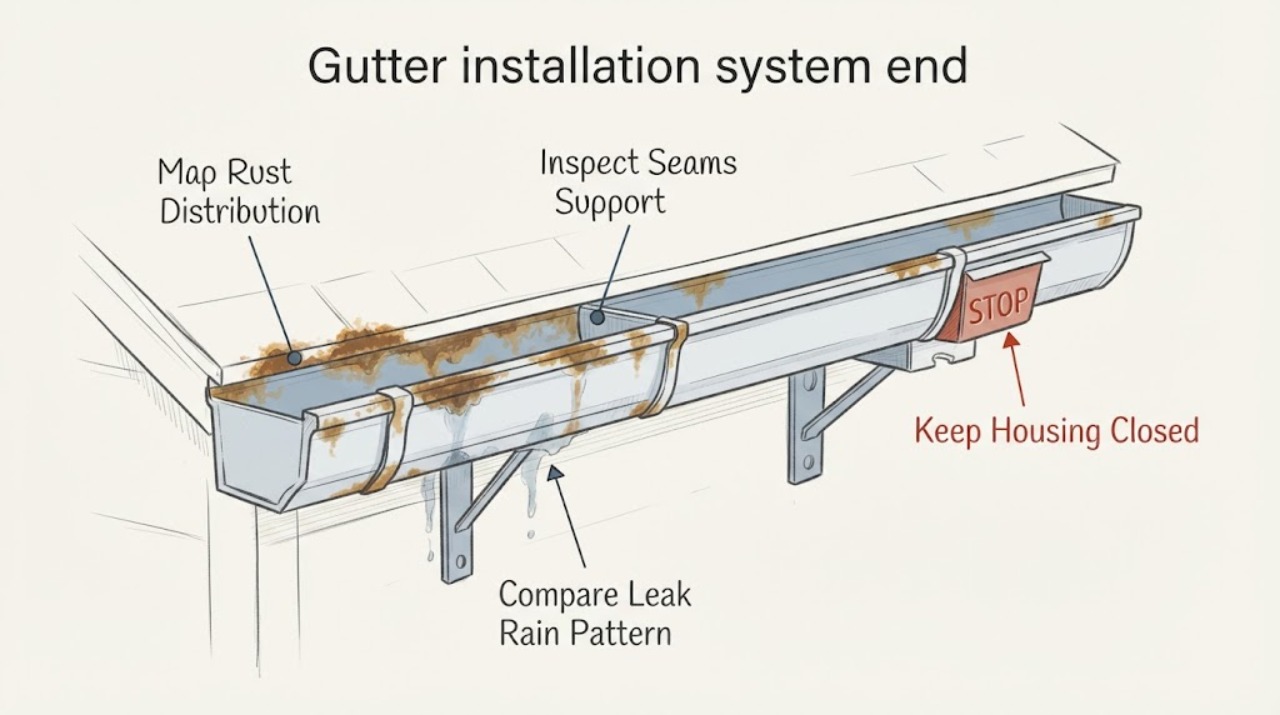
Widespread rust is a condition to map, not an automatic verdict that the entire gutter system is beyond repair. From the ground, distinguish a surface coating stain or discoloration from pinholes, through-rust, splits, leaking seams, bent runs, sagging, and gutter sections pulling away from the fascia. Record whether leaks repeat at one joint, occur across multiple sections, appear only when rain is intense, or follow a valley or downspout restriction. Also check safe visible fascia and soffit condition and any wall, foundation, or interior impact. Surface rust with sound shape and support may allow local treatment or section repair; through-rust in several runs, widespread deformation, failed support, or damage that will recur may favor system replacement. Do not climb, get on the roof, dismantle a section, hose-test, or inspect during a storm. A gutter professional should confirm material integrity, drainage capacity, and support before recommending repair or replacement.
Before you begin
Safety first
- Do not use ladders, climb the roof, inspect during storms, dismantle sections, scrape or probe corrosion, hose-test, pressure-flush, probe downspouts, or open roof-edge, wall, or interior materials.
Work through in order
Diagnostic checks
Use only checks that match the exact appliance or system and its official guide.
-
Check 1
From stable ground, photograph every visibly rusted run and mark whether the color is a surface film or coating stain, a localized patch, a pit or pinhole, a visible opening, or a section with flaking or missing material.
Expected result: Rust may be cosmetic and limited to one area, concentrated at seams or fasteners, or spread across many runs with pits, holes, and material loss. A dark color alone does not show how much metal remains.
Next step: Keep wide and close photographs with the run location and ask a professional to confirm the rust depth; do not scrape, poke, sand, or remove coating from the gutter.
Stop if: Stop for loose or falling metal, sharp edges, unstable attachment, falling debris, or any view that requires a ladder or roof access.
Why this matters
Why: Distribution and depth clues are more useful than the word widespread. Surface discoloration can support a maintenance discussion, while through-rust or holes can require section replacement; only an on-site professional can confirm integrity without dismantling.
-
Check 2
Look from the ground for rust at seams, end caps, outlets, fasteners, hangers, and fascia connections, and note whether the gutter is straight, sagging, separated, bent, or visibly pulling away from the support.
Expected result: A sound run with one rusty seam differs from multiple leaking joints, loose hangers, deformed runs, and a support surface that is stained, swollen, or soft-looking. A gutter leak can be caused by attachment or fascia movement rather than rust alone.
Next step: Photograph each joint and support condition and request a combined gutter, attachment, and fascia assessment; do not remove sealant, fasteners, or sections.
Stop if: Stop for loose trim, falling material, structural movement, exposed wiring, or a gutter that could detach.
Why this matters
Why: Local seam repair is a different path from system replacement or fascia repair. New gutter material will not remain secure if the supporting fascia or roof edge is damaged.
-
Check 3
For each safe rain event, record whether the rusted gutter leaks in light, sustained, or intense rain, when the leak starts, and whether it comes from the same seam, hole, run, or several sections.
Expected result: One joint that drips in every rain differs from several runs that leak only during intense flow. A stable location points toward local material or joint failure; a storm-dependent location can reflect capacity, valley flow, outlet spacing, or downspout restriction.
Next step: Keep a dated leak and rain log and give it to the professional; do not wait outside in lightning, high wind, hail, or flooding to collect a better observation.
Stop if: Stop for lightning, high wind, hail, falling debris, slippery or undermined ground, or water near electrical equipment.
Why this matters
Why: Repeated leaks do not automatically equal end of life. The rain pattern shows whether rust has created openings, whether flow is overwhelming a sound section, or whether a drainage cause is producing apparent leakage.
-
Check 4
Using only ground-level views, trace the roof planes, valleys, upper-roof discharge, and gutter run above the rusted area, then observe whether the downspout outlet is strong, weak, absent, backing up, or directing water at the wall or foundation.
Expected result: A broad roof or valley may concentrate flow into one run; a weak outlet can back water into a rusted gutter; a strong outlet with storm-only overflow may point to capacity or layout rather than widespread material failure.
Next step: Sketch the visible catchment, photograph the outlet and discharge, and request a drainage review; do not climb to measure the roof or probe or hose the downspout.
Stop if: Do not climb, walk the roof, inspect a concealed valley, probe a downspout, or work during a storm.
Why this matters
Why: Drainage and capacity must be separated from corrosion before choosing replacement. A new system with the same outlet or roof-flow limitation can repeat the problem.
-
Check 5
From safe ground and ordinary interior areas, look for wet or stained fascia and soffit, swelling, soft-looking trim, wall or siding marks, foundation pooling, ceiling or wall stains, bubbling finish, or musty odor after rain.
Expected result: Rust and leakage may be limited to the gutter, may have damaged the support surface, or may be allowing water into the wall, roof edge, basement, or interior. Interior marks may be delayed or offset from the gutter.
Next step: Photograph the impact, move belongings only from safe dry areas, and request prompt service if material is soft, loose, damp, spreading, or actively leaking.
Stop if: Stop for a sagging ceiling, wet electrical fixture, active flooding, structural movement, or suspected hazardous contamination.
Why this matters
Why: Support or interior damage can change a gutter-only repair into coordinated roofing, fascia, wall, or moisture work. The system's age cannot be judged from rust without checking what it has done to the building.
-
Check 6
Record the installation or replacement history if known, prior sealant or patch locations, recent roof work, nearby tree or roof changes, and whether the same rusted areas returned after a prior repair.
Expected result: A single old patch with no new opening may be serviceable; repeated patch failure, different materials reacting at joints, or rust returning across many sections suggests an unresolved material, drainage, or support cause.
Next step: Give the history and photographs to the professional and ask for a cause-specific repair or replacement recommendation, not a generic age-based verdict.
Stop if: Do not scrape, cut, pull, dismantle, or expose a patched or corroded section to inspect its thickness.
Why this matters
Why: History helps distinguish a repairable isolated defect from a system that is repeatedly failing. It is not a substitute for inspecting the actual metal, joints, support, and drainage.
-
Check 7
Prepare a handoff that maps surface rust versus pits or holes, joint and support defects, rain-linked leaks, roof and valley catchment, downspout discharge, fascia and soffit condition, interior impact, prior patches, and recent work.
Expected result: One sound section with one failed seam may support local repair; through-rust or holes in several runs, widespread deformation, failed support, or repeated failure after repair may support partial or full replacement. Storm-only overflow with strong discharge may require capacity redesign instead.
Next step: Arrange qualified gutter and roofing service and request a written repair-versus-replacement rationale, support-surface scope, drainage review, and safe temporary water-control plan.
Stop if: Do not climb, dismantle, hose-test, probe a downspout, inspect during a storm, or perform roof-edge or structural work as a DIY confirmation.
Why this matters
Why: Widespread rust is a decision input, not an automatic end-of-life label. Repair versus replacement depends on material integrity, distribution, attachment, support, drainage, and whether the cause will recur.
Use your observations
Decision map
Find the observation that best matches what you see, then follow the next safe action.
-
PATH 01Next step
What you see
Rust appears as surface discoloration or coating stain, with no visible pinholes, openings, major deformation, sagging, or loss of support.
Do this next
Ask a professional to confirm material integrity, drainage, and support before deciding whether any section needs repair.
Why this path and its safety boundary
Why it matters: The visible condition does not establish end of life and may support maintenance or localized professional treatment.
-
PATH 02Next step
What you see
One or a few seams, end caps, fasteners, or sections show pinholes or through-rust while the remaining system is straight and supported.
Do this next
Request a professional section-specific repair assessment and do not scrape, poke, or remove the damaged piece.
Why this path and its safety boundary
Why it matters: A localized section or joint repair may be appropriate if the adjacent material and drainage cause are sound.
-
PATH 03Next step
What you see
Several runs have holes, splits, flaking material, repeated openings, or corrosion combined with bent or sagging sections.
Do this next
Ask for a documented system replacement assessment that includes fascia, hangers, outlets, downspouts, and roof-flow design.
Why this path and its safety boundary
Why it matters: Material integrity may be broadly compromised, making partial or full replacement more reasonable than repeated patches, subject to support and drainage review.
-
PATH 04Next step
What you see
The gutter pulls away, sags, or shifts because fascia, soffit, hangers, or the roof edge is wet, swollen, soft-looking, or damaged.
Do this next
Request coordinated gutter, fascia, roof-edge, and moisture assessment before selecting local repair or a new system.
Why this path and its safety boundary
Why it matters: Replacing gutter metal alone may leave the support failure and recurring leakage unresolved.
-
PATH 05Next step
What you see
The system stays dry in lighter rain but leaks or overflows during intense flow from a broad roof or valley, with a strong downspout outlet and no clear openings.
Do this next
Ask for a drainage-capacity review before replacing sound sections or adding sealant.
Why this path and its safety boundary
Why it matters: Capacity, outlet spacing, roof catchment, or layout may be the limiting factor rather than widespread rust or age.
-
PATH 06Next step
What you see
Water stains, dampness, odor, bubbling finish, or active leaking appears at the wall, ceiling, roof edge, or interior below the rusted system.
Do this next
Keep clear of sagging ceilings and wet electrical fixtures, move belongings only from safe dry areas, and request roofing and moisture service with the gutter assessment.
Why this path and its safety boundary
Why it matters: The repeated leakage has a building-envelope or interior moisture consequence and should be addressed promptly.
-
PATH 07Next step
What you see
Confirming rust depth, the roof valley, the outlet, the attachment, or the support requires a ladder, roof access, storm inspection, hose testing, probing, or dismantling.
Do this next
Stop and arrange qualified gutter or roofing service with ground-level photographs and the rain and leak history.
Why this path and its safety boundary
Why it matters: The remaining uncertainty is beyond safe observation and does not justify risky or destructive testing.
Helpful context
Understand the symptom
Map rust before calling it end of life
Surface discoloration is not the same as pinholes, through-rust, splits, or lost material. Photograph the distribution from the ground and note whether rust is limited to a seam or fastener, spread across several runs, or paired with sagging and deformation. Repeated leaks are evidence to investigate, not an automatic replacement verdict.
Separate corrosion from drainage and support
Compare leak behavior in lighter and intense rain, then trace roof planes, valleys, upper-roof flow, and downspout discharge. A weak outlet can back water into a repairable gutter; a strong outlet with storm-only overflow can indicate capacity or layout. Also check whether wet fascia, soffit, or roof-edge support is causing the gutter to move. GAF advises roofing professionals to consider rust, cracks, open seams, supports, and fascia condition when evaluating gutters, rather than treating a single symptom in isolation.
Choose repair or replacement safely
One failed joint on sound material may be repairable. Multiple sections with holes, deformation, failing support, or repeated failure after repair may justify partial or full replacement, while storm-only overflow may need a drainage redesign instead. Do not climb, dismantle, hose-test, probe a downspout, inspect in a storm, or open roof-edge or interior materials.
Safety boundary
Stop conditions
- Do not use a ladder, climb or walk on the roof, lean over an edge, or inspect during lightning, high wind, hail, or flooding.
- Do not scrape, poke, cut, dismantle, remove fasteners, hose-test, pressure-flush, or probe a corroded section or downspout.
- Stop for loose or falling metal, sharp edges, structural movement, active flooding, wet electrical equipment, sagging ceilings, or contaminated water.
- Keep people clear of damaged material and arrange qualified gutter, roofing, fascia, or moisture service when repair versus replacement is uncertain.
When checks do not resolve it
Need a professional?
Arrange gutter or roofing service when rust recurs with leaks, appears across several runs, includes holes or deformation, affects supports or fascia, or coincides with storm-only overflow or interior water impact.
Safety scope: Do not use ladders, climb the roof, inspect during storms, dismantle sections, scrape or probe corrosion, hose-test, pressure-flush, probe downspouts, or open roof-edge, wall, or interior materials.
Common questions
FAQ
Does widespread surface rust mean I must replace all the gutters?
No. Surface discoloration or coating stain does not prove that the metal has lost integrity. Map pinholes, through-rust, splits, deformation, support failure, leak distribution, and drainage behavior before deciding between local repair and replacement.
What is the difference between a rust spot and through-rust?
A surface spot changes appearance without a visible opening; pinholes or through-rust show material loss or a hole. Do not poke or scrape to test it. Photograph the condition and have a professional confirm whether the section can be repaired.
When do several rusty sections favor replacement?
Several runs with holes, splits, flaking material, deformation, sagging, failed supports, or leaks that return after appropriate repairs can support partial or full replacement. The fascia, downspouts, roof catchment, and drainage layout still need review.
Can a downspout or roof valley make rusty gutters leak?
Yes. A weak outlet can back water into a rusted section, while a valley or upper roof can concentrate flow. Strong discharge with storm-only overflow may indicate capacity or layout rather than material failure. Do not probe or hose the downspout.
Why does fascia condition matter when replacing gutters?
Wet, swollen, soft-looking, or loose fascia may no longer support the gutter. Replacing the gutter without addressing the support or roof edge can leave movement and recurring leakage unresolved.
Should I climb up or dismantle a section to inspect rust?
No. Do not climb, access the roof, inspect during a storm, remove sections, hose-test, probe a downspout, scrape corrosion, or open roof-edge materials. Use safe photographs and arrange qualified gutter or roofing service.
Read the exact guide
Official sources
- Should You Remove Gutters When Replacing the Roof?GAF · The opened GAF manufacturer page says gutter evaluation depends on age, condition, placement, and roof architecture; it specifically discusses rust, cracks, open seams, supports pulling away, fascia damage, and when replacement may be considered.
Community feedback
Share a repair observation
Share a plain-text repair observation. Accepted observations are published automatically; this page may take a moment to update.