
On this page
Start here
Quick answer
A gutter system is a replacement-project question when several sections sag, corrode, leak at seams, overflow, detach, or repeatedly send water toward the building despite ordinary service. From the ground and only in safe, settled weather, document the visible pattern, downspout discharge, foundation moisture, and repair history. Do not use a ladder, climb onto the roof, reach into the gutter, remove or repair sections, or approach during a storm. A qualified gutter professional can decide whether the system needs localized repair or a coordinated replacement estimate; do not infer an end-of-life date from age alone.
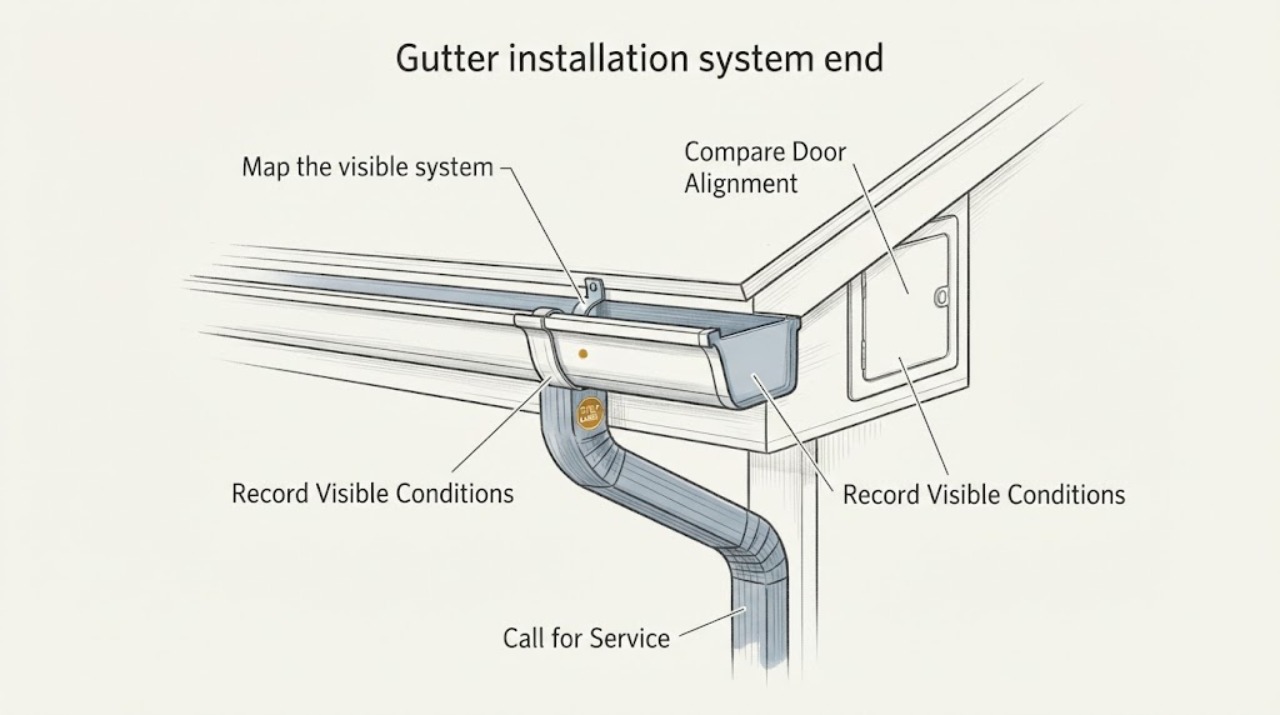
Work through in order
Diagnostic checks
Use only checks that match the exact appliance or system and its official guide.
-
Map the visible system from ground level
From stable ground in calm, dry conditions, look along each visible roof edge and downspout without a ladder or reaching. Note whether gutters appear continuous, whether sections are missing or visibly detached, and where downspouts are located relative to the corners and foundation.
Expected result: Record a mostly continuous system, isolated missing or detached sections, multiple gaps, visibly loose runs, or areas that cannot be seen safely. Take photos from the ground and do not zoom in by moving under an unsafe overhang.
Next step: Give the professional a simple elevation-by-elevation map and ground-level photos. Do not climb to fill in an unseen section.
Stop if: Stop if wind, ice, falling debris, unstable soil, electrical lines, or a loose section makes the exterior area unsafe.
Why this matters
Why: A single inaccessible or localized defect may call for a repair assessment; multiple missing, detached, or visibly failing sections support requesting a system-level replacement estimate. The view cannot confirm hidden fastener or roof-edge condition.
-
Look for sagging, tilt, and alignment changes
Use the roofline and nearby trim as visual reference from the ground. Look for a gutter run that bows, tilts, separates from the fascia, or appears lower between supports; do not touch, push, pull, or measure it from a ladder.
Expected result: Record no visible sag, one short sagging area, several low points, a detached run, or a section that appears to hold water. Note whether the same pattern repeats on more than one side of the building.
Next step: Include the number and location of sagging areas in a replacement estimate request. Do not attempt to re-pitch, tighten, or brace the run.
Stop if: Stop if the gutter is hanging, visibly twisting, over an entrance, near overhead conductors, or shedding material.
Why this matters
Why: DOE weatherization guidance identifies pitch toward downspouts and supports strong enough to prevent sagging as evaluation points. Repeated sagging across elevations suggests more than a single adjustment, but the underlying cause still requires professional inspection.
-
Record seam, corrosion, and overflow patterns from past rain
When no storm is occurring and the surfaces are safe, inspect from the ground for dark water trails, split or open seams, rust-through, white oxidation, staining below joints, or splash marks on siding. Use remembered or recorded observations from prior rainfall rather than standing under active overflow.
Expected result: Classify the pattern as no visible leak, one seam trail, multiple seam trails, pinhole or rust-through areas, water spilling over the front edge, or water running behind the gutter line. Record which roof edges show the pattern and whether it repeats after rain.
Next step: Photograph staining and provide the rainfall history to the professional. Do not apply sealant, scrape corrosion, clean from above, or remove a section to inspect the seam.
Stop if: Stop if water is still falling, lightning or high wind is present, metal is loose, or the suspected leak is near electrical equipment or an entrance.
Why this matters
Why: One visible seam may be a localized repair question; repeated corrosion, multiple leaking joints, and overflow across several runs support a broader replacement assessment. DOE explains that uncontrolled roof runoff can saturate soil and contribute to foundation moisture, mold, or rot concerns.
-
Observe downspout discharge and foundation clues
From ground level, follow each visible downspout to its outlet and look at the surrounding soil, splash area, siding, and foundation. Do not disconnect an elbow, move an extension, dig at the outlet, or walk through saturated or icy ground.
Expected result: Record an outlet that is visibly directed away, discharges beside the foundation, is disconnected, is missing, or cannot be seen. Note erosion, persistent pooling, damp foundation staining, basement moisture history, or no ground-level moisture clue.
Next step: Include the outlet and foundation observations in the estimate request and ask the professional to assess the complete discharge path. Do not redirect or disconnect the downspout yourself.
Stop if: Stop if the ground is flooded, icy, undermined, near exposed utilities, or if water is entering electrical equipment or the building.
Why this matters
Why: DOE and EPA guidance treat gutters and downspouts as a way to move roof runoff away from the building; an outlet close to the foundation or a missing discharge path can explain repeated moisture. The correct discharge arrangement depends on site and local requirements, so do not improvise one.
-
Summarize history without relying on age alone
Record the system's approximate installation or last-service history only if known, along with repeated cleaning or repair visits, storm or ice damage, prior replacement sections, recurring overflow, and any interior moisture reports. Do not assume a calendar age proves failure or approach the system during a current storm.
Expected result: Classify the history as little maintenance, recurring localized repair, repeated failures in multiple areas, recent storm damage, or unknown. Note whether the symptoms are stable, spreading, or only reported during unusual rainfall.
Next step: Ask a qualified professional for a system condition assessment and written options for repair versus replacement. Provide photos, elevations, discharge observations, and the known history.
Stop if: Stop if gathering history would require roof access, entering a hazardous area, or approaching active weather damage.
Why this matters
Why: A repeated multi-area pattern and ongoing water-management consequences are stronger replacement-estimate signals than age alone. A recent isolated event may call for a condition assessment rather than an unsupported end-of-life conclusion.
Use your observations
Decision map
Find the observation that best matches what you see, then follow the next safe action.
-
PATH 01Safety boundary
What you see
Several elevations show sagging, corrosion, open seams, overflow, detached sections, or repeated repair history.
Do this next
Request a professional system-level replacement estimate and ask the provider to assess downspout discharge and foundation drainage as part of the scope.
Why this path and its safety boundary
Safety stop: Do not remove, install, brace, seal, or measure gutters from a ladder or roof.
-
PATH 02Safety boundary
What you see
The system appears mostly intact and the concern is one visible seam or one localized defect with no foundation moisture history.
Do this next
Request a condition assessment that compares localized repair with replacement; do not label the entire system end-of-life from one defect.
Why this path and its safety boundary
Safety stop: Do not apply sealant, pull on the gutter, or reach the defect yourself.
-
PATH 03Safety boundary
What you see
Water repeatedly pools beside the foundation, enters the building, or the downspout discharges beside the structure.
Do this next
Arrange prompt gutter and drainage assessment and document the interior or foundation moisture pattern. Use appropriate emergency response for active flooding or electrical danger.
Why this path and its safety boundary
Safety stop: Do not redirect or disconnect a downspout during unsafe weather or walk through flooded, icy, or undermined ground.
-
PATH 04Safety boundary
What you see
Damage follows a recent storm, ice event, falling branch, or visible loose metal and the area is not currently safe.
Do this next
Stay clear until weather and debris hazards have settled, then request professional inspection and a repair-versus-replacement estimate.
Why this path and its safety boundary
Safety stop: Do not approach during the storm, climb, handle loose sections, or stand below damaged roof-edge material.
Helpful context
Understand the symptom
Replacement versus one visible defect
One leaf blockage or a single loose connection does not by itself establish that an entire system has reached the end of its useful service. A repeated pattern of sagging, corrosion, split seams, overflow, detached downspouts, and water at the foundation is more useful for deciding whether to request a system-level assessment. Gutters and downspouts are part of the building's water-management system, so the surrounding grade and foundation clues matter too.
Safe observation boundary
Do not climb, use a ladder, stand on a roof, reach over an edge, pull on a gutter, remove guards or sections, seal seams, straighten hangers, or attempt installation. Make observations from stable ground after weather has settled. Keep clear of falling ice, branches, loose metal, and electrical lines.
When checks do not resolve it
Need a professional?
Request a qualified gutter professional when multiple runs sag, corrode, leak, overflow, detach, or repeatedly send water toward the building, or when a replacement estimate is needed. Call promptly for foundation water entry, unstable sections, or damage after a storm or ice event.
Have this ready
- Provide ground-level photos, affected elevations, sag/seam/corrosion patterns, overflow history, downspout outlet and foundation observations, known repair history, and any storm or ice damage. Do not claim a service life solely from age.
Common questions
FAQ
How do I know whether gutters are at the end of their life?
Age alone is not enough. A repeated pattern across several areas—sagging, corrosion, open seams, overflow, detached runs, and recurring water problems—supports a professional system assessment and repair-versus-replacement estimate.
Can I inspect or repair gutters from a ladder?
Do not use a ladder or climb onto the roof for this check. Document what is visible from stable ground and have a qualified gutter professional inspect, repair, or replace elevated components.
Why does downspout discharge matter when replacing gutters?
Gutters and downspouts are intended to move roof runoff away from the building. A discharge beside the foundation can contribute to pooling or moisture problems, so include the outlet and surrounding ground in the professional assessment.
Read the exact guide
Official sources
- Stormwater Gutters DownspoutsU.S. Department of Energy Building Science Education · Supports observing runoff, overflow, foundation moisture, and discharge concerns without asserting a universal gutter lifespan.
- Soak Up the Rain: Disconnect / Redirect DownspoutsU.S. Environmental Protection Agency · Supports recording where downspouts discharge and avoiding an improvised redirection that could cause property damage or violate local requirements.
- Midwest Weatherization Best Practices Field GuideU.S. Department of Energy · Supports observing gutter pitch, sagging, secure downspouts, clog history, and discharge near the foundation; it is not a replacement-age rule.
- ENERGY STAR V3 Water Management GuidebookENERGY STAR · Supports noting downspout discharge and foundation moisture patterns; site-specific requirements must be confirmed by the professional.
Community feedback
Share a repair observation
Share a plain-text repair observation. Accepted observations are published automatically; this page may take a moment to update.