
On this page
Start here
Quick answer
A loose door lock can be loose trim, a moving handle or knob, a latch that no longer meets the strike, or damage around the mounting area. From a normal standing position, inspect the visible hardware, then observe the key, handle, latch, and strike with the door open and closed normally. If the door will not secure, the key binds, hardware can fall, or the frame is split, stop using it and call a locksmith. Do not try to defeat the lock, force the door, drill it, or disassemble unknown security hardware.
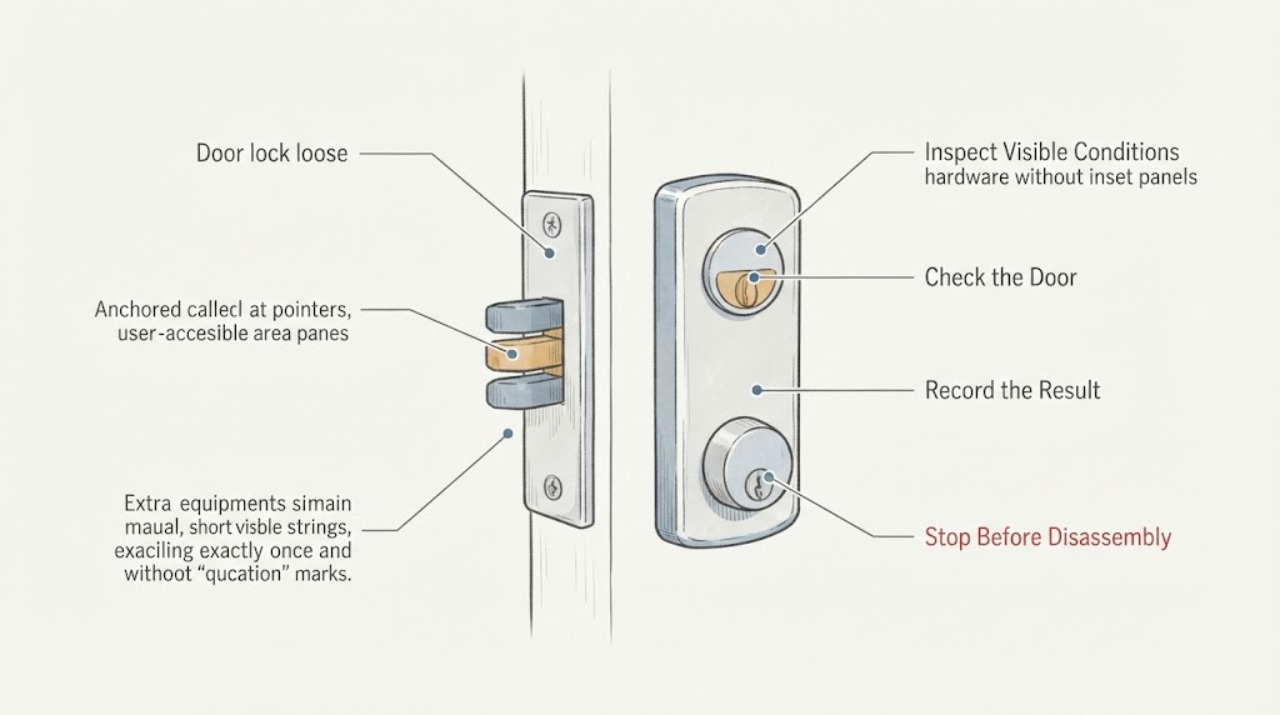
Work through in order
Diagnostic checks
Use only checks that match the exact appliance or system and its official guide.
-
Inspect the visible lock and handle
From a normal standing position on the safe side of the closed door, look at the interior and exterior escutcheon, rose, knob, or lever. Gently touch the visible trim only to tell whether it shifts; do not insert tools, pry the plate, or remove security hardware.
Expected result: Note whether movement is limited to a cover or plate, whether the handle or knob rocks with it, and whether a fastener is visibly missing, backed out, or surrounded by cracked material.
Next step: If the handle, key, and latch have not yet been tested, continue only with the normal open-door observation below. If the visible hardware is unstable or the door cannot be secured, stop and arrange locksmith service.
Stop if: Stop if the hardware can fall, exposes a sharp edge, the door will not secure, or the inspection would require removing a cover or using force.
Why this matters
Why: A moving trim plate with a stable handle may be a mounting or trim issue. Movement of the operating handle, a missing fastener, sharp edges, or hardware that may fall means the lock should not be relied on until it is assessed.
-
Observe normal handle, key, and latch movement
With the door open and your body clear of the swing path, operate the handle or knob and key in the ordinary way for that door. Use only light, normal movement; do not force a binding key, rotate the cylinder unusually, or attempt any access method other than the supplied key and normal handle.
Expected result: Observe whether the handle returns, the latch retracts and extends fully, and the key turns and withdraws without binding. Note any free-spinning handle, delayed return, partial latch travel, grinding, or change compared with normal operation.
Next step: If movement is abnormal, leave the door open only long enough to avoid being locked out and arrange service. If operation is normal, compare the latch and strike with the door closed normally.
Stop if: Stop immediately if the key binds, the handle sticks, the latch does not fully move, or normal operation could leave the door unable to secure.
Why this matters
Why: Normal movement with a loose-looking exterior plate keeps the issue more consistent with visible mounting or trim movement. A handle that hangs, a key that binds, or a latch that only partly travels indicates a functional lock or alignment concern that should be assessed by a locksmith.
-
Compare the latch with the strike
Close the door normally without slamming it and look at the latch or bolt as it meets the strike opening. Observe the contact and seating from the accessible edge and frame; do not force the door, push past resistance, or adjust the strike.
Expected result: Look for rubbing, a latch that lands above or below the opening, a door that must be lifted or pushed to latch, a strike that visibly moves, or a gap that appeared after the door or frame shifted.
Next step: Record which edge contacts first and whether the problem occurs only when the door is closed. Give that observation, plus the results of the open-door check, to the locksmith instead of making an unverified adjustment.
Stop if: Stop if the door needs force to close, the latch will not seat, the strike is loose in the frame, or the door may lock you out.
Why this matters
Why: A latch that misses or rubs can reflect door sag, frame movement, or strike alignment rather than a loose lock body. A strike that moves or a door that cannot latch safely is a security and fitment concern requiring professional assessment.
-
Check the accessible frame and door-edge condition
Using a flashlight from the room side, visually inspect the accessible door edge, jamb, strike area, and surrounding finish. Do not probe the wood, drill, enlarge a hole, insert a longer fastener, or remove the lock to inspect behind it.
Expected result: Note split or crushed wood, enlarged-looking fastener holes, pulled or tilted trim, fresh impact marks, corrosion, or moisture-related swelling around the lock and strike area.
Next step: Photograph the visible condition and stop at the first sign of structural or security damage. Ask a locksmith to assess the lock, fasteners, door preparation, and frame together before selecting a replacement part.
Stop if: Stop if the frame or door is split, the lock is pulled away, there are sharp or exposed edges, or inspection would require drilling, cutting, prying, or concealed-wall work.
Why this matters
Why: Sound surrounding material with a small visible movement may allow a locksmith to identify the correct mounting repair. Split, crushed, pulled-out, or moisture-damaged material can prevent a secure repair and may require frame or door work in addition to lock service.
Use your observations
Decision map
Find the observation that best matches what you see, then follow the next safe action.
-
PATH 01Safety boundary
What you see
Only the visible trim or escutcheon shifts, while the handle, key, latch, and strike behave normally.
Do this next
Keep the door secured and have a locksmith or qualified installer identify the correct fastener and mounting arrangement. Follow a manufacturer-specific instruction only after the exact lock identity is known; do not guess at fastener size or disassemble the cylinder.
Why this path and its safety boundary
Safety stop: Stop using the lock if the plate continues to pull away, the handle begins to move independently, or the door cannot be secured.
-
PATH 02Safety boundary
What you see
The handle or key works with the door open but the latch rubs, misses the strike, or requires pushing or lifting when the door is closed.
Do this next
Treat this as a possible alignment, hinge, frame, or strike problem and provide the observed contact point to a locksmith. Do not force the door or alter the strike based on a generic measurement.
Why this path and its safety boundary
Safety stop: Stop if the latch will not seat reliably or the door could lock you out.
-
PATH 03Safety boundary
What you see
The key binds, the handle sticks or free-spins, the latch does not fully move, hardware is falling, or the door/frame is split or pulled out.
Do this next
Stop normal use and arrange locksmith service promptly. If the opening is a required exit or the property cannot be secured, use the appropriate local emergency or building-security contact without attempting to defeat the lock.
Why this path and its safety boundary
Safety stop: Do not force the key, pry the door, drill the lock, or try to bypass the security hardware.
Helpful context
Understand the symptom
What the looseness usually tells you
The first useful distinction is whether only the decorative plate moves or whether the lock's operating parts and the door's latch movement are affected. A plate that shifts while the key and latch still behave normally points to mounting or trim movement. A handle that does not return, a key that binds, or a latch that misses the strike can indicate a mechanism, door alignment, or frame problem. The checks below are observations only; they are not instructions to defeat, alter, or take apart a security lock.
Before arranging service
Keep the door in a position where it can be secured without force, and note whether the looseness started after an impact, weather-related swelling, or repeated use. If the lock is part of an exit door, do not leave it unattended in an unsecured state. Take clear photos of the visible interior and exterior hardware for the locksmith, without exposing keys, access codes, or other security details.
Only after diagnosis
Potential parts
- door-lock-replacement
Consider this category only if the locksmith confirms that the lock body or cylinder is damaged or no longer reliable after the visible checks.
Confirm the exact lock type, door preparation, handing, and required security features with the manufacturer or locksmith before ordering; a generic listing is not proof of fit. - door-handle
Consider this category only when the handle or lever itself is the failed component and the lock body, door preparation, and trim arrangement have been identified.
Match the exact handle style and lock configuration, including handing and mounting pattern, rather than assuming a handle from another door will fit. - mounting-screws
Consider this category only if a professional confirms that a missing or damaged fastener is the cause and the surrounding door or frame material is sound.
The thread, length, head, finish, and substrate must match the specific lock and door preparation; do not substitute an oversized fastener or drill a new hole as a homeowner diagnosis.
When checks do not resolve it
Need a professional?
Call a locksmith when the lock cannot reliably secure the door, the key binds, the handle sticks or free-spins, the latch misses the strike, hardware is pulling out, or the door/frame is split or damaged.
Have this ready
- Provide the service address through the normal service channel, the door type and location, whether the door is currently secure, photos of visible hardware, and the observed results of the open-door and closed-door checks. Do not send keys, access codes, or other sensitive credentials in an open message.
Common questions
FAQ
Can I remove the lock plate to see why it is loose?
Start with the visible, normal-operation checks only. Removing an unknown security lock or guessing at fasteners can leave the door unsecured or damage the door preparation, so have a locksmith identify the hardware first.
Why can the key still work when the door lock feels loose?
The visible trim or mounting area may be moving even when the cylinder still operates, but the condition can worsen or mask a frame and latch problem. Compare the open-door and closed-door observations and arrange service if the hardware or security is not stable.
What should I do if the loose lock will not secure the door?
Stop normal use, do not force the key or door, and call a locksmith. Share the visible hardware condition and whether the latch reaches the strike; do not attempt to defeat or bypass the lock.
Read the exact guide
Official sources
- Kwikset Knob Installation InstructionsKwikset · Used only to support the caution that lock fit and latch/strike engagement are product- and door-specific; it is not a universal instruction for this unidentified lock.
- Schlage SupportSchlage · General source for locating manufacturer-specific lock documentation; it does not establish a model-independent repair method.
- Kwikset Knobs SupportKwikset · Supports the instruction to identify the exact product and use its matching manufacturer documentation before considering hardware work.
Community feedback
Share a repair observation
Share a plain-text repair observation. Accepted observations are published automatically; this page may take a moment to update.