
On this page
Start here
Quick answer
A rekey is usually the right service when the lock hardware is usable but you no longer trust who has copies of the keys—for example after moving, a tenant change, a lost or unreturned key, or a change in ownership. Before scheduling, confirm that you are authorized to change the lock, identify the lock type and visible brand or model without exposing a key code, list which old keys are missing or untrusted, and note whether the door and lock currently operate normally. A locksmith can determine whether the cylinder is rekeyable, whether an electronic or specialty lock needs a different service, and whether replacement is safer. Do not bypass, pick, force, decode, or disassemble the lock yourself.
Before you begin
Safety first
- The reader should limit work to ownership, access-control, and visible hardware observations. Do not bypass, pick, decode, force, destructively enter, expose key codes, or disassemble the lock.
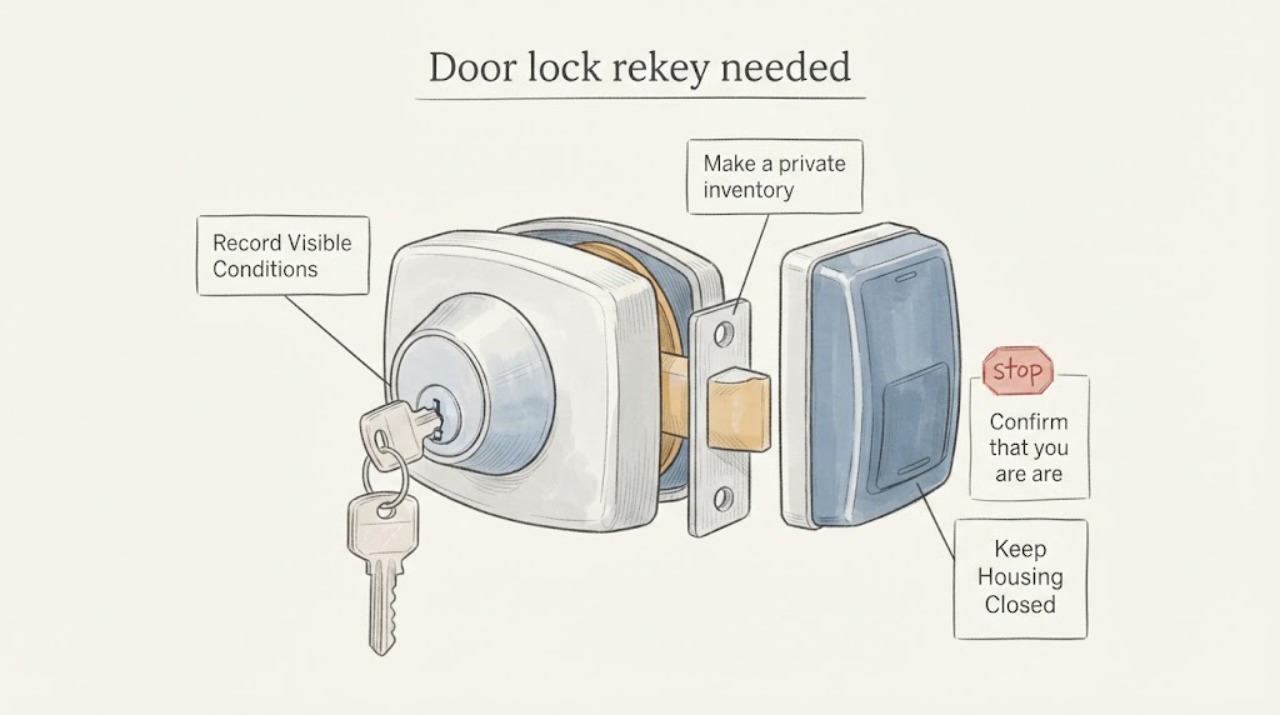
Work through in order
Diagnostic checks
Use only checks that match the exact appliance or system and its official guide.
-
Check 1
Confirm that you are the property owner, an authorized occupant, or an authorized property manager, and gather the documentation or management approval the locksmith may require; do not share private documents publicly.
Expected result: Authorization is clear, needs confirmation from an owner or manager, or cannot be established.
Next step: Tell the locksmith what authorization will be available at the appointment and arrange owner or manager participation when needed.
Stop if: Stop the request if you cannot establish a legitimate right to change the lock.
Why this matters
Why: Clear authorization allows a legitimate rekey request. Unclear authority must be resolved before a professional changes access control.
-
Check 2
From the exterior or interior without removing hardware, record the visible lock form—keyed knob or lever, deadbolt, handleset, mortise-style lock, keypad or electronic lock—and any visible manufacturer name or model marking.
Expected result: The lock type and visible identity are clear, only a partial marking is visible, or the lock appears electronic, specialty, or unknown.
Next step: Provide only the exterior-visible description and ask the locksmith to confirm rekey compatibility; do not send internal photographs or key-code information.
Stop if: Stop at identification if it would require removing the lock, opening a cover, exposing internal parts, or revealing a key code.
Why this matters
Why: A clear type helps the locksmith bring the right service path. An unknown or specialty lock may need an on-site assessment, a compatible cylinder, or replacement rather than a standard rekey.
-
Check 3
Make a private inventory of who may have an old key—former occupants, contractors, cleaners, property staff, or unknown holders—and whether any key was lost, stolen, copied, or not returned.
Expected result: All keys are accounted for, one or more keys are missing or unreturned, or the key history is uncertain.
Next step: Tell the locksmith the risk category and the number of doors affected, without naming people or exposing key images in public messages.
Stop if: Stop sharing details if a request asks for a key code, access code, or photograph that is not needed to schedule an authorized service.
Why this matters
Why: Missing, unreturned, or uncertain keys are a direct reason to request new key control. An accounted-for key history can still justify a rekey after ownership or occupancy changes.
-
Check 4
Observe whether the authorized user can operate the door, latch, and lock normally with the currently accepted key or credential, without forcing the key, pushing tools into the lock, or attempting entry without authorization.
Expected result: The lock operates normally, the key is stiff or intermittent, the latch does not align, or the user cannot safely test it.
Next step: Describe the symptom and door position to the locksmith and ask whether the appointment should include alignment or hardware assessment.
Stop if: Stop testing if the key bends, breaks, binds, or the door cannot be secured; do not force or lubricate an unknown mechanism.
Why this matters
Why: A normally operating lock may be suitable for a rekey assessment. Stiffness, alignment trouble, or an untestable lock may require repair, adjustment, cylinder replacement, or a different service before access control is changed.
-
Check 5
List the doors and locks that should share a key or have separate credentials, and note whether any are part of a rental, condominium, common-area, office, or restricted-access system.
Expected result: Only one private entry is involved, several private doors should be keyed alike, or the request includes shared, managed, or restricted doors.
Next step: Give the locksmith a door count and access-control goal, and obtain property-manager or system-owner approval for any shared or restricted lock.
Stop if: Do not request changes to a shared or restricted system without the responsible system owner's authorization.
Why this matters
Why: The scope changes what compatibility and authorization the locksmith must verify. Shared or restricted systems may have a master-key or property-management policy that overrides a private rekey request.
Use your observations
Decision map
Find the observation that best matches what you see, then follow the next safe action.
-
PATH 01Safety boundary
What you see
Authorization is clear, the lock operates normally, and the hardware type is identifiable.
Do this next
Schedule an authorized locksmith rekey assessment and provide the door count, key-control goal, visible lock identity, and operation observations.
Why this path and its safety boundary
Safety stop: Do not attempt the internal rekey procedure yourself unless a qualified professional confirms the exact product and safe scope.
-
PATH 02Safety boundary
What you see
The lock is electronic, specialty, mortise-style, unknown, or the visible brand does not confirm compatibility.
Do this next
Ask the locksmith to assess whether it can be rekeyed, reprogrammed, or replaced and what credentials or owner approval are required.
Why this path and its safety boundary
Safety stop: Do not open the lock, expose its code, or substitute a generic cylinder based on appearance.
-
PATH 03Safety boundary
What you see
The key history includes a lost, stolen, unreturned, or unknown key.
Do this next
Tell the locksmith the key-control risk and request a rekey or replacement recommendation for every affected door.
Why this path and its safety boundary
Safety stop: Do not rely on recovering the old key or on a verbal promise that it was destroyed.
-
PATH 04Safety boundary
What you see
The lock is stiff, the latch is misaligned, or the door cannot be secured normally.
Do this next
Request a combined lock, door-alignment, and rekey assessment rather than treating the request as a key change only.
Why this path and its safety boundary
Safety stop: Do not force the key, defeat the lock, or leave the property unsecured while testing.
-
PATH 05Safety boundary
What you see
The lock belongs to a rental, condominium, master-key, common-area, or other managed system.
Do this next
Obtain written or documented approval from the responsible owner or manager and use the system's authorized locksmith path.
Why this path and its safety boundary
Safety stop: Do not change a shared or restricted lock without system-owner authorization.
Helpful context
Understand the symptom
Rekeying changes which key operates a compatible lock while leaving the main hardware in place. It is different from replacing the complete lock, and it is not the same as recovering access to a locked property. The correct choice depends on authority, lock type, hardware condition, and the level of confidence you need over old keys.
Keep the preparation focused on access control, not entry techniques. Gather ownership or management authorization, a private description of the keys you control, and exterior-visible lock information. Do not send key photographs, key cuts, access codes, or security details through an unverified channel.
Manufacturer systems differ. Some modern products advertise a model-specific rekey feature, while other mechanical, electronic, mortise, and specialty locks may require a locksmith or a cylinder change. A brand name alone does not prove that a particular lock can be rekeyed or keyed alike.
Use the observations below to give a locksmith a safe, accurate service brief. The article does not provide bypass, picking, forced-entry, key-code, or internal lock-disassembly instructions.
Only after diagnosis
Potential parts
- rekeyable lock
Consider a replacement rekeyable lock only if the existing lock is not compatible, damaged, or unsuitable after a locksmith's assessment.
Confirm door preparation, backset, handing, security requirements, keyway, and property approval; do not infer fit from exterior style alone. - key cylinder
Consider a cylinder only if the locksmith determines that the current lock body can remain and the cylinder is the appropriate authorized repair.
Match the exact lock family, cylinder format, keyway, finish, and security system through the professional; no generic compatibility is assumed.
When checks do not resolve it
Need a professional?
Safety scope: The reader should limit work to ownership, access-control, and visible hardware observations. Do not bypass, pick, decode, force, destructively enter, expose key codes, or disassemble the lock.
Have this ready
- Share authorization status, door count, private key-history category, visible lock type and brand or model marking, normal-operation observations, managed-property restrictions, and whether you want one key or separate credentials.
Common questions
FAQ
When should I rekey a door lock instead of replacing it?
Rekeying may fit when the hardware is compatible and operates normally but old keys are no longer trusted. Replacement may be better when the lock is damaged, incompatible, specialty, or part of a managed system that requires a different cylinder or credential plan.
Do I need to show a locksmith proof that I own or manage the property?
Be prepared to establish authorization. Requirements vary, but a legitimate locksmith may need owner, occupant, or property-manager confirmation before changing access control. Resolve authorization before the appointment.
Can I send a photo of my key or key code to get a rekey quote?
Do not expose key cuts, key codes, access codes, or detailed security information through an unverified channel. Provide a private description of the lock type and let the authorized locksmith inspect what is necessary in person.
Read the exact guide
Official sources
- How to Re-Key SupportKwikset · Used only to show that rekey behavior is product-specific and that a manufacturer may distinguish lock types and current-key requirements; the article intentionally omits the manufacturer's step-by-step procedure.
- Security you control with Advanced RekeySchlage · Used as a product-specific example that rekey features can apply to certain mechanical and electronic lock families and may require a current working key; it is not a universal rekey method.
Community feedback
Share a repair observation
Share a plain-text repair observation. Accepted observations are published automatically; this page may take a moment to update.