
On this page
Start here
Quick answer
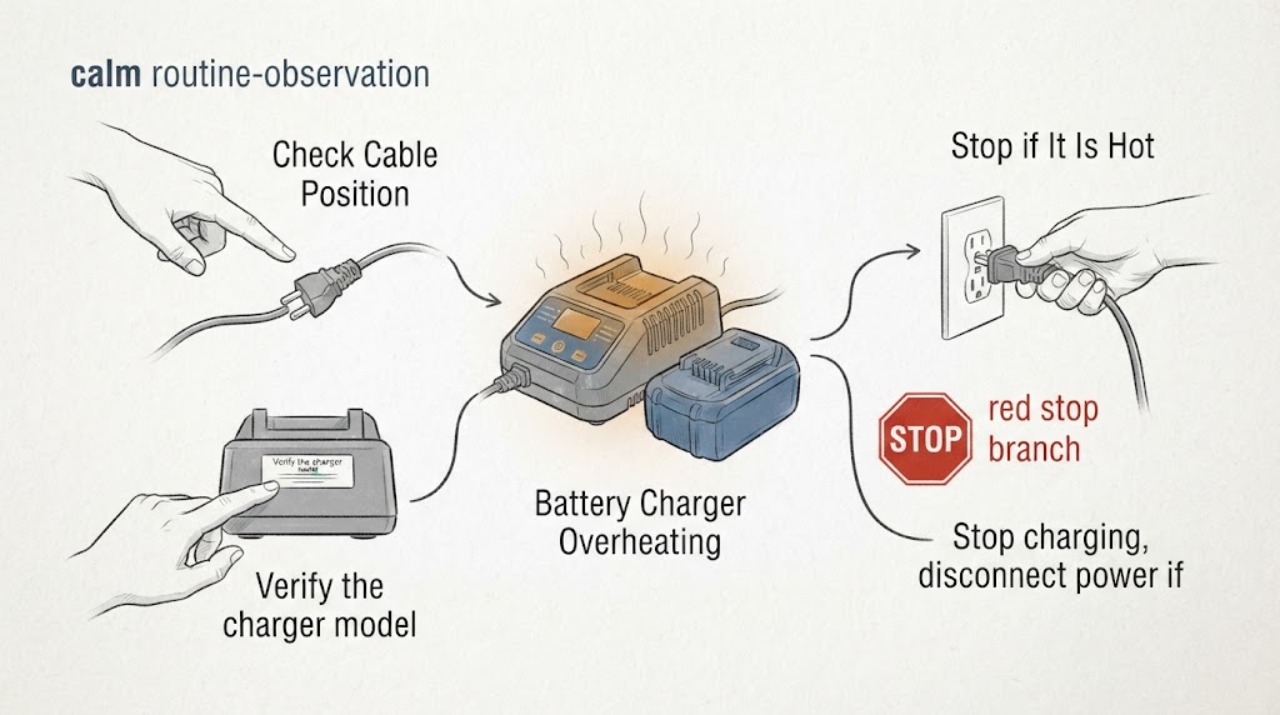
A battery charger that becomes unusually hot should be unplugged and allowed to cool on a nonflammable surface. Check the charger, cable, battery, ventilation, and model compatibility only from the outside and only as the manufacturer's manual permits. If there is swelling, smoke, odor, melting, arcing, repeated overheating, or an incompatible or recalled charger, stop using it and arrange qualified service or the manufacturer's replacement process.
Work through in order
Diagnostic checks
Use only checks that match the exact appliance or system and its official guide.
-
Check 1
Stop charging, disconnect power if the plug and area are dry and undamaged, and move the charger away from flammable material without touching a smoking or melting unit.
Expected result: Smoke, odor, swelling, melting, arcing, or extreme heat is present.
Next step: Leave the charger out of service, evacuate for an active fire, and contact emergency or qualified service as appropriate.
Why this matters
Why: These are fire or battery safety warnings, not a normal charging condition.
-
Check 2
After it is cool and disconnected, inspect the external charger label, cable, plug, battery pack, connectors, and ventilation for damage or mismatch; do not open the charger or battery.
Expected result: The charger is damaged, the battery is swollen, the connector is loose, ventilation is blocked, or all visible parts appear normal.
Next step: Replace or service only through the manufacturer's exact instructions. Keep using no charger that is damaged or incompatible.
Why this matters
Why: Damage, swelling, poor ventilation, or mismatch can cause overheating; normal exterior appearance does not prove internal safety.
-
Check 3
Verify the charger model and battery compatibility against the manufacturer's manual or recall database before one supervised charge; do not use a power strip or unapproved substitute if the manual prohibits it.
Expected result: The combination is confirmed compatible, compatibility is uncertain, or overheating returns.
Next step: Do not charge when compatibility is uncertain or heat returns. Use the manufacturer's replacement/service path.
Why this matters
Why: Compatibility is a model-specific fact; recurrence indicates the charger, battery, or supply remains unsafe.
Use your observations
Decision map
Find the observation that best matches what you see, then follow the next safe action.
-
PATH 01Next step
What you see
Only mild warmth occurs within the manufacturer's documented normal range and no damage or odor is present.
Do this next
Monitor only under the manufacturer's instructions.
Why this path and its safety boundary
Why it matters: Normal operation may be possible, but compatibility still needs the exact manual.
-
PATH 02Next step
What you see
The charger or battery is too hot, damaged, swollen, mismatched, or repeatedly overheats.
Do this next
Stop charging and arrange the manufacturer's replacement or qualified service.
Why this path and its safety boundary
Why it matters: A charging or battery fire hazard is possible.
-
PATH 03Next step
What you see
Smoke, melting, arcing, or an active fire occurs.
Do this next
Leave the area and contact emergency services; do not handle the device.
Why this path and its safety boundary
Why it matters: An immediate fire hazard is present.
Helpful context
Understand the symptom
A warm charger can differ from a charger that is too hot to touch, smells, changes shape, or heats the battery. Treat smoke, swelling, melting, or arcing as an immediate stop condition.
CPSC charger warnings emphasize that apparently universal chargers may be incompatible and can pose fire or burn hazards. Use the exact charger and battery instructions rather than substituting ratings by appearance.
When checks do not resolve it
Need a professional?
Stop charging and seek qualified service or the manufacturer's replacement process for recurrent overheating, swelling, smoke, odor, melting, arcing, damaged cables, or uncertain compatibility.
Common questions
FAQ
Can I use another charger with the same connector?
Only if the exact manufacturer documentation confirms compatibility. Connector fit alone does not establish safe voltage, current, or battery chemistry.
Read the exact guide
Official sources
- Consumer Product Safety CommissionUSAGov · Consumer-product electrical and fire hazard safety
- CPSC Warns Consumers to Immediately Stop Using SafPow and AMPOWSURE Battery ChargersU.S. Consumer Product Safety Commission · Battery-charger incompatibility, overheating, fire, and stop-use safety
Community feedback
Share a repair observation
Share a plain-text repair observation. Accepted observations are published automatically; this page may take a moment to update.