
On this page
Start here
Quick answer
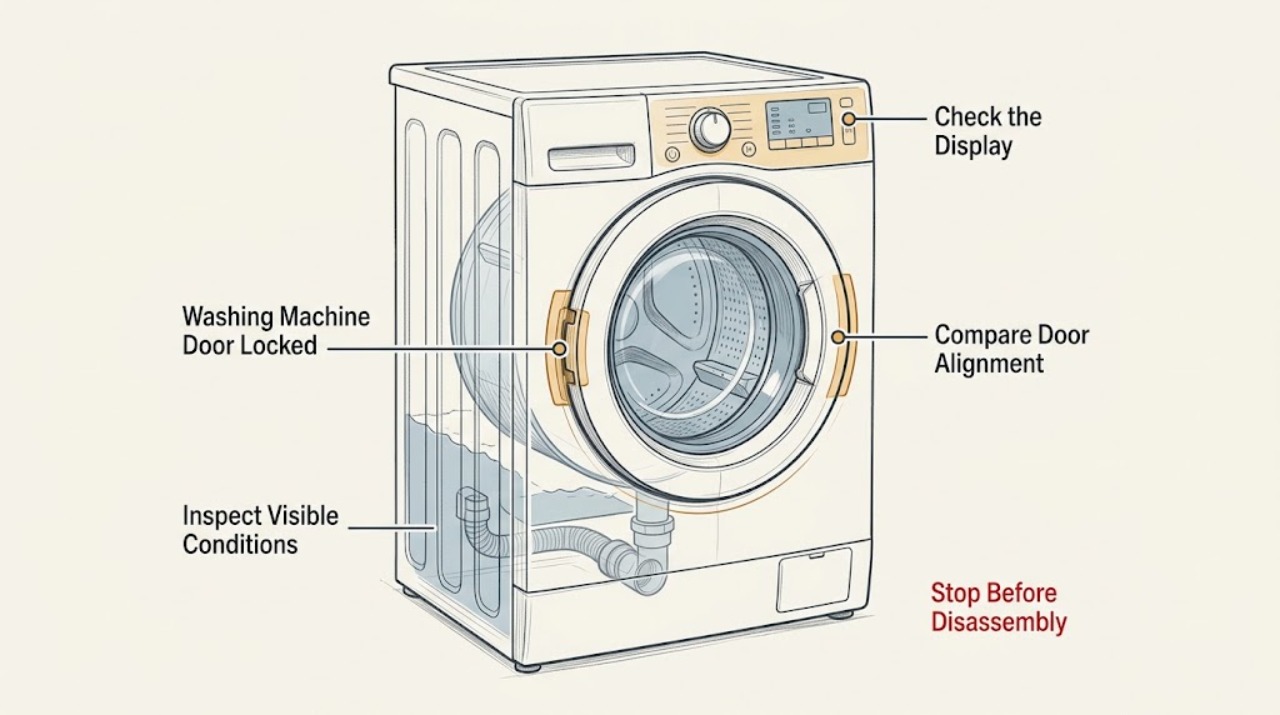
Do not force a locked Bauknecht washing-machine door. First determine whether the program has really ended and allow the model's normal unlock delay to finish; Bauknecht's own door-lock guidance says the door can remain blocked briefly after the cycle ends. If water is visible, use the exact model manual's Drain or Spin procedure rather than pulling the door. Then check the visible door closure, pause or delay setting, child lock, and displayed error. If the lock stays on after the drum is safe and the manual-directed checks or one permitted reset do not clear it, stop and arrange authorized service; never bypass the lock or open the cabinet.
Work through in order
Diagnostic checks
Use only checks that match the exact appliance or system and its official guide.
-
Check 1
Leave the door closed and observe the display, lock indicator, cycle stage, water level, and any error message. Note whether the program was just canceled, has just ended, or stopped unexpectedly.
Expected result: The cycle is still running or cooling, the end status is shown, water is visible, or a fault indication is present.
Next step: Wait for the documented end state only when no hazard is present. If there is a leak, burning smell, damaged cord, water near electricity, or an unsafe hot drum, stop and use the safety-service branch.
Why this matters
Why: A lock during an active or recently completed cycle may be normal. Water or an error means the washer may be protecting against opening an unsafe drum, not simply holding the door shut.
-
Check 2
Confirm that the selected program has actually ended, then allow the model's normal unlock delay to pass without pulling the handle. Bauknecht's door FAQ describes a short post-cycle lock for the models it addresses; use the exact manual if its timing or indicator differs.
Expected result: The lock indicator goes out and the door opens normally, or it remains on after the program end state and the model-directed waiting period.
Next step: If the door releases, remove laundry normally. If it stays locked, continue with the safe water and control checks; do not force it or use a tool.
Why this matters
Why: A normal release after the delay indicates a safety hold rather than a failed lock. A continuing lock means water, temperature, a control state, or the lock circuit may still be preventing release.
-
Check 3
If water is visible in the drum, use the exact model manual to select its Drain, Spin, or equivalent pump-out program. Keep hands away from the door gap and do not open the filter, hose, or plumbing while water is present unless the manual explicitly defines a safe owner procedure.
Expected result: Water pumps out and the lock clears, water remains, or a drain-related error returns.
Next step: If one documented pump-out succeeds, wait for the normal unlock state. If water remains or the pump-out faults, stop and request service rather than draining through improvised methods or moving the appliance.
Why this matters
Why: The lock may be preventing a spill while water remains above the safe door-opening level. Failure to pump out leaves a drain path or internal pump fault possible.
-
Check 4
Inspect only the visible door edge and seal for an obvious item preventing closure, then check the panel for Pause, Start Delay, child lock, or an error state. Do not push against the locked door or defeat the lock switch.
Expected result: The door was not fully latched or a visible pause/delay/lock setting is active, or the door and controls appear normal but the lock remains engaged.
Next step: Correct only an obvious obstruction or visible setting according to the exact manual, then make one start or resume attempt. If the lock remains abnormal, stop and use the service branch.
Why this matters
Why: Bauknecht troubleshooting guidance identifies incomplete door closure, control settings, and lock functions as possible causes of a program not starting. A normal-looking door with a persistent lock points toward a sensor or lock fault.
-
Check 5
From a dry, safe position, confirm that the plug is seated and the household protection has not tripped. If the exact manual permits a reset, switch the washer off, disconnect it only by a safely reachable dry plug, wait once for the manual's interval, and restore power; do not repeat resets.
Expected result: The washer returns to a normal display and unlocks, or the lock/error returns immediately after the one permitted reset.
Next step: Stop using the washer if the lock or error returns. Do not open panels or test wiring; record the message and arrange qualified appliance service.
Why this matters
Why: A one-time recovery can reflect a temporary control or supply interruption. A repeated lock or error after stable external power is not evidence that the door should be bypassed.
-
Check 6
Record the model and serial information, displayed error, cycle stage, whether water was visible, and what happened after the documented wait, pump-out, and one reset attempt. Keep the door closed until service gives model-specific instructions.
Expected result: The lock remains engaged without a safe explanation, the washer will not complete or drain, or the same indication recurs.
Next step: Stop using the washer and provide the recorded sequence to authorized service. Do not remove the lock, cabinet, or electrical covers yourself.
Why this matters
Why: A persistent lock after safe external checks can involve the door-lock assembly, drain system, temperature or water-level sensing, control, or power circuit; those causes require isolation and diagnosis.
Use your observations
Decision map
Find the observation that best matches what you see, then follow the next safe action.
-
PATH 01Next step
What you see
There is an active leak, burning smell, damaged cord, water near electrical equipment, an unusually hot drum, or unsafe access.
Do this next
Stop the washer. Isolate power only from a safely reachable dry control if this can be done without contact with water or damage; otherwise leave it alone and contact a qualified appliance, electrical, or plumbing professional.
Why this path and its safety boundary
Why it matters: The locked-door problem has become a water, heat, fire, or electrical safety concern.
-
PATH 02Next step
What you see
The program has just ended and the lock indicator clears after the exact model's normal wait, with no water or hazard present.
Do this next
Open the door normally and leave it ajar after unloading. No part replacement is indicated by this observation alone.
Why this path and its safety boundary
Why it matters: The lock was performing its normal safety function.
-
PATH 03Next step
What you see
Water remains, the washer is paused or delayed, the door is not visibly latched, or an error prevents the program from completing.
Do this next
Use only the exact manual's Drain/Spin, resume, or visible-setting procedure once. If the lock remains, stop and use qualified service; do not force or bypass it.
Why this path and its safety boundary
Why it matters: The lock may be responding to water level, cycle state, door feedback, or a documented control condition.
-
PATH 04Next step
What you see
The door remains locked after the safe wait and one model-directed pump-out or reset, or the washer repeats a lock/error indication.
Do this next
Stop using the washer and arrange authorized appliance service. Provide the model, serial information, error, water level, and observed sequence; do not open the cabinet or perform live testing.
Why this path and its safety boundary
Why it matters: An internal lock, drain, sensor, control, or power fault remains possible.
Helpful context
Understand the symptom
A locked door is often a safety state
The lock can remain engaged while a cycle is running, while the drum still contains water, or while the washer is waiting for a safe temperature or control state. A door that unlocks after the documented delay is different from a lock that stays on with an error, leak, or full drum. The exact unlock behavior and emergency procedure are model-specific, so the rating plate and matching manual control.
Do not force or bypass the door lock
Keep the door closed if water is visible or the drum may be hot. Do not pull the handle, insert tools, bypass the interlock, tilt a water-filled washer, remove panels, or reach into the drum through a gap. Stop for a leak, burning smell, damaged cord, water near electrical equipment, or any uncertainty about safe access, and use qualified service.
Only after diagnosis
Potential parts
- door-lock or latch assembly
Consider this category only if a qualified technician confirms that the door cannot release or provide lock feedback after water level and control conditions are normal.
Verify the exact model and approved fit before ordering; no universal lock compatibility is assumed. - drain pump or water-level sensor
Consider this category only when the technician confirms that remaining water or an incorrect level signal is keeping the lock engaged after the visible drain path is clear.
Confirm the exact model and component fit with authorized service before replacement; do not infer a failed part from the locked indicator alone.
When checks do not resolve it
Need a professional?
Contact authorized appliance service when the door stays locked after the model-specific wait and safe pump-out or control checks, when water remains, when an error returns, or when diagnosis would require removing the lock, opening panels, moving a water-filled appliance, or testing electrical circuits. Stop immediately for a leak, burning smell, damaged cord, water near electricity, or an unusually hot drum.
Common questions
FAQ
Why is my Bauknecht washing-machine door still locked after the cycle?
The door may remain locked briefly after the program ends for safety, or because water, temperature, an error, or the door-lock circuit still prevents release. Wait for the exact model's normal delay and never force the handle.
How can I open a locked Bauknecht washer if there is water inside?
Do not pull the door. Use the exact model manual's Drain or Spin procedure once if the controls respond. If water remains or the pump-out fails, stop and arrange qualified service rather than opening plumbing or moving the machine.
Can I bypass the Bauknecht washing-machine door lock?
No. The lock is a safety device. Do not insert tools, defeat the interlock, or remove panels; a persistent lock requires model-specific diagnosis by authorized service.
What should I tell service about a locked Bauknecht washer?
Provide the exact model and serial information, the display message, cycle stage, whether water was visible, how long you waited, and what happened after the manual-directed pump-out or one reset. This lets the technician distinguish a normal safety hold from a recurring fault.
Read the exact guide
Official sources
- Wieso lässt sich die Bullaugentür nicht öffnen?Bauknecht · Bauknecht washing-machine door-lock FAQ
- Die Waschmaschine startet nicht: So finden Sie den FehlerBauknecht · Bauknecht washing-machine no-start troubleshooting and error guidance
Community feedback
Share a repair observation
Share a plain-text repair observation. Accepted observations are published automatically; this page may take a moment to update.