
On this page
Start here
Quick answer
An AEG washing-machine door can remain locked while a cycle is still hot, the drum is rotating, or water remains inside. Wait for the lock indicator to clear after the programme ends, then check whether water is visible and run the model's drain programme before considering an emergency drain. If a padlock or key symbol is shown, clear Child Lock using the exact model instructions. Never force or pry the door. AEG documents a model-specific emergency release only after switching off, disconnecting power, checking water level and temperature, and confirming the drum is stopped; if the door stays locked, the lock or drain fault persists, or water spills when opened, keep the machine out of use and arrange qualified service.
Before you begin
Safety first
- Keep the washing machine disconnected and do not force the door, bypass the interlock, open a full or hot drum, or remove cabinet-level lock and pump components.
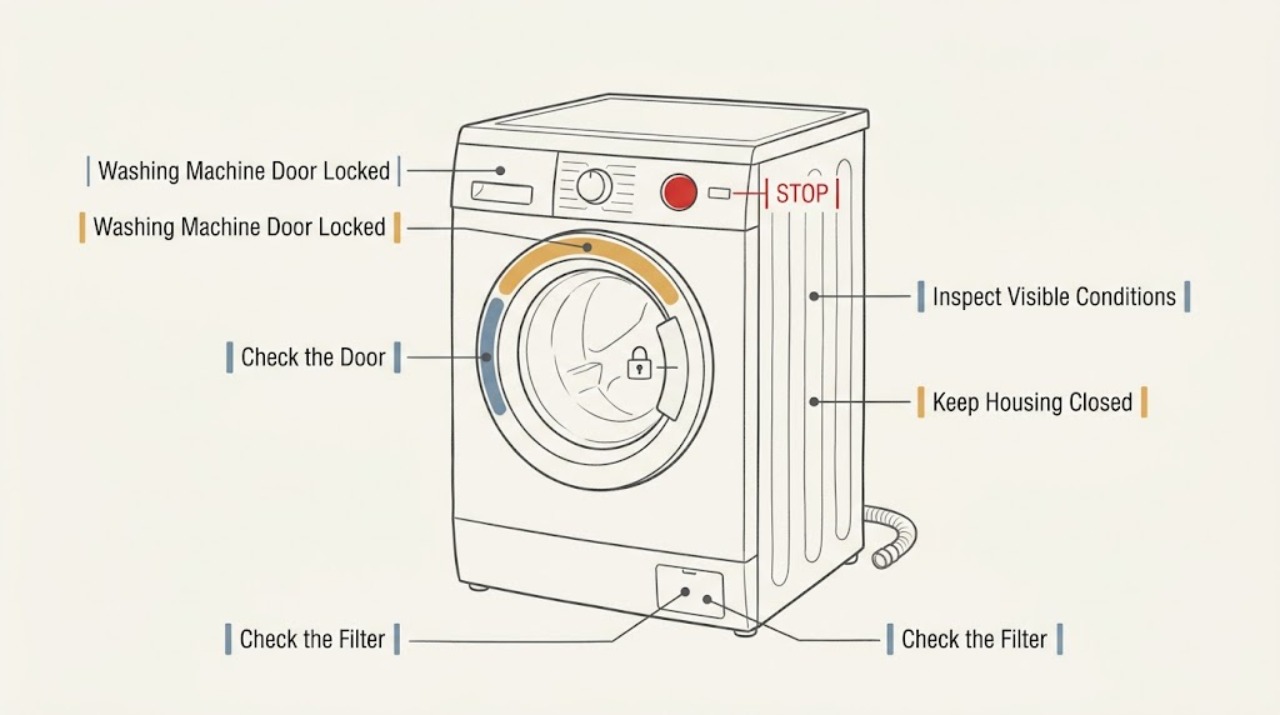
Work through in order
Diagnostic checks
Use only checks that match the exact appliance or system and its official guide.
-
Check 1
Leave the door closed while the programme is active or just finished. Press Start/Pause or On/Off only as the model manual directs, and wait for the lock icon to clear or the unlock sound. Do not pull the handle, wedge the door, or reach into the drum.
Expected result: Note whether the drum is still rotating, whether the water feels or appears hot through the glass, how long the programme has been finished, and whether the lock indicator remains on.
Next step: If the drum is stopped, the water is not hot, and the lock clears, open normally. If the lock remains, continue to the water-level check without forcing it.
Stop if: Do not force the door during a wash or spin cycle and do not open it while the drum is rotating or water is hot.
Why this matters
Why: AEG states that a door may remain locked briefly after a cycle while the lock cools, and that a rotating or hot drum is not ready to open. If the icon clears after the normal wait, the behavior is likely a safety state rather than a failed lock.
-
Check 2
Check through the door for standing water and read the display for a drain, pump, or error indication. If the manual provides a normal drain programme, use that programme before opening any filter or hose. Keep a shallow container and towels ready only if the model manual describes an emergency drain.
Expected result: Water may be visible in the drum, the drum may be empty, the machine may drain normally, or water may fail to leave while the door-lock icon remains on.
Next step: Run the model's documented drain cycle if safe. If it will not drain, switch off and follow only the exact manual procedure for the fluff filter or emergency drain, or arrange service.
Stop if: Do not loosen a filter or hose with a full drum unless the manual and a safe collection method clearly cover your model.
Why this matters
Why: AEG says the door cannot be opened while water is in the machine; a blocked or failed drain can therefore keep the interlock engaged. A full drum makes an emergency opening a spill and possible burn hazard.
-
Check 3
Look for a padlock or key symbol and check whether the controls respond only to On/Off. Use the exact AEG model manual or its marked control-panel buttons to clear Child Lock; do not guess a combination. After clearing it, select the same programme and observe whether the lock indicator changes.
Expected result: The padlock may disappear, remain present, or be absent while the door still stays locked. The panel may become responsive, or it may continue to ignore programme and Start/Pause commands.
Next step: If the icon clears, let the current safe drain or end-of-cycle state complete and test the door normally. If it remains or the panel is unresponsive, continue to the physical door check and service boundary.
Stop if: Do not defeat Child Lock with a tool or use the handle as a substitute for clearing the interlock.
Why this matters
Why: AEG identifies the padlock as Child Lock and notes that the release buttons differ by model. A cleared Child Lock can restore normal control, but it does not override a full drum, active cycle, or physical interlock fault.
-
Check 4
Once the door is open, or before starting a new cycle if it is closed, inspect the latch area and door seal for clothing caught between the glass and seal. Check that the drum is not overloaded and that the machine stands level and does not rock. Remove only visible laundry that prevents normal closure.
Expected result: The latch may click and align normally, or the door may sit proud, fail to click, show trapped fabric, or close only when pushed unusually hard. Record E40/E41 or other exact indicators.
Next step: Remove trapped or excess laundry, close the door normally, and test one programme. If E40/E41 returns or the latch/hinge is damaged, stop use and request service.
Stop if: Do not slam, tape, wedge, or bypass the door lock, and do not operate with a damaged seal that can leak.
Why this matters
Why: AEG links poor closure, trapped laundry, overloading, an unlevel machine, and faulty door-lock detection to start/lock problems. A door that cannot be detected safely is an interlock fault, not a reason to keep pressing the handle.
-
Check 5
If the door is still locked after the machine is off, disconnected, drained as far as the model allows, cool, and motionless, check whether the owner manual explicitly describes an emergency release for that model. Use it only exactly as documented; otherwise do not improvise a release near the filter, lock, seal, or front panel.
Expected result: The manual may identify a model-specific release near the fluff filter, or it may provide no user release. After a documented release, check whether water spills, the latch is damaged, or the lock remains engaged.
Next step: If the documented release is absent, unclear, or unsuccessful, keep the appliance unplugged and request authorised service. Provide the model, water level, lock symbol, and any error code.
Stop if: Never pry the door, insert a tool into the lock, or perform an emergency release while water is hot, the drum can move, or the model procedure is unknown.
Why this matters
Why: AEG limits emergency opening to selected models and requires checks for water level, temperature, and drum movement. A release that does not work, a spill, or a damaged lock indicates a fault requiring service rather than more force.
Use your observations
Decision map
Find the observation that best matches what you see, then follow the next safe action.
-
PATH 01Next step
What you see
The cycle has just ended and the drum is stopped but the lock icon has not yet cleared.
Do this next
Wait for the model's unlock indication and open normally; do not pull the handle.
Why this path and its safety boundary
Why it matters: A short post-cycle interlock cooling period may be normal.
-
PATH 02Next step
What you see
Water remains in the drum or the machine cannot complete its drain.
Do this next
Run the documented drain programme; if it fails, follow the exact model emergency-drain instructions or call service.
Why this path and its safety boundary
Why it matters: The interlock is keeping the door closed for a water-level safety condition, with a drain fault still possible.
-
PATH 03Next step
What you see
A padlock or key symbol is displayed and the panel is otherwise responsive.
Do this next
Clear it with the model-specific button sequence from the manual and retest without forcing the door.
Why this path and its safety boundary
Why it matters: Child Lock may be preventing normal control or start behavior.
-
PATH 04Next step
What you see
E40/E41 appears, the door will not latch, or laundry is trapped at the seal.
Do this next
Remove visible obstruction or excess laundry and try once; arrange service if the code or latch fault persists.
Why this path and its safety boundary
Why it matters: The machine may not be detecting a safe closed door; overload, alignment, or lock failure remains possible.
-
PATH 05Next step
What you see
The door remains locked after a safe drain, the drum is cool and stopped, and the model's documented emergency release is absent or fails.
Do this next
Keep the washing machine disconnected and request authorised service; do not pry the door or remove the lock.
Why this path and its safety boundary
Why it matters: A door-lock, drain, or control fault requires professional diagnosis.
-
PATH 06Next step
What you see
The door opens unexpectedly during a filled wash or spin, or water spills when it is opened.
Do this next
Switch off and disconnect the appliance, contain the water only if safe, and arrange immediate service.
Why this path and its safety boundary
Why it matters: The safety interlock or water-level condition may be defective and the appliance is unsafe to continue using.
Helpful context
Understand the symptom
Locked does not always mean broken
The interlock is meant to keep the door closed while the drum rotates, the water level is unsafe, or the water is hot. A short wait after a completed programme can be normal. The useful distinction is whether the lock icon clears, whether water remains in the drum, and whether the door can close and be detected normally on the next cycle.
Why a generic release trick is unsafe
AEG shows an emergency release only for selected models and places it near the filter area. The release does not make a full or hot drum safe, and a tool-based opening can spill water or damage the interlock. Use the owner's manual for the exact model; if its release is not clearly described, stop at the service boundary.
Safety boundary
Stop conditions
- Do not force, pry, wedge, or bypass the door lock or Child Lock.
- Stop if water is hot, the drum is rotating, water spills unexpectedly, or the door can open during a filled wash or spin.
- Keep the machine disconnected for a damaged latch, hinge, seal, repeated error code, or failed drain that leaves water inside.
- Do not use a generic emergency-release tool or remove the lock unless the exact model manual explicitly covers it.
Only after diagnosis
Potential parts
- door safety interlock
A persistent lock or E40/E41 after correct closure can lead a technician to inspect the interlock, but water level, wiring, latch alignment, and control faults can present similarly.
Confirm the full model and product identification; the symptom and brand alone do not establish fit. - door latch or hinge assembly
A door that will not align or engage may require latch or hinge inspection after trapped laundry and overload are excluded.
Match the exact model and door configuration only after professional diagnosis. - drain pump or filter assembly
Water left in the drum can keep the door locked and may lead service to inspect the drain path, but the water level alone does not identify a failed pump.
Use the model manual and technician findings; do not open a filter with unsafe water pressure or temperature. - door seal
A damaged seal or trapped fabric can prevent proper closure and cause leaks, but a locked door does not by itself prove the seal needs replacement.
Confirm model-specific dimensions and the cause of the closure problem before selecting a seal.
When checks do not resolve it
Need a professional?
The door remains locked after the drum is stopped, cool, and drained as far as the model safely allows., The machine shows E40/E41 repeatedly, the latch or hinge is damaged, or laundry cannot be removed without force., The pump will not drain, water remains in the drum, the emergency release is unclear or fails, or water spills during opening., The door opens while the machine is full or during a wash/spin cycle.
Safety scope: Keep the washing machine disconnected and do not force the door, bypass the interlock, open a full or hot drum, or remove cabinet-level lock and pump components.
Common questions
FAQ
How long should an AEG washing-machine door stay locked after a cycle?
AEG says the door can take about 3–5 minutes to open after a wash while the lock cools. If the lock icon remains, check for water, a rotating drum, a code, or Child Lock; do not force the handle.
Why is my AEG washer door locked with water inside?
AEG states that water in the machine prevents the door from opening. Use the model's normal drain programme first; if it cannot drain, follow the exact emergency-drain instructions or arrange service rather than opening a full drum.
What does the padlock symbol mean on an AEG washing machine?
AEG identifies the padlock as Child Lock. The button or button pair varies by model, so use the manual for the exact sequence; clearing Child Lock does not make it safe to open a hot or full drum.
Can I force open an AEG washing-machine door?
No. Forcing or prying can damage the interlock and release hot water. AEG documents an emergency release only on selected models and only after power is disconnected, the water level and temperature are safe, and the drum has stopped; otherwise use qualified service.
Read the exact guide
Official sources
- The door of the washing machine cannot be openedAEG · AEG front-loading washing machines with a stuck door, key/lock icon, water in the drum, or an emergency-opening question
- The washing machine door does not close properlyAEG · AEG front-loading washing machines whose door cannot close or whose programme will not start
- Washing Machine Error Code E40, E41 (4 Beeps / 4 Flashes): Causes & FixesAEG · AEG front- and top-loading washing machines or washer-dryers showing E40/E41 door detection errors
- Opening washing machine's door at the beginning of wash cycleAEG · AEG washing machines and washer-dryers whose door lock persists during or shortly after a cycle
- Washing machine displays padlock - AEGAEG · AEG washing machines showing a padlock and appearing unresponsive or unable to start
Community feedback
Share a repair observation
Share a plain-text repair observation. Accepted observations are published automatically; this page may take a moment to update.