
On this page
Start here
Quick answer
A Beko washing-machine door can remain locked because the cycle is still running, the water is hot or above the safe level, the machine has not finished draining, Remote Start is active on applicable models, or power has failed. First wait for the programme to finish and the lock to release, then check whether water remains in the drum. If water is present, use the exact model's Pump or Spin/Drain programme only when safe; do not force the door. If the machine still will not unlock, isolate power only from a dry, safe position and use the model manual's pump-filter drain and emergency-release procedure only after confirming there is no water that could overflow. A damaged lock, blocked filter, persistent drainage problem, or door that stays locked after safe checks needs qualified Beko service.
Before you begin
Safety first
- The reader may wait for a cycle, observe the water level, and use only the exact manual's accessible drain or filter procedure from a dry safe position. Do not force the door, bypass the lock, open panels, probe wiring, reach into the pump, or improvise an emergency release.
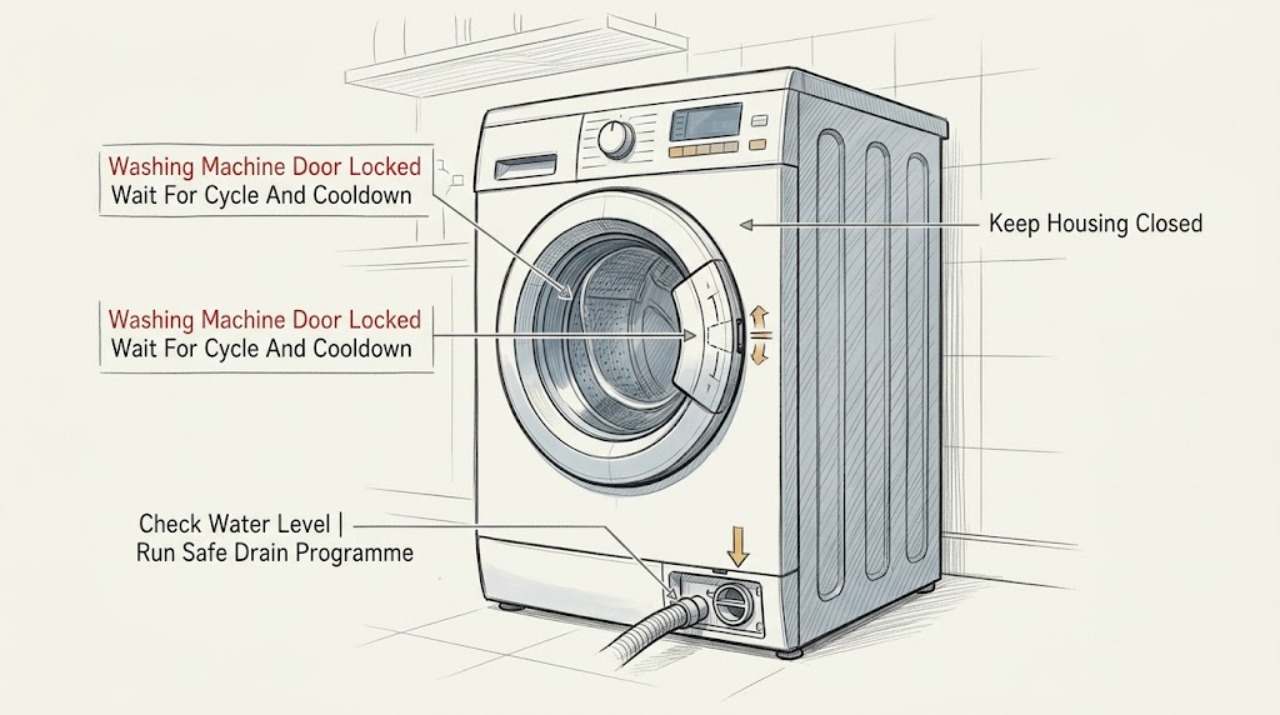
Work through in order
Diagnostic checks
Use only checks that match the exact appliance or system and its official guide.
-
Check 1
Check the display and programme selector without pulling the door. If a wash, spin, or dry-related programme is still active or paused, let the exact programme finish; after completion, wait briefly for the lock to release and listen for the lock to disengage.
Expected result: The programme is still running, the machine is in a hot/heating or spinning phase, the lock releases after completion and a short wait, or the programme is finished but the lock remains shown.
Next step: If it releases, open normally. If it remains locked, continue with the water-level and drainage checks without forcing the handle.
Stop if: Stop for steam, a very hot door, smoke, burning smell, an electrical fault, or any attempt to force the door.
Why this matters
Why: A running, heating, spinning, or not-yet-cooled programme can intentionally keep the door locked. A lock that remains after a completed and cooled programme shifts attention to water level, drainage, power, Remote Start, or a fault rather than a door that should be forced.
-
Check 2
Look through the closed door for visible water and note whether the drum is full, nearly empty, or impossible to see clearly. Do not open the door to check a full drum.
Expected result: Water is visibly above the lower drum area, no water is visible, or the window is obscured and the level cannot be judged.
Next step: With no flooding, heat, or electrical danger, use the exact model's Pump or Spin/Drain programme to remove water. If the level cannot be judged or the programme will not run, keep the door closed and continue to the filter/manual boundary.
Stop if: Do not force the door, open the filter cap over a full drum, or use an emergency release while water may remain inside.
Why this matters
Why: Beko's lock system prevents opening when the water level is unsuitable. Visible water means the door must stay closed until the machine drains; no visible water does not prove that the pump path is clear, because water can remain in an unseen section.
-
Check 3
If the machine is cool, stable, and not flooding, select the exact model's Pump or Spin/Drain programme as directed by its manual; observe from outside and do not reach through the door or touch moving parts.
Expected result: The machine drains and the door unlocks, the drain programme cannot start, the pump runs without removing water, or water backs up or leaks.
Next step: If it does not drain, stop the programme, isolate the appliance only from a dry safe position, and use the exact manual's filter-drain instructions or arrange service. Do not run repeated cycles.
Stop if: Stop immediately for rising water, a leak, unusual pump noise, smoke, a repeated electrical trip, or any need to open the door while water is present.
Why this matters
Why: A successful drain supports a water-level lock rather than a failed door mechanism. Failure to drain keeps the lock active and can indicate a blocked pump filter, drain hose, or pump; back-up or leakage makes continued testing unsafe.
-
Check 4
Only after power is off safely and the drum is not visibly full, consult the exact Beko manual for the pump-filter location and drain method. If the manual permits user cleaning, place a low container and towels under the filter or drain tube, open the housing slowly, and inspect for debris; do not remove a filter abruptly.
Expected result: Water drains slowly or heavily from the filter area, debris is found, the filter and drain path appear clear, or the housing will not open without force.
Next step: If permitted, rinse and refit the filter exactly as the manual specifies, then retry only the model's safe drain path. If the filter is inaccessible, damaged, still blocked, or the door remains locked, stop and arrange service.
Stop if: Do not open the filter with water still in the drum, use tools to force the cap, reach into moving or hot parts, or continue if water could reach electrical equipment.
Why this matters
Why: Beko warns that the pump-filter housing may release a large amount of water and identifies a blocked pump filter or drain hose as a cause of a door that will not open. A clear filter with a persistent lock shifts suspicion to the pump, lock, control, or another model-specific fault.
-
Check 5
If the cycle has ended but the control is blank or the lock remains, determine whether there was a power interruption. On models with Remote Start or Remote Control, check whether that function is active and deactivate it only using the documented button or programme control.
Expected result: Power is absent, the machine resumes after power returns, Remote Start is active, or power and remote control are normal but the lock remains.
Next step: After power is stable, allow the machine to complete or cancel the programme only as the exact manual directs. If the lock remains after a safe drain and reset, do not bypass it; arrange service.
Stop if: Do not repeatedly reset a tripped circuit, touch damaged wiring, open the control panel, or use an unverified reset sequence.
Why this matters
Why: Beko says a power failure can keep the loading door closed and that applicable remote-control operation can deliberately keep it locked. A normal display with Remote Start off and a drained, cool drum leaves an electrical, lock, or control fault unresolved.
-
Check 6
If there is a power failure and the exact Beko model manual identifies an emergency loading-door handle behind the pump-filter lid, first confirm that no water remains in the drum, turn the appliance off and unplug it from a dry safe position, then follow that manual's release steps without forcing the handle.
Expected result: The model manual confirms the handle and the door releases, the handle is not present or the model is unknown, water remains, or the door still resists after the documented attempt.
Next step: If the model-specific release does not work immediately, close the filter lid if safe, keep the appliance off, and arrange qualified service with the model details. Do not improvise a lever or pry the door.
Stop if: Stop for any water, hot load, damaged cord, electrical exposure, sharp edge, resistance, or uncertainty about the exact model procedure.
Why this matters
Why: Beko documents an emergency handle for some models, but warns that water must be removed first to avoid flooding. An unknown model, residual water, or resistance means the emergency procedure is not established as safe or compatible.
-
Check 7
Record the model, display symbol or error text, programme stage, visible water level, drain result, filter condition, power status, and whether Remote Start is active; do not open the lock, door seal, pump, or control housing.
Expected result: The door remains locked after the exact manual's safe drain/reset path, the lock or handle is visibly damaged, or the appliance repeatedly locks without a water or programme explanation.
Next step: Arrange Beko or qualified appliance service and provide the recorded observations so the technician can select the correct model-specific repair path.
Stop if: Keep the appliance out of service; do not force the door or run further cycles to retrieve laundry.
Why this matters
Why: A persistent lock can involve the door-lock assembly, pump or drain system, control, wiring, or a model-specific condition that ordinary observation cannot separate safely.
Use your observations
Decision map
Find the observation that best matches what you see, then follow the next safe action.
-
PATH 01Safety boundary
What you see
The programme is running, heating, spinning, or has not finished.
Do this next
Wait for the programme to finish and the lock to release; do not pull the door.
Why this path and its safety boundary
Why it matters: The lock is likely performing its safety function.
Safety stop: Stop for heat, smoke, burning smell, electrical symptoms, or abnormal noise.
-
PATH 02Safety boundary
What you see
Water is visible in the drum or the machine cannot confirm a safe water level.
Do this next
Keep the door closed and use the exact model's safe Pump or Spin/Drain path; then follow the manual's filter procedure if needed.
Why this path and its safety boundary
Why it matters: The door lock may be preventing a flood; drainage must be resolved first.
Safety stop: Do not open the door or filter cap over a full drum, and stop for rising water or leakage.
-
PATH 03Safety boundary
What you see
The drain programme fails, the pump runs without removing water, or the filter/drain hose is blocked.
Do this next
Clean the filter only by the exact manual's safe procedure, or arrange service if access, drainage, or refitting is uncertain.
Why this path and its safety boundary
Why it matters: A drainage fault can keep the water level unsuitable and the lock active.
Safety stop: Do not force the cap, reach into the pump, or run repeated drain tests.
-
PATH 04Safety boundary
What you see
There was a power failure, the display is blank, or Remote Start is active on an applicable model.
Do this next
Restore stable power and follow the model instructions to cancel or deactivate the active function; keep the door closed until water and heat are safe.
Why this path and its safety boundary
Why it matters: The lock may remain engaged because the machine lost its release sequence or remote operation deliberately keeps it locked.
Safety stop: Do not reset a circuit repeatedly, touch wiring, or bypass the lock.
-
PATH 05Safety boundary
What you see
A power failure persists and the exact model manual confirms an emergency release behind the pump-filter lid, with no water in the drum.
Do this next
Turn off and unplug only from a dry safe position, then follow the exact manual once without force.
Why this path and its safety boundary
Why it matters: A documented manual release may allow access, but it is conditional on model, water level, and safe isolation.
Safety stop: Do not use this path for an unknown model, a full or hot drum, damaged electrical equipment, or a resistant door.
-
PATH 06Safety boundary
What you see
The drum is drained and cool, power and remote settings are normal, but the door remains locked or the lock is damaged.
Do this next
Keep the appliance off and request qualified Beko service with the model and diagnostic observations.
Why this path and its safety boundary
Why it matters: The lock, pump, control, wiring, or another model-specific fault remains unresolved.
Safety stop: Do not pry, bypass, dismantle, or repeatedly cycle the locked machine.
Helpful context
Understand the symptom
The lock is a safety state, not a handle problem
A locked door usually means the machine has not established that opening is safe. Beko documentation says the lock protects against an unsuitable water level, and a current programme or high water temperature can keep it active. Do not pull the handle, wedge the door, or restart repeatedly just to make the lock disappear; forcing it can damage the door and lock mechanism.
Treat standing water as the first decision
Look through the door without opening it. If water is visible, keep the door closed and choose the model-specific drain or pump path. The pump-filter housing can release a large amount of water, so draining must be slow and controlled with a container and towels, and only when the exact manual and the appliance position make that safe.
Manual release is a last, model-specific step
Some Beko models place an emergency loading-door handle under the pump-filter lid for a power failure. Beko's own instructions require the appliance to be turned off and unplugged and the drum to contain no water before using it. Because the handle location and procedure vary by model, identify the model and follow its manual; if water, heat, a damaged cord, or resistance remains, stop and arrange service.
Safety boundary
Stop conditions
- Do not force, wedge, pry, or bypass the locked door or latch; this can damage the lock and create a flood or injury risk.
- Do not open the door, filter cap, or emergency release while water or hot laundry may remain in the drum.
- Do not unplug while standing in water, touch wet electrical equipment, repeatedly reset a tripped circuit, or open the control panel.
- Do not move a stacked, built-in, or unstable appliance alone, and do not reach into a moving, hot, or inaccessible pump or drum.
- Do not use an emergency handle unless the exact Beko model manual confirms its location and the drum is safely empty; stop if the handle resists.
Only after diagnosis
Potential parts
- pump filter or filter seal
Consider this category only if the exact model's inspection confirms a damaged filter or seal after a drainage-related lock and the manual or technician identifies it as replaceable.
Confirm the exact model and filter design before ordering; do not use a replacement to avoid correcting a blocked drain or to force the filter housing. - washing-machine door-lock assembly
Consider this category only after the drum is safely drained and cool and qualified diagnosis confirms that the lock assembly, rather than drainage, power, or control state, is faulty.
Confirm exact model and wiring or latch configuration; installation and any access behind the door seal should follow the model manual or be handled by qualified service. - washing-machine drain hose
Consider this category only if inspection identifies a kinked, split, or blocked drain hose and the exact model procedure supports replacement.
Confirm the model-specific routing, length, connections, and securement; do not move a stacked or built-in appliance alone.
When checks do not resolve it
Need a professional?
Arrange service when the machine will not drain, the filter or hose is inaccessible or damaged, the lock remains after a completed cool cycle and safe drain, the emergency handle is absent or fails, the door or latch is damaged, or any internal electrical or mechanical access would be required.
Safety scope: The reader may wait for a cycle, observe the water level, and use only the exact manual's accessible drain or filter procedure from a dry safe position. Do not force the door, bypass the lock, open panels, probe wiring, reach into the pump, or improvise an emergency release.
Have this ready
- Beko model and serial details and the door-lock symbol or error text
- Programme, stage, whether the cycle completed, and whether the drum is visibly empty or contains water
- Drain-programme result, pump-filter or hose observations, power status, and Remote Start status where applicable
- Whether the unit is stacked, built in, unstable, hot, leaking, or affected by a power interruption
Common questions
FAQ
Why is my Beko washing-machine door locked after the cycle?
Wait briefly after the programme ends because the lock may need time to release. If water remains, use the exact model's Pump or Spin/Drain programme; Beko says an unsuitable water level can keep the door locked. Do not force the handle.
Can I open a Beko washer door with water inside?
No. Keep the door closed and drain the machine using the exact model's safe programme or filter procedure first. Beko warns that water must be removed before an emergency release to avoid flooding, and the water may be hot.
What if my Beko washing machine will not drain and the door stays locked?
A blocked or kinked drain hose or pump filter can prevent drainage and keep the lock active. From a dry safe position, isolate power and follow the exact manual's slow filter-drain procedure only when the drum is not full; otherwise arrange service.
Does a power failure keep a Beko washing-machine door locked?
It can. Beko says the loading door may remain closed without electricity. Some models provide an emergency handle behind the pump-filter lid, but use it only after confirming no water remains and following the exact model manual.
Can I force open a Beko washing-machine door?
Do not force it. The lock may be protecting against water or heat, and forcing the door can damage the latch and cause flooding. If a completed, cool, safely drained machine remains locked, arrange qualified service.
Read the exact guide
Official sources
- Loading Door LockBeko · Beko washing-machine models covered by the referenced official manual; model documentation takes precedence
- TroubleshootingBeko · Beko washing-machine models covered by the referenced official troubleshooting manual
- How to Open a Washing Machine Door?Beko UK · General Beko washing-machine door-release guidance; exact model manual controls the procedure
- Changing Selections After Program StartsBeko · Beko washing-machine models covered by the referenced official manual
- How can open my Beko washing machine door?Beko · General Beko washing-machine door-lock timing; model manual takes precedence
Community feedback
Share a repair observation
Share a plain-text repair observation. Accepted observations are published automatically; this page may take a moment to update.