
On this page
Start here
Quick answer
A beverage cooler with not turning on should be checked through power, setpoint, door seal, and ventilation or condenser access. Keep the door closed during recovery and arrange service for a persistent symptom, active leak, or abnormal heat.
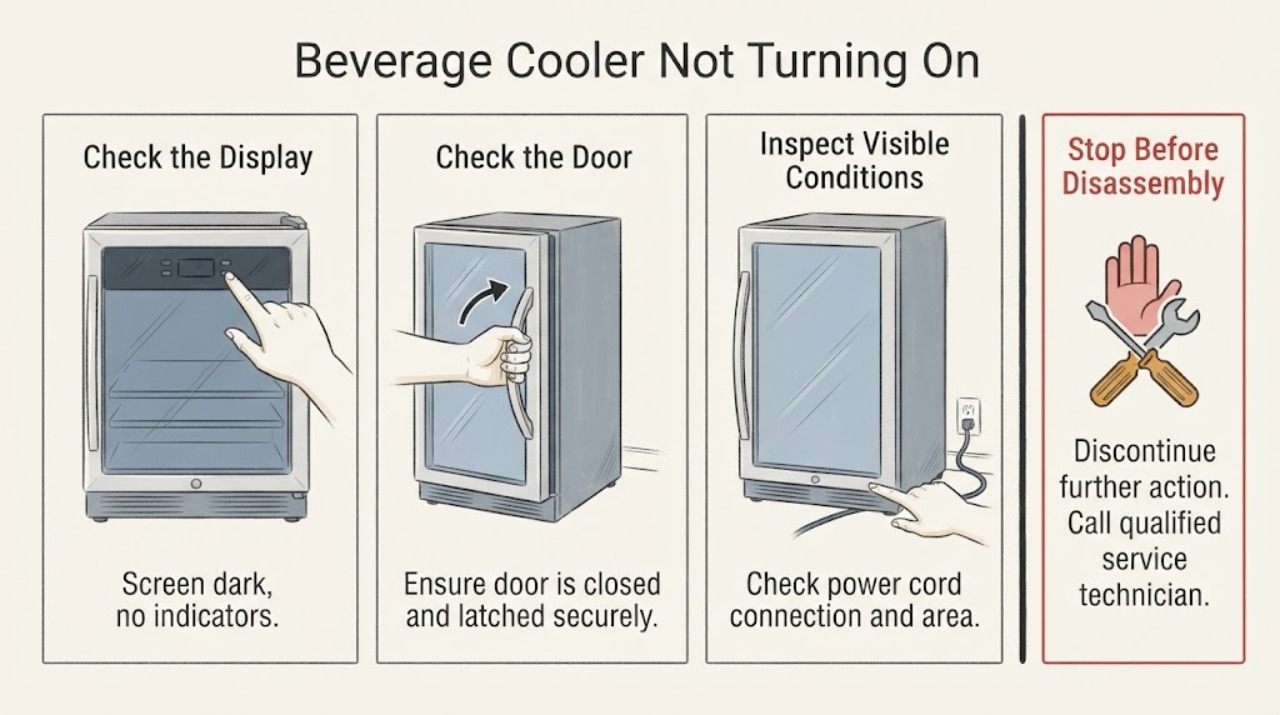
Work through in order
Diagnostic checks
Use only checks that match the exact appliance or system and its official guide.
-
Check 1
Check power and the display: Confirm the beverage-cooler is connected to power, the control is on, and no service indicator is showing.
Expected result: The control is off, an indicator is shown, or the unit has power but the symptom remains.
Next step: Record any indicator and use the model manual for its meaning.
Why this matters
Why: An off control or indicator can explain an apparent {p}; power with a persistent symptom points toward airflow, sealing, or service.
-
Check 2
Verify the temperature setting: Read the compartment setpoint and confirm it is appropriate for the intended storage, then keep the door closed while it attempts to stabilize.
Expected result: The setpoint is warmer than intended, or it is appropriate but the symptom continues.
Next step: Adjust only through the normal controls and allow a closed-door recovery check.
Why this matters
Why: A wrong setting is an operating condition; a correct setting shifts attention to the door seal, condenser, or refrigeration system.
-
Check 3
Inspect the door and gasket: Check for bottles, shelves, or racks preventing closure; clean and dry the gasket and look for a torn, displaced, or persistently wet section.
Expected result: The door closes fully with an intact gasket, or it remains obstructed or damaged.
Next step: Do not remove the door or bypass a switch.
Why this matters
Why: A poor seal admits warm humid air and can cause moisture or cooling complaints; damage needs a compatible replacement or service.
-
Check 4
Check airflow and condenser access: Inspect the manufacturer-approved condenser or ventilation area for visible dust or blockage and clear only loose surface debris with power safely off.
Expected result: The airflow path is blocked or dirty, or it is clear and the symptom remains.
Next step: Do not open the refrigeration circuit.
Why this matters
Why: Restricted heat rejection can worsen warm or moisture symptoms; a clear path points toward controls, sensors, fans, or sealed-system service.
-
Check 5
Allow recovery and retest: After correcting an accessible condition, keep the door closed and observe whether temperature, moisture, sound, or operation returns toward normal.
Expected result: The symptom resolves, or it returns or worsens.
Next step: Arrange qualified appliance service for a persistent fault, active leak, repeated trip, or abnormal heat.
Why this matters
Why: Recovery supports an operating-condition cause; recurrence needs model-specific diagnosis.
Use your observations
Decision map
Find the observation that best matches what you see, then follow the next safe action.
-
PATH 01Next step
What you see
The control is inactive, paused, delayed, or showing an error or lockout.
Do this next
Record the display and follow the exact owner or equipment manual reset or cycle procedure.
Why this path and its safety boundary
Why it matters: The appliance may be waiting for a documented control action or reporting a model-specific fault rather than a generic component failure.
-
PATH 02Next step
What you see
An accessible supply, seal, filter, hose, container, load, or airflow path is visibly restricted or damaged.
Do this next
Correct only the accessible condition described by the source or model manual, then perform one controlled retest.
Why this path and its safety boundary
Why it matters: An external operating or maintenance condition is more likely than an internal component failure.
-
PATH 03Next step
What you see
Power and accessible paths are normal but the same symptom returns during a controlled retest.
Do this next
Stop using the appliance when damage or overheating is possible and contact the manufacturer or a qualified technician with the recorded observations.
Why this path and its safety boundary
Why it matters: The remaining possibilities include an internal pump, heater, motor, sensor, valve, burner, drive, or control fault that requires model-specific service tools.
Helpful context
Understand the symptom
This guide keeps the beverage-cooler diagnosis at external checks supported by an authoritative safety or manufacturer source. Work in order and use each observation to choose the next branch.
When checks do not resolve it
Need a professional?
Stop and contact the manufacturer, site supervisor, or a qualified technician if the symptom persists, a safety control or interlock is involved, there is smoke, fire, gas odor, sparks, burning smell, water near electrical parts, abnormal heat, or any internal sealed, electrical, gas, heating, motor, or control work is needed.
Common questions
FAQ
What should make me stop immediately?
Stop for gas odor, uncontrolled flame, smoke, sparks, burning smell, damaged wiring, water near electrical parts, repeated breaker trips, or excessive heat. Isolate the appliance safely and use qualified service.
Why is the exact model or equipment manual important?
Control sequences, filters, safety interlocks, reservoirs, vents, and service procedures vary by model. Record the identification label and any displayed code before ordering a part or attempting a repair.
When is a replacement part justified?
Only after the model manual or a qualified technician connects the observed result to that part. A similar symptom alone does not establish fit or compatibility.
Read the exact guide
Official sources
- Sub Zero Warm Wine Storage Troubleshooting | How to GuideSub-Zero · beverage and wine coolers
Community feedback
Share a repair observation
Share a plain-text repair observation. Accepted observations are published automatically; this page may take a moment to update.