
On this page
Start here
Quick answer
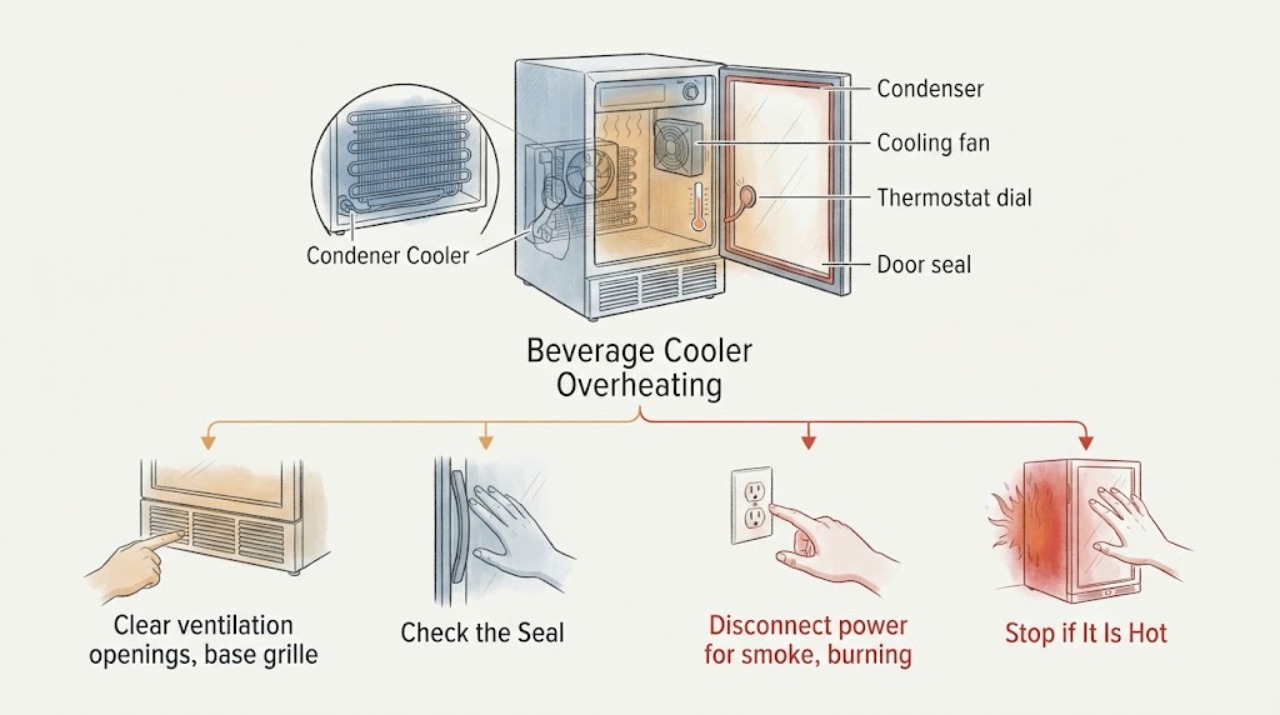
When a beverage cooler overheats, clear every ventilation opening, keep the door sealed, reduce a warm load, and check room temperature and controls. Dometic's official cooler guidance says warm exterior walls indicate overheating and recommends uncovering ventilation openings so heat can escape. If the cooler stays hot, cannot hold temperature, makes abnormal fan noise, or trips power, stop use and arrange service.
Work through in order
Diagnostic checks
Use only checks that match the exact appliance or system and its official guide.
-
Check 1
Disconnect power for smoke, burning odor, damaged cord, repeated trip, or dangerously hot surfaces.
Expected result: A safety symptom exists or not.
Next step: Keep it off and arrange service.
Why this matters
Why: Safety risk overrides airflow troubleshooting.
-
Check 2
Clear ventilation openings, base grille, and space around the condenser without removing panels.
Expected result: Openings are blocked or clear.
Next step: Restore the manual-required clearance and allow cooling.
Why this matters
Why: Restricted heat release raises cabinet and compressor temperature.
-
Check 3
Check door gasket and closure for gaps, frequent openings, or a door held by bottles.
Expected result: Seal is abnormal or normal.
Next step: Clear the obstruction and service a damaged gasket.
Why this matters
Why: Warm-air entry increases cooling demand.
-
Check 4
Check load, control setting, and ambient room temperature.
Expected result: Many warm beverages, warm room, or incorrect setting is present.
Next step: Reduce load and use the manual setting, then allow stabilization.
Why this matters
Why: Temporary demand can cause long operation and heat.
-
Check 5
Listen for the fan and compressor and record whether contents cool after airflow is restored.
Expected result: Fan is silent, noisy, or normal; temperature recovers or not.
Next step: Stop testing for abnormal noise or no recovery and arrange service.
Why this matters
Why: Persistent heat with normal external conditions suggests fan, sensor, compressor, or sealed-system fault.
-
Check 6
Apply the stop boundary after one stable test: check recurring overheating, frost, leak, or power fault.
Expected result: Cooling normalizes or issue recurs.
Next step: Protect beverages and provide the log to service.
Why this matters
Why: Recurrence needs internal diagnosis.
Use your observations
Decision map
Find the observation that best matches what you see, then follow the next safe action.
-
PATH 01Next step
What you see
Ventilation openings are blocked and cabinet cools after clearance.
Do this next
Maintain clearance and monitor.
Why this path and its safety boundary
Why it matters: Heat rejection restriction is likely.
-
PATH 02Next step
What you see
Door seal or load is abnormal and temperature recovers after correction.
Do this next
Maintain closure and loading practice.
Why this path and its safety boundary
Why it matters: Warm-air entry or temporary demand caused the heat.
-
PATH 03Next step
What you see
Openings, seal, load, and setting are normal but cabinet remains hot.
Do this next
Arrange service.
Why this path and its safety boundary
Why it matters: Fan, compressor, sensor, or sealed-system fault is likely.
-
PATH 04Next step
What you see
Burning odor, repeated trip, leak, or abnormal noise accompanies heat.
Do this next
Disconnect power if safe and obtain service.
Why this path and its safety boundary
Why it matters: Unsafe or damaging fault exists.
Helpful context
Understand the symptom
Record cabinet temperature, beverage temperature, ambient temperature, fan sound, door condition, and whether the outside walls are hot. Contents warming and cabinet overheating are related but not identical symptoms.
Use the exact cooler manual for clearance and cleaning; do not open refrigerant or electrical compartments.
When checks do not resolve it
Need a professional?
Service may test fan, condenser, compressor, thermostat, sensors, door seal, and sealed-system operation.
Common questions
FAQ
Can blocked vents overheat a beverage cooler?
Yes. Official guidance says ventilation openings must remain clear so generated heat can escape.
Can a warm room make the cooler run hot?
Yes. Check ambient conditions and the manual's climate limits; warm loads also increase pull-down time.
Why is the cabinet hot but drinks are cool?
Some warmth can occur during heat rejection, but unusually hot walls or abnormal noise require monitoring and service if persistent.
Should I remove the back panel?
No. Keep external airflow clear and arrange qualified service for internal components.
Read the exact guide
Official sources
- The cooler is overheatedDometic · General thermoelectric/compressor cooler guidance; exact beverage-cooler model manual controls clearance.
Community feedback
Share a repair observation
Share a plain-text repair observation. Accepted observations are published automatically; this page may take a moment to update.