
On this page
Start here
Quick answer
A beverage cooler may make normal compressor, fan, clicking, or expansion sounds, but a new loud vibration or unusual noise should first be separated by timing and location. Make sure the unit is on a stable, level surface, remove loose bottles and shelves that can rattle, and listen for whether the sound follows compressor or fan operation. If the noise continues after external leveling and loose-item checks, stop short of opening the sealed system and arrange model-specific service.
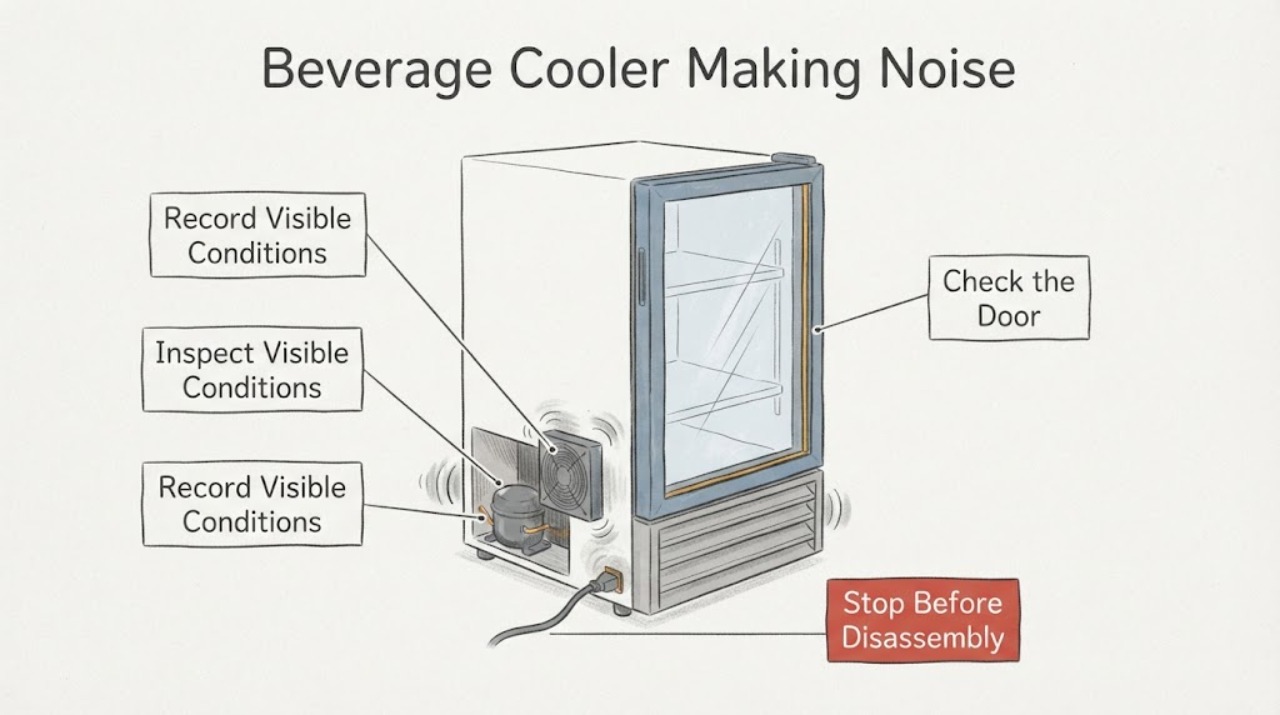
Work through in order
Diagnostic checks
Use only checks that match the exact appliance or system and its official guide.
-
Check 1
From outside the cooler, note the sound type, location, and timing: steady hum, fan rush, click, gurgle, expansion crack, rattling, scraping, or buzzing. Record whether it starts with cooling or door movement and whether cooling performance remains normal.
Expected result: The sound is a brief cycle-related hum or click, a cabinet or shelf rattle, a scrape or buzz, or is paired with poor cooling.
Next step: Continue only with the external stability and loose-item checks; do not insert tools near a fan or compressor.
Why this matters
Why: Danby documents several normal operating sounds, while persistent scraping, buzzing, or noise with poor cooling needs a service assessment rather than a guessed part.
-
Check 2
Check that the beverage cooler stands level and does not rock. Look at accessible feet, cabinet clearance, and the floor without tipping the unit or removing panels.
Expected result: The cabinet rocks, a foot is not supporting it, or the unit is stable and level.
Next step: Adjust only the accessible leveling foot as the model manual permits, then observe one cooling cycle.
Why this matters
Why: A rocking cabinet can amplify compressor vibration; a level unit shifts attention to loose contents or internal service diagnosis.
-
Check 3
Remove or reposition loose bottles, cans, shelves, racks, and drip components while the door is open and the unit is stable. Confirm that nothing touches the cabinet wall or fan grille.
Expected result: The noise changes when contents are removed, or it remains with the cooler empty.
Next step: Reload without contact points and continue monitoring; if noise persists, arrange service.
Why this matters
Why: A changed noise supports a loose-item or contact vibration; persistent noise with an empty, stable cabinet is less likely to be a shelf rattle.
-
Check 4
Listen from a safe distance for a sound that follows the compressor or fan, and check for visible frost, water, or a blocked ventilation opening. Do not remove the rear cover or touch hot or moving parts.
Expected result: The sound follows a cooling cycle, a fan appears obstructed, the unit has frost or water, or no external abnormality is visible.
Next step: Keep clear of the rear machinery and use the exact model manual or technician if the abnormal sound continues.
Why this matters
Why: Cycle-related sound can be normal, while obstruction, frost, water, or a changed mechanical sound may signal airflow or refrigeration service needs.
Use your observations
Decision map
Find the observation that best matches what you see, then follow the next safe action.
-
PATH 01Next step
What you see
The sound is a brief hum, click, or expansion noise during normal cooling and the unit cools normally.
Do this next
Keep the cooler level and monitor for a change in sound, cooling, or vibration.
Why this path and its safety boundary
Why it matters: Normal refrigeration operation is more likely than a fault.
-
PATH 02Next step
What you see
The sound decreases after leveling or removing bottles, shelves, or loose parts.
Do this next
Restore the contents without contact and monitor one cycle; seek service if the noise returns empty.
Why this path and its safety boundary
Why it matters: Cabinet vibration or an accessible loose item was more likely than an internal compressor fault.
-
PATH 03Next step
What you see
A stable, empty cooler makes persistent scraping, harsh buzzing, or abnormal vibration.
Do this next
Stop short of panel removal and arrange model-specific professional service.
Why this path and its safety boundary
Why it matters: An internal fan, compressor mount, or other mechanical condition is possible, but the source cannot be identified safely from outside.
-
PATH 04Next step
What you see
Noise is accompanied by poor cooling, frost, water, burning odor, or a hot/damaged cord.
Do this next
Stop use when safe and arrange qualified appliance service; isolate power for burning odor or electrical damage only if safe.
Why this path and its safety boundary
Why it matters: The noise is part of a broader appliance or electrical symptom and has crossed the service boundary.
Helpful context
Understand the symptom
Noise location and timing matter more than volume alone. A hum or click that follows a cooling cycle can be normal, while a rattle that changes when bottles, shelves, or the cabinet moves points to vibration or a loose accessible item.
When checks do not resolve it
Need a professional?
Arrange professional beverage-cooler service if unusual noise continues after leveling and loose-item checks, or if noise is accompanied by scraping, poor cooling, frost, water, burning odor, or electrical damage. Do not open the sealed refrigeration system or reach into moving components.
Common questions
FAQ
Are clicks and hums normal for a beverage cooler?
Danby’s manual says a new beverage center can make operating sounds that an older unit did not. A brief cycle-related sound with normal cooling can be normal; persistent harsh, scraping, or vibrating noise needs service.
Why does leveling change beverage-cooler noise?
Danby specifically recommends a stable and level surface because cabinet vibration can amplify sound. Check stability and loose items before suspecting an internal part.
Should I remove the rear cover to find the noise?
No. If the cooler remains noisy after external checks, Danby recommends professional service. Keep away from moving and hot components and do not open the sealed system.
Read the exact guide
Official sources
- The beverage center is making unusual noises. How can I fix this?Danby · Danby beverage-center unusual-noise, stability, leveling, loose-parts, and service guidance
- Beverage CenterDanby · Danby beverage-center normal operating sounds and model manual context
Community feedback
Share a repair observation
Share a plain-text repair observation. Accepted observations are published automatically; this page may take a moment to update.