
On this page
Start here
Quick answer
If a beverage cooler is not cooling, confirm power and the temperature setting, keep the vents clear, allow time after loading, and listen for the compressor. A compressor that runs without cooling, or a unit with no compressor response after stable power, needs service for sealed-system or control diagnosis.
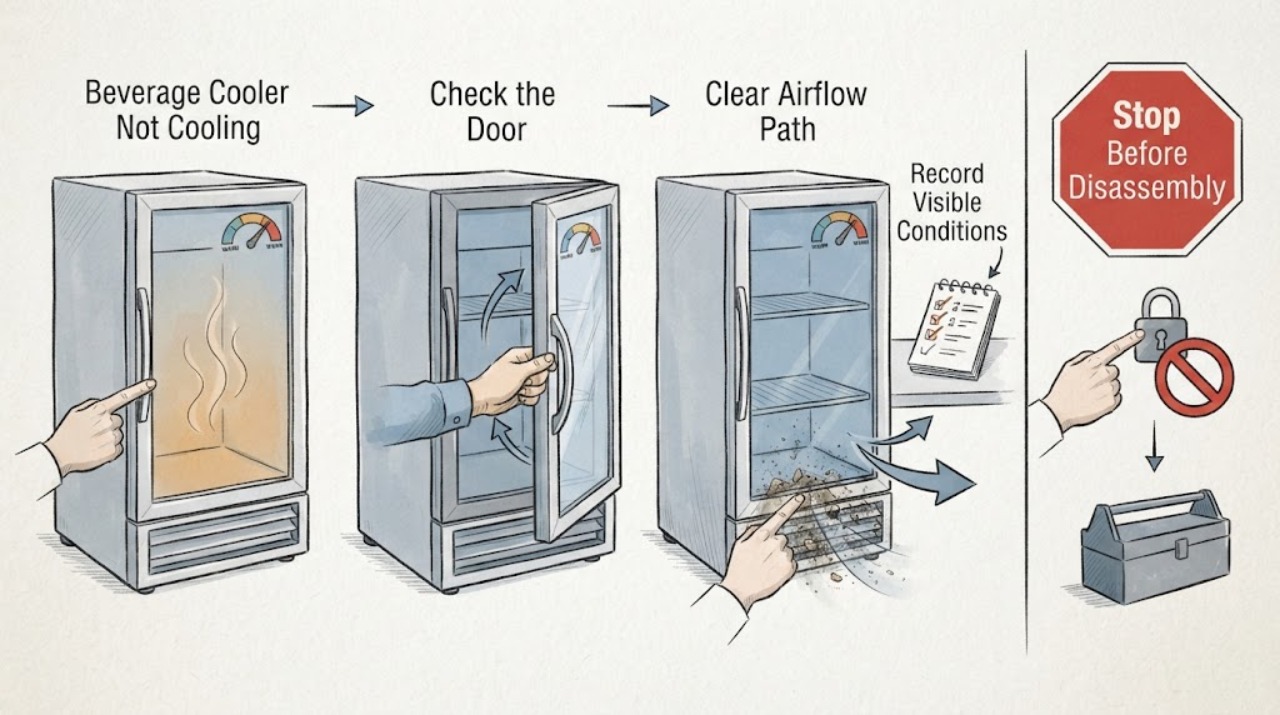
Work through in order
Diagnostic checks
Use only checks that match the exact appliance or system and its official guide.
-
Check 1
Confirm the cooler has power and set the thermostat to a colder position within the model’s range; keep the door closed during the test.
Expected result: The display or control responds, or the cooler remains dead.
Next step: Use the model manual for control behavior and arrange service if power remains absent.
Why this matters
Why: A power or setting issue can explain warm contents; a live cooler with no temperature change shifts attention to airflow or refrigeration diagnosis.
-
Check 2
Check that the intake and exhaust areas are not blocked and that the door closes with its gasket contacting the cabinet.
Expected result: Airflow or door sealing is blocked, or the exterior path and seal appear clear.
Next step: Move obstructions and test once with the door closed.
Why this matters
Why: Restricted ventilation or warm air entering through a poor seal can prevent cooling; a clear path points deeper into the system.
-
Check 3
Allow the cooler time to stabilize after loading or changing the setting, then record the cabinet temperature and compressor sound or vibration.
Expected result: The temperature falls and the compressor cycles, or the cabinet stays warm.
Next step: Do not repeatedly change the dial or open the refrigeration circuit.
Why this matters
Why: Cooling after stabilization supports a load or setting effect; persistent warmth narrows the issue to compressor, control, or sealed-system diagnosis.
-
Check 4
Listen for compressor vibration without touching hot or moving parts and note whether it runs continuously, cycles, or stays silent.
Expected result: The compressor vibrates but the cabinet does not cool, or there is no compressor response.
Next step: Arrange qualified appliance service for either persistent pattern.
Why this matters
Why: Vibration without cooling can indicate a capillary or refrigerant problem; no response can indicate control or compressor trouble.
Use your observations
Decision map
Find the observation that best matches what you see, then follow the next safe action.
-
PATH 01Next step
What you see
Power, setting, airflow, and door seal are correct, and cooling returns after stabilization.
Do this next
Keep the vents clear and monitor normal cycling.
Why this path and its safety boundary
Why it matters: The operating setting, load, or airflow was the leading cause.
-
PATH 02Next step
What you see
The compressor runs or vibrates but the cabinet remains warm after the stabilization period.
Do this next
Stop adjusting the system and arrange qualified refrigeration service.
Why this path and its safety boundary
Why it matters: A capillary restriction, refrigerant leak, or compressor performance fault is more likely.
-
PATH 03Next step
What you see
The cooler has stable power but the compressor never responds and the control is set correctly.
Do this next
Provide the model and recorded sound or temperature to service.
Why this path and its safety boundary
Why it matters: A control, sensor, start, or compressor fault is more likely.
Helpful context
Understand the symptom
NewAir’s cooling guidance separates a setting or airflow issue from a compressor and sealed-system symptom. Record the setpoint, room conditions, loading, compressor vibration, and time allowed to cool.
A beverage cooler may need a stabilization period after loading or a setting change. Refrigerant, capillary, compressor, and sealed-system work is not a user adjustment.
Only after diagnosis
Potential parts
- model-specific temperature control, sensor, compressor, or sealed-system component
Consider a part only after setting, airflow, door seal, and compressor observations support the diagnosis.
A warm cabinet does not establish a component or refrigerant fit.
When checks do not resolve it
Need a professional?
Contact qualified appliance service when a beverage cooler remains warm after correct power, setting, airflow, door sealing, and stabilization checks, especially if the compressor runs without cooling or stays silent.
Common questions
FAQ
How long should I wait after loading a beverage cooler?
Allow the unit time to stabilize after loading or a setting change, and keep the door closed during the test. The exact time depends on the model and conditions.
Can I add refrigerant to a beverage cooler that is not cooling?
No. A compressor that runs without cooling can involve a capillary or refrigerant issue, which requires qualified sealed-system service.
Read the exact guide
Official sources
- Not CoolingNot · Opened manufacturer or official support guidance; exact model details vary.
Community feedback
Share a repair observation
Share a plain-text repair observation. Accepted observations are published automatically; this page may take a moment to update.