
On this page
Start here
Quick answer
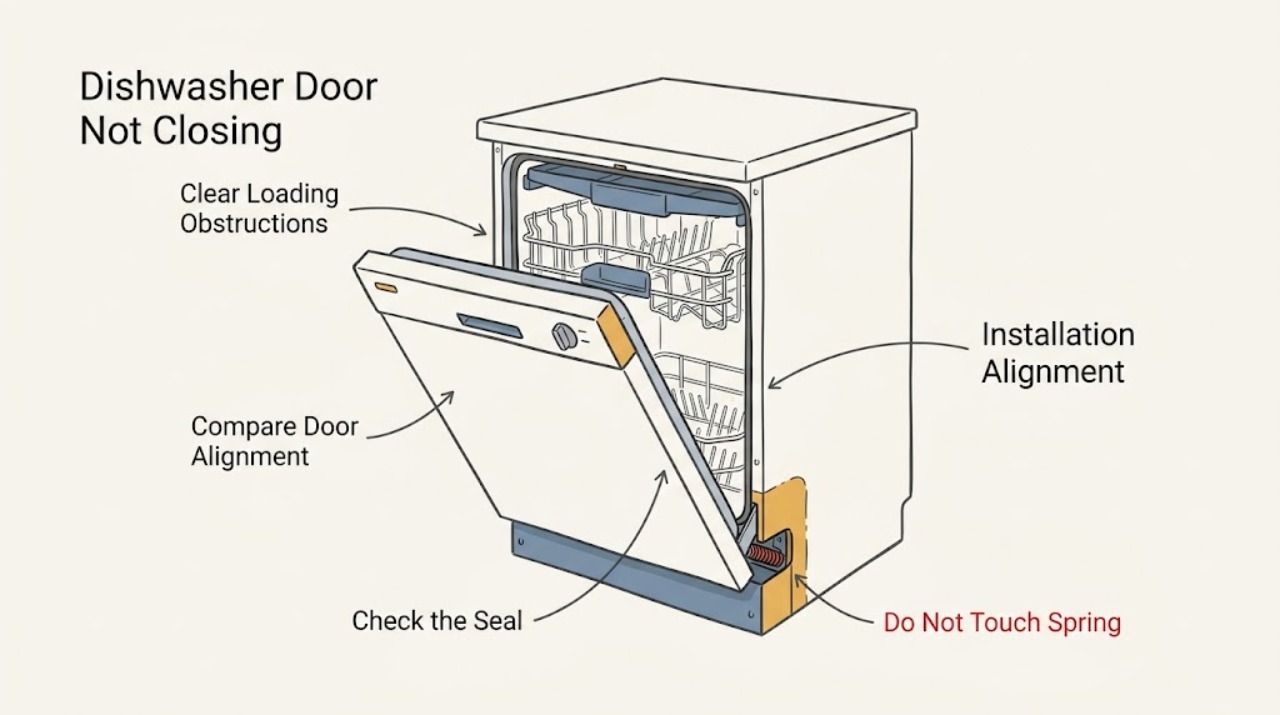
If a Bosch dishwasher door will not close, first pull the racks out and check for a dish, utensil, handle tray, detergent item, or rear hose holder pressing against the door. Confirm that the racks sit evenly, the dishwasher is not visibly out of alignment, and the door can meet the latch without force. Bosch guidance links an unlatched door with failure to start and identifies obstructions, an unlevel installation, damaged latch, lock, or hinges as possible causes. If the door closes but will not latch, springs open, rubs cabinetry, or needs a latch, hinge, lock, or panel adjustment, stop forcing it and arrange qualified Bosch service. Do not defeat the interlock, remove enclosure panels, or work on the door mechanism while energised.
Before you begin
Safety first
- This article covers loose loading obstructions, rack position, visible clearance, and symptom recording. A qualified technician must handle latch, lock, interlock, hinge, spring, seal, control, enclosure-panel, live electrical, and built-in installation work.
Work through in order
Diagnostic checks
Use only checks that match the exact appliance or system and its official guide.
-
Check 1
Pull out the upper and lower racks and inspect the door path for dishes, utensils, a detergent item, an upper-rack handle tray object, or anything protruding beyond the rack front. Check the rear of the unit for an accessible hose holder or item pressing the panel, without pulling the appliance out.
Expected result: A dish or utensil touches the door, an upper-rack item prevents closure, a rear holder presses the panel, or the path is clear.
Next step: Remove only the loose loading obstruction and reposition the rack or dish according to the model manual. If the door still resists, do not apply more force; continue to the alignment and hardware decision.
Stop if: Do not force a rack, bend a dish, pull on a hose holder, or push the door against resistance.
Why this matters
Why: A clear physical obstruction can prevent the door from reaching the latch and is more likely than a latch failure. If the path is clear but the door still stops or springs back, alignment or hardware becomes more likely.
-
Check 2
With the racks empty, slide each one fully into its tracks and check that both sides sit at the same height and that the spray arm or rack hardware is not displaced. Compare any adjustment with the exact Bosch manual rather than using a generic rack position.
Expected result: A rack is skewed, a wheel or stop is out of its track, the two sides are at different heights, or both racks move and sit normally.
Next step: Re-seat only an obviously displaced rack or wheel if the model manual describes it. If a rack part is broken, the door still does not close, or adjustment requires removing hardware, arrange service.
Stop if: Do not force rack stops, remove the door, or operate with a broken rack component that could fall into the door or pump area.
Why this matters
Why: A displaced or uneven rack can project into the door path and may also prevent the upper spray connection from aligning. Normal empty racks make a door latch, hinge, seal, cabinet, or installation problem more likely.
-
Check 3
Close the empty dishwasher door slowly and observe where it stops. Inspect the visible seal, cabinet edge, countertop, and nearby cabinetry for a fold, loose trim, screw, panel, or rubbing point. Check only for visible level or clearance issues; do not loosen built-in mounting hardware.
Expected result: The door rubs cabinetry, the seal is folded or damaged, the appliance appears tilted, the latch meets but does not engage, or the door moves evenly to the latch area.
Next step: Remove only a clearly loose external obstruction and consult the exact installation instructions. Leave damaged seals, hinges, latch alignment, or built-in mounting adjustments to qualified Bosch service.
Stop if: Do not pry the door, bend hinges, adjust springs, loosen mounting screws, or force the latch closed.
Why this matters
Why: Cabinet interference, a distorted seal, or installation alignment can stop the door before it latches. A door that reaches the latch but will not engage makes the latch, lock, hinge, or interlock more likely than a dish obstruction.
-
Check 4
If the door now reaches the closed position, note whether it clicks and remains latched, whether the display or controls respond, and whether a cycle starts. Check the exact model manual for any child-lock or start/resume behavior; do not test the interlock with a tool or bypass it.
Expected result: The door closes and latches but the dishwasher will not start, the door closes without a latch click, the door opens during operation, or everything works after the obstruction is removed.
Next step: Use only the documented control or child-lock procedure for the exact model. Arrange service for a non-engaging latch, a door that opens during a cycle, or controls that report a door fault.
Stop if: Do not defeat the interlock, run the dishwasher with the door unsecured, or remove enclosure panels.
Why this matters
Why: A latched door with no start may indicate power, controls, or lock-state issues rather than physical clearance. Failure to latch or opening during operation makes the latch, lock, hinges, seal, or alignment a service concern.
Use your observations
Decision map
Find the observation that best matches what you see, then follow the next safe action.
-
PATH 01Safety boundary
What you see
The door stops against a dish, utensil, handle-tray item, rack, hose holder, or other visible loading obstruction.
Do this next
Remove or reposition only the loose item and ensure the racks sit correctly. Test gentle closure; seek service if resistance remains.
Why this path and its safety boundary
Why it matters: The obstruction is more likely than a failed latch or hinge.
Safety stop: Do not force the door or bend the rack to make clearance.
-
PATH 02Safety boundary
What you see
The racks are empty but uneven, out of track, or the door rubs cabinetry, countertop, seal, or a nearby screw or panel.
Do this next
Use the exact rack or installation instructions for an obvious, permitted adjustment. Do not loosen built-in hardware; arrange service if alignment or leveling needs tools or dismantling.
Why this path and its safety boundary
Why it matters: Rack alignment or installation clearance is more likely than an internal electronic problem.
Safety stop: Do not pull the appliance out by the door or operate with a door rubbing or unsecured.
-
PATH 03Safety boundary
What you see
The door reaches the cabinet but will not click or stay latched, springs open, opens during a cycle, or has a visibly damaged seal, latch, lock, or hinge.
Do this next
Stop using the dishwasher and arrange qualified Bosch service for diagnosis and any latch, lock, hinge, seal, or mounting repair.
Why this path and its safety boundary
Why it matters: A door hardware, interlock, seal, or alignment fault is more likely than loading interference.
Safety stop: Do not bypass the interlock, bend hinges, pry the latch, or remove panels.
-
PATH 04Safety boundary
What you see
The door closes and latches securely, but the dishwasher still will not start or reports a door-related condition.
Do this next
Follow the exact model manual for controls and safe reset behavior. Arrange service if the display, latch sensing, or start function remains abnormal.
Why this path and its safety boundary
Why it matters: Power, controls, child lock, door-sensor circuit, or another operating fault is more likely than the physical door path.
Safety stop: Do not hold the latch closed with an object or operate with the door interlock defeated.
Helpful context
Understand the symptom
A door that physically stops is different from one that will not latch
Start by separating the symptom. If the door hits an object before reaching the cabinet, loading or installation clearance is the first decision. If it reaches the cabinet but will not click or stay closed, the latch, lock alignment, hinges, door position, or an interlock may be involved. If it closes and latches but the dishwasher does not start, the issue is no longer simply door clearance and should be assessed with the model controls and power checks.
Racks and installation hardware can block the closing path
Bosch identifies dishes too close to the front of the racks, objects in an upper-rack handle tray, a rear panel pressed by a hose holder, and cabinetry or nearby screws as possible interference points in its dishwasher guidance. Rack height and alignment also vary by model. Remove only a clearly loose loading obstruction and use the exact manual for rack adjustment; do not force a rack or door against resistance.
Level and door hardware are safety boundaries
An incorrectly installed or visibly unlevel dishwasher can change how the door meets the latch. A damaged latch, lock, hinge, or seal is not a reason to bypass the door interlock. Bosch's safety guidance says not to tamper with controls or interlocks and not to operate the dishwasher unless enclosure panels are in place. Leave hardware adjustment, replacement, and internal access to qualified service.
Use the exact model instructions before changing the door
Bosch dishwasher racks, latches, door springs, cabinetry brackets, and control-lock procedures are not interchangeable across models. Find the owner's manual using the dishwasher model number before changing rack height or attempting a reset. If the door still cannot close or latch after visible loading checks, Bosch directs owners toward support and professional repair for latch, lock, or hinge faults.
Safety boundary
Stop conditions
- Stop using the dishwasher if the door cannot latch securely, opens during operation, or water can escape around a damaged seal or door.
- Do not defeat or bypass the door latch, lock, sensor, or any other interlock; do not operate without enclosure panels in place.
- Do not pry the door, bend hinges, loosen built-in mounting hardware, remove panels, or test live wiring.
- Keep hands clear of sharp utensils and move perishable items or standing water safely if a door or drainage fault leaves the appliance unusable.
When checks do not resolve it
Need a professional?
Safety scope: This article covers loose loading obstructions, rack position, visible clearance, and symptom recording. A qualified technician must handle latch, lock, interlock, hinge, spring, seal, control, enclosure-panel, live electrical, and built-in installation work.
Common questions
FAQ
Why will my Bosch dishwasher door not close?
Check for dishes, utensils, rack hardware, an upper-rack handle-tray item, or a hose holder blocking the door. With the racks empty, check visible seal, cabinetry, and alignment issues. If the door still will not reach or engage the latch, arrange service.
Can an uneven Bosch dishwasher rack stop the door closing?
Yes. A displaced or uneven rack can project into the door path or prevent components from aligning. Re-seat only an obviously displaced rack as described in the exact model manual; do not force rack stops or broken hardware.
What if my Bosch dishwasher door closes but will not latch?
A damaged or misaligned latch, lock, hinge, seal, or installation can prevent engagement even when the door reaches the cabinet. Do not bypass the interlock or force the latch; arrange qualified Bosch service.
Why does my Bosch dishwasher door close but the cycle will not start?
A door that appears closed may not be sensed as latched. Check the exact model's control or child-lock guidance and confirm there is no visible obstruction. If the display reports a door condition or the cycle still will not start, service may be needed for the latch, sensor, controls, power, or another fault.
When should I call Bosch service for a dishwasher door problem?
Arrange service when the door cannot latch securely, opens during a cycle, rubs cabinetry, has a damaged seal, latch, lock, or hinge, or needs interlock, spring, panel, electrical, or built-in installation work. Do not operate with the safety interlock defeated.
Read the exact guide
Official sources
- Bosch Dishwasher Use and Care Manual 9001349513_ABosch · Official Bosch manual for the cited model family; use only as model-specific guidance and obtain the manual for the user's complete model.
- Bosch Dishwasher Troubleshooting & Repair GuideBosch · Official Bosch US dishwasher support guidance; exact model instructions control rack, lock, and installation details.
- Bosch Dishwasher Use and Care Manual 9001179846_ABosch · Official Bosch manual for the cited dishwasher model; used to support rack and safety principles, not universal part compatibility.
Community feedback
Share a repair observation
Share a plain-text repair observation. Accepted observations are published automatically; this page may take a moment to update.