
On this page
Start here
Quick answer
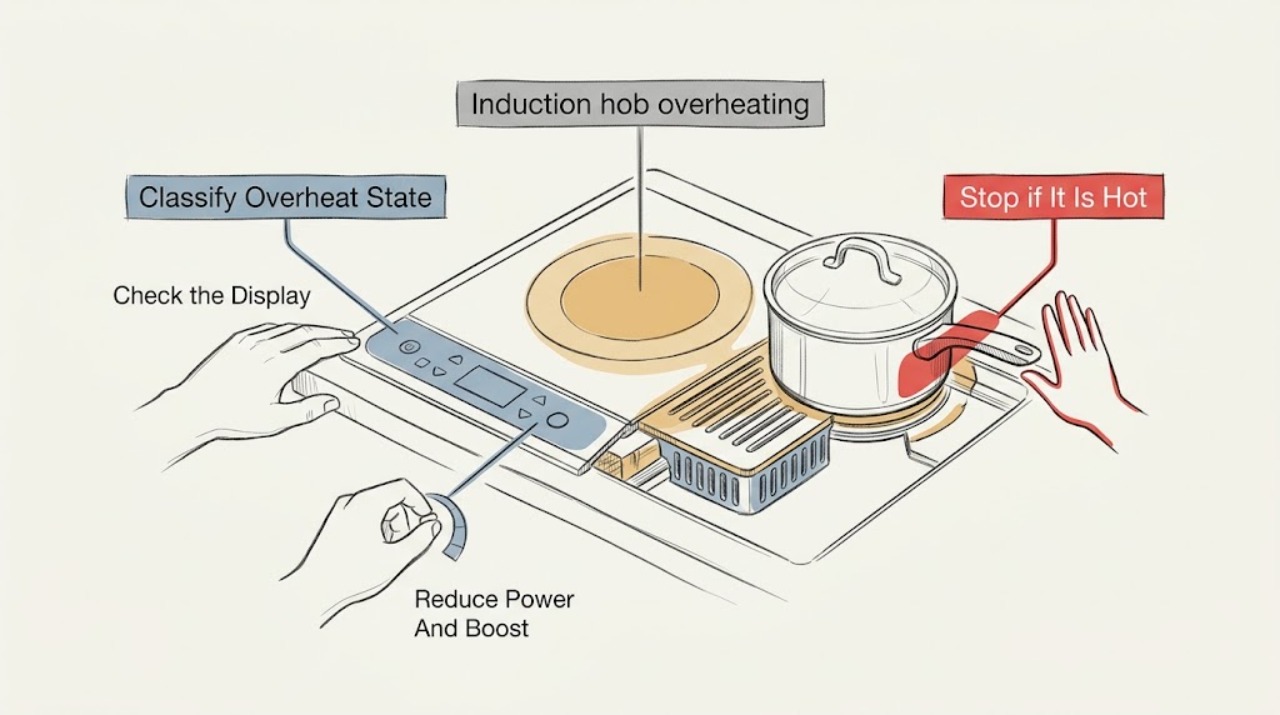
A Bosch induction hob may shut a cooking zone off to protect the work surface or electronics when it overheats. Switch the affected zone off, remove cookware from the control area, keep ventilation clear, and wait until the hob has cooled before one model-specific restart. Lower high or boost settings and avoid prolonged maximum-power cooking. If an error returns, all zones shut off, the hob will not restart after cooling, the supply-voltage warning appears, the glass is cracked, or there is smoke, a burning or electrical smell, sparking, or a breaker trip, stop using it and arrange qualified Bosch appliance or electrical service. Do not open the hob, change wiring, block vents, or keep resetting a recurring overheat fault.
Work through in order
Diagnostic checks
Use only checks that match the exact appliance or system and its official guide.
-
Check 1
From a dry, safe position, record which cooking zone is affected, whether one or all zones stopped, the exact display symbol or code, the power or boost setting, pan position, and whether the controls still respond.
Expected result: One zone is off, all zones are off, hot cookware is near the control panel, an overheat code appears, power is reduced, or there is smoke, smell, sparking, damaged glass, or a breaker trip.
Next step: Follow the zone, electronics, cookware, or electrical-safety branch below and preserve the exact display state.
Stop if: Stop immediately for smoke, burning or electrical smell, visible sparking, a cracked glass surface, liquid entering controls, hot or damaged wiring, or repeated breaker trips.
Why this matters
Why: Bosch distinguishes zone overheating, electronic overheating, and hot cookware near the controls. A hazard symptom changes the response to an immediate stop; a code without a hazard directs the next external cooling and code check.
-
Check 2
If a hot pan is on or close to the control panel, turn the affected zone off normally and, only when the pan and surface can be handled safely, move the pan away from the controls without covering vents or touching a damaged surface.
Expected result: The warning or beep clears after the pan is removed and the electronics cool, or the warning remains and the zone stays off.
Next step: Allow cooling and use only the model-specific external acknowledgement or restart; arrange service if the warning returns or the zone will not recover.
Stop if: Do not slide a very hot, unstable, or damaged pan across the hob, place it on the controls, or continue if smoke, smell, sparking, or cracked glass is present.
Why this matters
Why: Bosch identifies hot cookware near the control panel as an electronics-overheating risk and instructs removal before continuing. Persistence after the pan is removed means the heat condition or another fault has not cleared.
-
Check 3
When no hazard is present and the display responds, stop boost or maximum-power operation and select a lower setting for the affected zone; avoid running multiple zones at their highest setting while observing whether the hob remains stable.
Expected result: The hob continues without an overheat warning at a lower setting, the same zone overheats again, or all zones shut down despite moderate use.
Next step: Use the lowest effective setting and monitor one ordinary cooking session only if the hob cooled and reset normally; stop and arrange service for recurrence.
Stop if: Do not repeatedly provoke the shutdown, leave high-power cooking unattended, or continue after a warning accompanied by a smell, smoke, sparking, abnormal heating, or power trip.
Why this matters
Why: Bosch's troubleshooting guidance links overheating protection with high heat settings and prolonged high-temperature cooking. Recovery only at lower power suggests heat load was relevant; recurrence at moderate use needs diagnosis.
-
Check 4
After switching the hob off and letting accessible surfaces cool, inspect only the visible surrounding ventilation path for objects, cookware, cloth, or residue that could obstruct airflow; do not remove the hob or reach into openings.
Expected result: The visible airflow path is clear and the hob recovers after cooling, an obstruction is found and removed safely, or overheating persists with a clear path.
Next step: Keep the visible ventilation area clear and make one normal restart after complete cooling; arrange qualified service if the warning or shutdown returns.
Stop if: Do not dismantle the hob, use compressed air or liquid in openings, block airflow, or continue if wiring, the underside, or the glass appears damaged.
Why this matters
Why: Bosch identifies blocked ventilation as a possible overheating contributor in its induction troubleshooting guidance. A clear path with repeated overheating points toward an internal or installation condition that cannot be confirmed from outside.
-
Check 5
With the hob off, allow it to cool fully, then read and record the complete display code or symbol before touching any control; use the exact Bosch model manual to identify whether it indicates a hot zone, overheated electronics, hot cookware near controls, or another condition.
Expected result: The code disappears after cooling, the model instruction permits one acknowledgement or restart, the code is not listed, or it returns after cooling.
Next step: Follow the model-specific external instruction once and record the result; arrange service if the code remains or returns.
Stop if: Do not repeatedly clear a warning, touch a hot surface, remove covers, or reconnect power after smoke, smell, sparking, or a breaker event.
Why this matters
Why: Bosch lists distinct overheat indications, including zone protection, electronic protection, and hot cookware near the controls. The precise meaning and control action are model-dependent; a returning or unlisted code is not safely solved by guessing.
-
Check 6
If the hob shows a supply-voltage warning, shuts down repeatedly, or will not restart after complete cooling, leave wiring and the electrical panel untouched and record whether other household loads or the dedicated circuit also lost power.
Expected result: A supply-voltage code is displayed, the dedicated circuit has tripped, the hob restarts once but shuts down again, or the hob remains dead after cooling.
Next step: Stop using the hob and arrange qualified appliance or electrical service with the exact code and event history; do not change the circuit or connection yourself.
Stop if: Do not repeatedly reset a breaker, open the electrical panel, change supply connections, or test live voltage.
Why this matters
Why: Bosch identifies incorrect supply voltage as a separate fault category and directs it to the electricity provider or qualified support. A repeated shutdown or failure to restart may involve the appliance or installation rather than cookware.
-
Check 7
Only when the hob is cool, dry, free of damage, and the exact model guidance permits it, isolate its power for the documented reset interval, restore power once, and observe whether the same overheat code or shutdown returns.
Expected result: The hob operates normally once, the code returns immediately, the zone overheats again, or the controls remain unresponsive.
Next step: If the symptom returns or the hob remains unresponsive, leave it off and arrange qualified Bosch appliance or electrical service with the model and recorded code.
Stop if: Do not repeat the reset, bypass protection, open the hob, or restore power after a smell, smoke, spark, water intrusion, cracked glass, or breaker trip.
Why this matters
Why: Bosch describes a limited power-cycle path for some error conditions, but a returning overheat state indicates an unresolved problem. A reset cannot confirm that internal cooling, sensing, control, or supply components are safe.
Use your observations
Decision map
Find the observation that best matches what you see, then follow the next safe action.
-
PATH 01Safety boundary
What you see
A hot pan is on or close to the control panel and a warning or beep indicates electronics are at risk.
Do this next
Remove the cookware from the controls when safe, allow cooling, and follow the model's external acknowledgement instruction once.
Why this path and its safety boundary
Safety stop: Stop for smoke, smell, sparking, damaged glass, or a warning that remains after the cookware is removed.
-
PATH 02Safety boundary
What you see
Overheating occurs during boost or prolonged high-power cooking and clears after reducing power and cooling.
Do this next
Use a lower setting, avoid prolonged maximum-power operation, keep the hob attended, and monitor one normal session.
Why this path and its safety boundary
Safety stop: Arrange service if the zone overheats at moderate power, shuts off repeatedly, or develops a code or abnormal heating.
-
PATH 03Safety boundary
What you see
Visible airflow around the hob is obstructed by an object, cookware, cloth, or residue and no electrical hazard is present.
Do this next
Remove only the accessible obstruction after the hob is off and cool, keep the path clear, and allow complete cooling before one restart.
Why this path and its safety boundary
Safety stop: Do not dismantle or blow liquid into the appliance; service is needed if overheating returns with a clear visible path.
-
PATH 04Safety boundary
What you see
The display indicates a cooking-zone or electronics overheat state, and the hob has switched one or all zones off.
Do this next
Wait until the appliance cools, then use only the model-specific external acknowledgement or restart; record whether the code disappears.
Why this path and its safety boundary
Safety stop: Arrange service if the code remains or returns, the hob will not restart, or heating and controls are abnormal.
-
PATH 05Safety boundary
What you see
A supply-voltage warning appears, the dedicated circuit trips, or the hob repeatedly shuts down after cooling.
Do this next
Leave the appliance and wiring untouched and arrange qualified electrical or Bosch appliance service with the exact display and event history.
Why this path and its safety boundary
Safety stop: Do not reset the circuit repeatedly, open the panel, alter connections, or test live parts.
-
PATH 06Safety boundary
What you see
Overheating is accompanied by smoke, burning or electrical smell, sparking, liquid in the controls, cracked glass, exposed wiring, or a hot connection.
Do this next
Stop using the hob and isolate power only if it can be done without contacting water or damaged equipment; arrange qualified service.
Why this path and its safety boundary
Safety stop: Do not reconnect, touch damaged areas, remove the glass, or attempt an internal repair until assessed.
Helpful context
Understand the symptom
An automatic shutoff can be the protection working
Bosch documents separate protection states: a cooking zone can overheat and switch off, the electronics can overheat and switch off one or all zones, and hot cookware near the control panel can put the electronics at risk. A hob can also temporarily reduce power to protect fragile parts and limit excess heat or noise. The display code, affected zone, cookware location, and whether the appliance recovers after cooling determine the next safe step.
Reduce heat load before testing again
Move only safe-to-handle cookware away from the controls, lower the power or stop boost operation, and leave the ventilation path clear. Do not cover vents or place a hot pan on the control panel. Allow the hob to cool fully before using the model's documented external reset or restart. A single recovery after cooling is different from a fault that returns under ordinary settings.
Repeated overheating is not a user-reset problem
If the same warning returns after cooling, if the hob shuts off at moderate settings, or if heating and controls behave abnormally, stop repeated experiments. Internal airflow, temperature sensing, power electronics, installation, or supply conditions may need diagnosis. Keep the model and exact code for qualified service rather than removing the glass or testing live components.
Safety boundary
Stop conditions
- Stop immediately for smoke, burning or electrical smell, visible sparking, liquid entering the controls, a cracked glass surface, exposed or hot wiring, or repeated breaker trips.
- Stop using the hob when the overheat warning returns after cooling, a zone or all zones repeatedly shut off, the hob will not restart, or heating and controls behave abnormally.
- Do not open the hob, remove the glass, block ventilation, change supply wiring, bypass thermal protection, or test live electrical parts.
Only after diagnosis
Potential parts
- cooling fan assembly
Only consider this part if a qualified diagnosis confirms inadequate or abnormal cooling after visible ventilation and cookware causes have been excluded.
Confirm the exact Bosch model or E-number and manufacturer fit information before ordering; do not infer a fan fault from an overheat code alone. - temperature sensor or control module
Only consider this component if qualified testing identifies a sensor or control fault after the hob overheats or shuts down under normal conditions.
Confirm the exact Bosch model and diagnosis before ordering; internal electrical parts are not user-replaceable through generic code matching.
When checks do not resolve it
Need a professional?
Arrange qualified Bosch appliance or electrical service when the hob overheats again after cooling, shuts off at moderate settings, an overheat or supply-voltage code returns, the controls do not recover, visible ventilation is clear but the fault persists, the glass or wiring is damaged, or any smoke, smell, sparking, or breaker trip occurred.
Common questions
FAQ
Why does my Bosch induction hob shut off from overheating?
Bosch describes protective shutoff when a cooking zone or the electronics overheat. High or prolonged power, blocked ventilation, or hot cookware near the controls can contribute. Let the hob cool, lower the setting, keep airflow clear, and arrange service if the warning returns.
What should I do when a Bosch hob shows an overheat code?
Record the exact code, switch the affected zone off, remove hot cookware from the control area when safe, and wait until the hob cools. Follow only the exact model's external instruction once. If the code remains or returns, stop using the hob and arrange qualified service.
Can high power or boost overheat an induction hob?
Bosch's troubleshooting guidance links overheating protection with high heat settings and prolonged high-temperature cooking. Reduce power and avoid extended boost use. A hob that overheats at moderate settings needs diagnosis rather than repeated resets.
Can a hot pan near the controls cause a Bosch overheat warning?
Yes. Bosch identifies hot cookware near the control panel as a risk to the electronics. Move it away only when safe, keep the controls clear, and wait for the warning to clear. Do not place a hot pan on the control panel or continue with smoke, smell, sparking, or damaged glass.
How long should a Bosch induction hob cool before restarting?
Bosch directs the user to wait until the electronics or cooking zone have cooled sufficiently; the exact timing depends on model, heat load, and ambient conditions. Do not restart while the surface or warning remains hot. If the condition returns after cooling, arrange service.
Should I keep resetting a Bosch hob that overheats?
No. Bosch provides a limited external reset path for some errors, but a recurring overheat warning or shutdown indicates an unresolved condition. Stop repeated resets, leave the hob off, and provide the model and exact code to qualified appliance or electrical service.
Read the exact guide
Official sources
- SIR_Induction_IU_en-us_fr-caBosch Home Appliances · Bosch's manual describes overheated electronics or cooking zones, hot cookware near controls, power and ventilation-related cautions, fault-code handling, cookware testing, and model identification for service.
- Bosch Induction Cooktop Error CodesBosch Home Appliances · The guide distinguishes zone and electronics overheating, hot cookware near controls, incorrect supply voltage, and a limited external reset path.
- Bosch Induction Cooktop TroubleshootingBosch Home Appliances · Bosch identifies high or prolonged heat, blocked ventilation, automatic safety shutoff, cooling before restart, and recurring errors as relevant to induction-cooktop overheating.
Community feedback
Share a repair observation
Share a plain-text repair observation. Accepted observations are published automatically; this page may take a moment to update.