
On this page
Start here
Quick answer
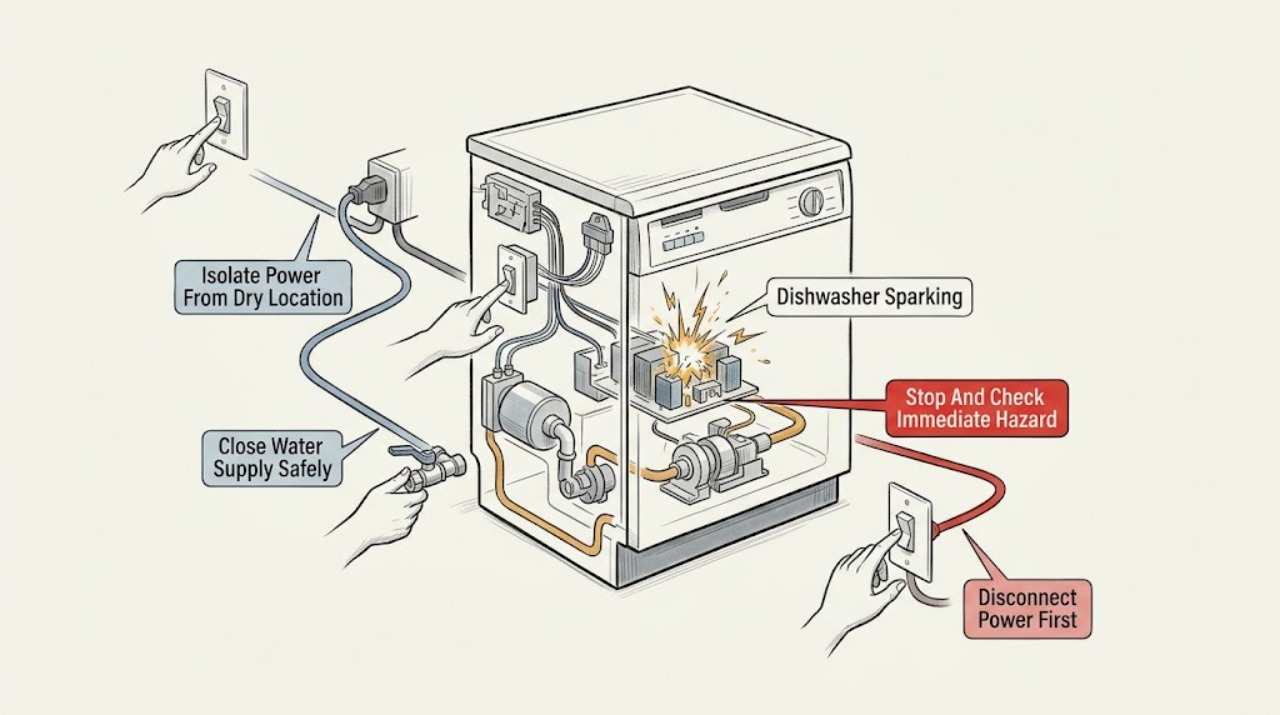
Treat a Candy dishwasher that sparks as an electrical and possible water hazard, not as a normal error that can be cleared. Stop the cycle and keep away from the appliance if sparks, smoke, a burning smell, heat, or water at the floor or plug is present. If you can reach a dry, accessible isolation switch without crossing water or approaching an arc, switch the dishwasher off; otherwise use an upstream breaker only from a safe dry position. Close the dishwasher's water stop valve only when it is safely reachable, and do not pull out, tilt, open, reset, restart, or unplug a wet appliance. After isolation and cooling, record only what is visible from outside: the spark location, smoke or odor, water marks or pooling, display or error, and whether the breaker or RCD operated. Leave the dishwasher out of service and arrange qualified appliance service; an electrician may also be needed for a hot, scorched, damaged, or repeatedly tripping outlet or supply. Do not remove panels, bypass a door or safety device, make a reset test, or perform any live electrical check.
Before you begin
Safety first
- The owner-facing checks stop at external observation and safe isolation. A qualified technician must handle panels, wiring, controls, pumps, heaters, motors, interlocks, water-protection components, insulation tests, and any energized diagnosis.
Work through in order
Diagnostic checks
Use only checks that match the exact appliance or system and its official guide.
-
Check 1
Stop the dishwasher and step back. From a dry position, observe without touching the machine whether sparking, smoke, flame, crackling, burning odor, unusual heat, or water on the floor or around the plug is still present.
Expected result: Sparks or smoke continue; there is flame, a strong burning smell, a hot or scorched outlet or cord, exposed wiring, water at the floor, or no active hazard is visible.
Next step: For fire or spreading smoke, leave the area and contact local emergency services. Otherwise keep people away and proceed only to a safe isolation point; do not press dishwasher controls or touch a wet plug, cord, or appliance.
Stop if: Do not open the door to investigate, pour water on an electrical fire, or cross a wet floor to reach the appliance.
Why this matters
Why: An active arc, heat, smoke, or a wet electrical area is an immediate hazard. No visible activity does not prove the fault is gone; a previous flash still makes the appliance unsafe to restart.
-
Check 2
If there is no water underfoot and the control point is dry and reachable without approaching sparks, switch off the dishwasher at its accessible isolation switch or wall control. If that point is unsafe, use the upstream household breaker only when it can be reached from a dry, safe position. Do not restore power.
Expected result: The dishwasher loses power at the dry isolation point, the breaker or RCD has already operated, the isolation point is wet or hot, or power cannot be safely reached.
Next step: Leave the power off. If the plug, outlet, cable, or fixed wiring is scorched, hot, wet, or repeatedly trips, keep clear and arrange electrical inspection as well as appliance service. Never reset it to see whether the dishwasher works.
Stop if: Do not pull a plug from water, touch a sparking outlet, open an electrical box, test for voltage, or cycle the breaker back on.
Why this matters
Why: A successful shutoff removes normal supply but does not make a wet or damaged appliance safe to handle. A tripped protective device or an unsafe isolation point raises concern about the supply as well as the dishwasher.
-
Check 3
From a dry, safe position, look for water at the dishwasher base, under the sink, or along the visible inlet connection. If the dishwasher stop valve is accessible without moving the unit or reaching through water, close it; otherwise leave the area and have the supply isolated by a qualified person.
Expected result: There is active water, a puddle or wet cabinet base, a damp visible hose or fitting, no visible water, or the shutoff cannot be reached safely.
Next step: Keep power off and the water supply closed when safely possible. Do not mop around a live appliance, remove the kick plate, pull out the dishwasher, loosen a hose, or tilt the machine; arrange professional service.
Stop if: Do not reach into pooled water, handle a wet plug or cable, or assume the built-in safety valve has made the dishwasher safe to use.
Why this matters
Why: Water near an energized appliance increases shock and short-circuit risk and may be a separate leak that contributed to the event. No visible water does not rule out an internal leak or electrical fault. Candy's anti-overflow device, where fitted, is protective rather than a diagnosis.
-
Check 4
Only after power is off and the area is safe, record from outside the appliance: where the flash appeared (outlet, cord, door edge, control area, underside, or inside the tub as seen without opening), when it occurred in the cycle, smoke or odor, water marks, display or error, and any breaker or RCD operation.
Expected result: The location is near the house supply; at the door or controls; below or behind the unit with water evidence; inside the tub; or cannot be identified without opening or moving the dishwasher.
Next step: Give the observations and exact model or product code to qualified service. Keep the dishwasher isolated and do not reproduce the spark for a clearer observation.
Stop if: Do not remove panels, the kick plate, filters, racks, or wiring to improve the view; do not take a live photo or video close to the appliance.
Why this matters
Why: The location helps a technician separate a household supply concern from an appliance-side electrical or water-related fault, but it cannot safely identify a failed component. An unknown location is still a valid stop-use result.
-
Check 5
Read the Candy model or product code only from an exterior rating label, paperwork, or the manufacturer's account/app while the appliance remains isolated. Note whether it is freestanding or built in and whether the supply is a plug or fixed connection, without moving the dishwasher.
Expected result: The full model or product code is available; only a partial identity is available; the unit is hardwired; or the label cannot be reached safely.
Next step: Book qualified Candy/authorized appliance service and, when the outlet or fixed supply is affected, an electrician. Tell them the appliance is isolated after sparking and provide the external symptom record; keep it out of service until inspected.
Stop if: Do not reset, restart, run an empty cycle, substitute a fuse, bypass a door or water safety device, or perform any internal or live electrical test.
Why this matters
Why: Candy manuals and safety details are model-specific, and a hardwired or inaccessible installation increases the need for a qualified visit. A partial model is enough to request help but not enough to select a replacement part or reset sequence.
Use your observations
Decision map
Find the observation that best matches what you see, then follow the next safe action.
-
PATH 01Safety boundary
What you see
Sparking, smoke, flame, strong burning odor, abnormal heat, or exposed/arching wiring is active or returns, especially with a wet floor or a hot outlet.
Do this next
Leave the area for fire or spreading smoke and contact local emergency services. Otherwise keep the area clear, cut power only from a safe dry upstream point, and arrange qualified electrical and appliance service.
Why this path and its safety boundary
Why it matters: An immediate electrical or fire hazard is more likely than a recoverable control error, and the appliance should not be approached for a reset or closer inspection.
Safety stop: Do not touch the appliance, plug, outlet, water, or breaker if doing so requires crossing the hazard; do not use water on an electrical fire.
-
PATH 02Safety boundary
What you see
The flash occurred with water at the base, under-sink connection, cabinet, or floor, or the dishwasher's water protection appears to have operated.
Do this next
Keep power off and close the accessible dishwasher water valve only from a dry safe position. Do not move, tilt, open, or partially dismantle the unit; arrange appliance service and electrical inspection if the supply was affected.
Why this path and its safety boundary
Why it matters: A leak or water path may have contributed to an electrical fault. Candy's listed anti-overflow valve can limit water flow on some models, but it does not establish that the electrical system is safe.
Safety stop: Do not reach through water, handle a wet cord or plug, mop while power may be present, or restart after the water stops.
-
PATH 03Safety boundary
What you see
The visible flash was at the wall outlet, plug, cord, or fixed connection, or the breaker/RCD trips when the dishwasher is connected, with no need to open the appliance to see it.
Do this next
Leave the supply isolated and keep the dishwasher disconnected only if it can be done from a dry safe position. Arrange an electrician for the outlet or fixed wiring and qualified appliance service for the dishwasher.
Why this path and its safety boundary
Why it matters: The household supply, outlet, plug, or cable is at least as plausible as an internal dishwasher component; reconnecting could recreate the arc.
Safety stop: Do not try another outlet, use an extension lead, reset the breaker repeatedly, or touch a scorched or wet connection.
-
PATH 04Safety boundary
What you see
The flash was seen at the door edge, controls, underside, or inside the dishwasher, or the location is unknown after the event; power and water are now isolated.
Do this next
Keep the unit out of service, provide the exact model and external record to qualified Candy service, and let the technician use the matching manual and safe test procedure.
Why this path and its safety boundary
Why it matters: An internal wiring, control, pump, heater, motor, or moisture-related fault remains possible, but external symptoms cannot safely distinguish these parts.
Safety stop: Do not run a diagnostic cycle, reset to test, remove panels, bypass a safety interlock, or perform live measurements.
Helpful context
Understand the symptom
Sparking changes the decision immediately
A visible arc, flash, crackle, smoke, or burning odor is not a routine Candy dishwasher symptom. The safe decision is to stop use and isolate the appliance only from a dry, accessible control point. Candy's installation material links safe operation to a grounded outlet, an accessible water shutoff, and intact water and electrical connections; those installation facts support a stop-use response, but they do not identify which internal part failed.
Do not rely on the anti-overflow system
Some Candy dishwasher models list an anti-overflow device that closes a safety valve when an error or malfunction occurs. That is a water-protection feature, not a guarantee that a sparking appliance is electrically safe. If water is visible, keep clear of the wet area and close the supply only from a safe, dry position; never move or tilt a built-in dishwasher to reach a hose or connection.
The outside evidence is enough for the first service call
Once the appliance is isolated and cool, an owner can report the exact Candy model or product code and describe what was visible without opening the machine. The location of the flash, a wet floor or cabinet base, a tripped breaker or RCD, smoke, odor, and the point in the cycle are useful distinctions. The exact manual portal is model-driven, so do not substitute a reset or diagnostic sequence from another Candy dishwasher.
Safety boundary
Stop conditions
- Stop immediately for active or returning sparks, smoke, flame, burning odor, abnormal heat, exposed wiring, a wet floor near the dishwasher, or a hot or scorched outlet, plug, or cable.
- Cut power only from a dry, accessible isolation point; if the route is wet or arcing, keep clear and use qualified emergency or electrical help.
- Close the dishwasher water valve only when it is safely reachable; do not pull out, tilt, open, or dismantle the dishwasher to reach it.
- Do not reset, restart, run an empty cycle, try another outlet, bypass a safety device, remove a panel, or perform live testing after a sparking event.
- Keep the Candy dishwasher out of service until qualified appliance service, and electrical inspection where the household supply was involved, has assessed it.
When checks do not resolve it
Need a professional?
Safety scope: The owner-facing checks stop at external observation and safe isolation. A qualified technician must handle panels, wiring, controls, pumps, heaters, motors, interlocks, water-protection components, insulation tests, and any energized diagnosis.
Common questions
FAQ
Should I reset a Candy dishwasher after it sparks?
No. Leave power off and do not restart or run a test cycle. A reset cannot distinguish a supply fault, moisture path, damaged wiring, or an internal component fault, and restoring power could recreate the arc.
Can I unplug the dishwasher if I see water near it?
Do not reach through water or touch a wet plug, cord, or outlet. Isolate power only from a dry, safe upstream point and close the water valve only when it is safely reachable; then arrange qualified service.
Does Candy's anti-overflow valve make a sparking dishwasher safe?
No. Some Candy models list a valve that stops water flow during an error or malfunction, but that water-protection feature does not clear an electrical fault or make it safe to restart.
What should I tell the service technician?
Provide the exact model or product code, the external spark location, when it happened, any smoke, odor, heat, water, display message, breaker or RCD operation, and whether power and water were isolated. Do not open the dishwasher to collect more evidence.
Read the exact guide
Official sources
- CDPH 2L1049W-80 | Dishwasher Brava | CandyCandy · One official Candy model page; anti-overflow wording is model-specific and is not generalized as a guarantee for every Candy dishwasher.
- Cómo instalar un lavavajillas fácilmente – Candy EspañaCandy España · Official Candy installation guidance; used for safe access boundaries and connection context, not as proof of a particular component failure.
- Jak zapojit myčku: jednoduchý průvodce – Candy Česká republikaCandy Česká republika · Official Candy installation guidance; general safety and connection principles, not a diagnosis of a specific sparking model.
- Search and download of instruction manuals | HooverHoover / Candy Hoover Group · Official group support page; used to require the exact model or product code before applying any model-specific instruction.
Community feedback
Share a repair observation
Share a plain-text repair observation. Accepted observations are published automatically; this page may take a moment to update.