
On this page
Start here
Quick answer
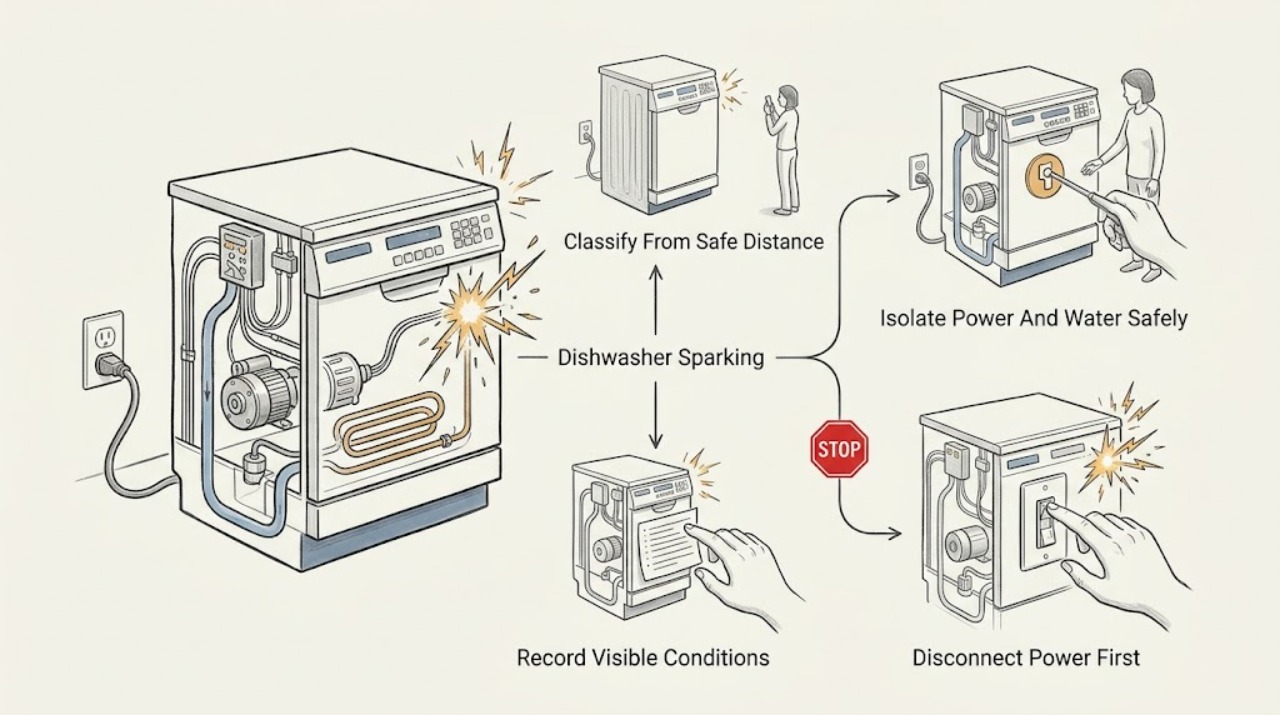
If you saw an actual spark or arc, smelled burning, saw smoke or melted plastic, heard electrical crackling, or the breaker tripped, stop the dishwasher immediately and do not start it again to reproduce the event. Keep away from water and the appliance, and isolate power at the breaker or unplug only if the path is dry and safe; if the plug, outlet, or floor is wet, do not touch it. Close the dishwasher water shutoff if that can be done safely, and arrange qualified service. If there was no physical arc, compare the report with Frigidaire's documented normal dishwasher sounds—water-valve hissing, pump humming, spray-arm whooshing, or dispenser clunking—or with its flashing-light guidance for power failure, door-not-closed, and keypad patterns. Those normal-sound and light explanations do not clear a genuine electrical hazard, and no Frigidaire model-independent spark diagnosis is safe without the exact model and an inspection.
Before you begin
Safety first
- This article covers safe-distance classification, safe power/water isolation, model/event recording, and comparison with documented light or normal-sound patterns only when no physical hazard occurred. Do not operate, reproduce, open panels, reach into the tub, perform live measurements, or replace electrical, heater, motor, control, latch, or wiring parts; qualified appliance/electrical service is required.
Work through in order
Diagnostic checks
Use only checks that match the exact appliance or system and its official guide.
-
Check 1
From a safe distance, with the dishwasher off and no attempt to reproduce the event, record whether there was a visible arc, smoke, burning odor, melted or scorched material, electrical crackling, a breaker trip, a display/indicator flash, or only a normal operating sound.
Expected result: Any physical arc, smoke, odor, heat damage, crackle, or breaker trip is present; only an indicator light flashed; only a water/pump/spray sound was heard; or the report is uncertain.
Next step: Use the hazard branch immediately for physical evidence or uncertainty. Use the light/sound branches only when there is no arc, smoke, odor, damage, or trip and the appliance remains off.
Stop if: Do not look through gaps, open service panels, put hands in the tub, or run a cycle to identify the source.
Why this matters
Why: Physical electrical evidence or uncertainty is a high-risk stop-use condition. A display flash or documented operating sound may be a different symptom, but the distinction must be made without approaching live or wet parts.
-
Check 2
For a confirmed or possible electrical event, leave the area dry and isolate the dishwasher's power from a safe location. Unplug only when the plug, outlet, floor, and your hands are dry and reachable without touching damaged material; otherwise use the appropriate breaker only if it can be reached safely. Close the dishwasher water shutoff if it is safely accessible.
Expected result: Power is safely isolated; water or the outlet area is wet; the breaker trips again; the cord/outlet is damaged; or isolation cannot be performed without approaching a hazard.
Next step: Keep clear, do not restore power, and arrange qualified appliance/electrical service. If there is active smoke or fire, leave and contact emergency services according to local procedure.
Stop if: Never touch a wet plug or outlet, pull a cord through water, reset a tripping breaker, or handle exposed conductors.
Why this matters
Why: Safe isolation reduces shock and fire risk. Water near electricity, a repeated trip, damaged supply equipment, or inaccessible isolation means the user must not continue handling the appliance and may need an electrician or emergency assistance.
-
Check 3
Once the appliance is safely isolated and there is no need to approach a hazard, record the complete model and serial information, the cycle/options selected, the approximate event time, where the flash or sound appeared to come from, and whether the tub contained water. Do not remove panels to find the label; use the label location described by Frigidaire.
Expected result: The model is known and the event can be described; only a partial model is available; the source location is unknown; or the label/area is unsafe to reach.
Next step: Give the record to Frigidaire or a qualified technician. If the model cannot be safely read, report that and use photos taken from a safe position rather than approaching the appliance.
Stop if: Do not reach behind the unit, remove the toe-kick, or expose the model label by moving a wet or damaged dishwasher.
Why this matters
Why: A complete model and event stage let service distinguish control, motor, heater, water, and installation paths. An unknown source or unsafe label location is not a reason to power the dishwasher for more evidence.
-
Check 4
Only when there was no physical arc, smoke, odor, heat damage, crackle, or breaker trip, compare the recorded light pattern or display with the exact model's Owner's Guide. Frigidaire's general flashing-light guidance describes power-failure, door-not-closed, and shorted-keypad patterns; its FGID2476SF guide is a model-specific example and must not be substituted for another model's manual.
Expected result: The exact manual identifies a normal status or door condition; it identifies a keypad/power condition; the pattern is absent from the manual; or the pattern recurs after the allowed model-specific action.
Next step: Follow only the exact model's external instruction and stop if it does not clear. If any physical electrical evidence appears, return to the immediate stop-use branch.
Stop if: Do not use a light pattern as permission to restart after an odor, spark, damage, or trip, and do not bypass a keypad or latch.
Why this matters
Why: A documented light/status condition may be separate from sparking. A recurring keypad/power pattern or an unrecognized sequence requires service; absence of an arc does not make it safe to open the control area.
-
Check 5
Only when the dishwasher is already off and there was no electrical evidence, compare a sound-only report with Frigidaire's normal-sound descriptions: water-valve hissing, wash-pump or drain-pump humming, detergent-dispenser or valve clunking, and spray-arm whooshing. Do not restart the machine merely to listen again.
Expected result: The report matches a documented water/pump/spray sound; it was a sharp electrical crackle or pop; the sound was accompanied by odor or visible damage; or the source remains uncertain.
Next step: For a sound-only report with no hazard, use the exact model's normal-operation guidance. For any other pattern, leave power isolated and arrange service with the recording.
Stop if: Do not place a phone, tool, or hand near the door seal, tub, motor, heater, or wiring to locate the sound.
Why this matters
Why: A documented water or mechanical sound can be normal when no electrical warning exists. A crackle/pop, accompanying heat/odor/damage, or uncertainty remains a stop-use condition and cannot be cleared by the noise guide.
Use your observations
Decision map
Find the observation that best matches what you see, then follow the next safe action.
-
PATH 01Safety boundary
What you see
A visible spark/arc, smoke, burning odor, melted or scorched material, electrical crackle, or repeated breaker trip occurred at or around the dishwasher.
Do this next
Keep the appliance off, isolate power only from a safe dry location, close the water shutoff if safely accessible, and arrange qualified appliance/electrical service. Provide the exact model and event record.
Why this path and its safety boundary
Why it matters: This is a stop-use electrical/fire/shock-risk branch. The observation cannot identify whether the cause is the outlet, cord, water intrusion, heater, motor, control, or internal wiring.
Safety stop: Do not reset power, run another cycle, open panels, touch wet parts, or attempt a component replacement.
-
PATH 02Safety boundary
What you see
The report includes water on the floor or under the dishwasher, a wet outlet/plug area, damaged cord, or inability to safely reach the isolator.
Do this next
Do not touch the wet electrical area. Move away and obtain qualified electrical/appliance help; isolate the water supply only from a safe dry location and do not move the unit to expose it.
Why this path and its safety boundary
Why it matters: Water and mains electricity create a higher shock risk; a leak can also be the event that was mistaken for a spark. The user cannot safely distinguish a supply-side from appliance-side fault.
Safety stop: Do not unplug through water, pull the dishwasher out, wipe an energized outlet, or restore power to check for a leak.
-
PATH 03Safety boundary
What you see
There was no arc, smoke, odor, heat damage, crackle, or breaker trip, and the report is a display flash or repeating indicator-light sequence.
Do this next
Record the model, light order, timing, and door/start state, then follow the exact Owner's Guide. If the pattern persists or the manual does not identify it, leave the unit off and arrange service.
Why this path and its safety boundary
Why it matters: A control/status condition is more likely than sparking. Frigidaire documents power-failure, door-not-closed, and shorted-keypad light patterns, but exact behavior varies by model.
Safety stop: Do not restart if any odor, damage, crackle, or trip is later noticed, and do not open the control panel.
-
PATH 04Safety boundary
What you see
There was no physical electrical evidence and the report is a sound that matches water-valve hiss, pump hum, spray-arm whoosh, or a dispenser/valve clunk during normal operation.
Do this next
Do not reproduce the event solely for confirmation. If the sound remains within the model's normal operation and no hazard exists, use the exact guide; otherwise request service.
Why this path and its safety boundary
Why it matters: A documented operating sound is more likely than a spark, but the sound guide cannot validate an electrical-looking event or a sound accompanied by an odor or trip.
Safety stop: Stop immediately if the sound changes to crackling, is accompanied by heat/smoke/odor, or power trips.
-
PATH 05Safety boundary
What you see
The user cannot distinguish an arc from a light flash or sound, the model is unknown, or the event recurs after any model-approved external action.
Do this next
Keep the dishwasher disconnected and arrange qualified service. Supply the model, photos, stage, power/water state, and what was observed without attempting another cycle.
Why this path and its safety boundary
Why it matters: Evidence is insufficient to declare the appliance safe. Uncertainty and recurrence should be treated as a possible electrical fault rather than solved by a generic Frigidaire troubleshooting list.
Safety stop: Do not guess at a part, bypass protection, or power the machine for a better look.
Helpful context
Understand the symptom
Treat real electricity as the diagnosis
A dishwasher is connected to mains power and water. A visible arc, smoke, a burnt smell, melted insulation, electrical crackle, or a breaker trip is enough to stop use; you do not need to identify the component first. Do not open the door repeatedly, reach into the tub, reset the breaker, or run another cycle to see whether the event happens again. If the report may have been a light flash or a normal pump/valve sound, that can be sorted from a safe distance after the appliance is off, but uncertainty favors the stop-use path.
A display flash is not automatically a spark
Frigidaire's support material describes distinct flashing-light patterns for power failure, a door that is not closed, and a shorted keypad. Its noise guide separately describes hissing from the water valve, humming from wash or drain pumps, and whooshing from spray arms. These are possible explanations only when there was no physical arc, smoke, odor, heat damage, or breaker operation. They do not justify a live test or a restart after a real electrical event.
Why no part should be ordered from 'sparking' alone
A spark report can involve the outlet or cord, an internal connection, a wet electrical area, a heater, motor, keypad, control, or a component that is not visible without removing the enclosure. The exact model guide—not a brand-wide parts list—sets the safe service boundary. Preserve the evidence and model information for a qualified technician instead of guessing at a pump, heater, board, or harness.
When checks do not resolve it
Need a professional?
Safety scope: This article covers safe-distance classification, safe power/water isolation, model/event recording, and comparison with documented light or normal-sound patterns only when no physical hazard occurred. Do not operate, reproduce, open panels, reach into the tub, perform live measurements, or replace electrical, heater, motor, control, latch, or wiring parts; qualified appliance/electrical service is required.
Common questions
FAQ
What should I do if my Frigidaire dishwasher actually sparks?
Stop the dishwasher and do not restart it. Keep away from water and the appliance, isolate power only from a safe dry location, and arrange qualified service. Do not open panels, reset a tripping breaker, or run a cycle to identify the source.
Could a Frigidaire dishwasher light flash be mistaken for a spark?
Yes, if there was no physical arc, smoke, odor, heat damage, crackle, or breaker trip. Frigidaire documents separate light patterns for power failure, a door that is not closed, and a shorted keypad. Record the exact sequence and use the model's guide; those patterns do not make a genuine spark safe.
Is a popping or hissing sound from a Frigidaire dishwasher always sparking?
No. Frigidaire lists water-valve hissing, wash or drain pump humming, spray-arm whooshing, and some dispenser or valve clunks as normal operating sounds. Do not use that list to dismiss a crackle, burning odor, smoke, damage, or breaker trip, and do not restart solely to listen again.
Can I reset my Frigidaire dishwasher after a spark?
No. Do not reset or reproduce a confirmed or possible electrical event. Keep power isolated and arrange service. A model-approved reset can apply to some ordinary status or fault conditions only when the exact guide permits it and there is no spark, odor, smoke, damage, water/electrical hazard, or repeated trip.
Why do I need the exact Frigidaire dishwasher model?
Frigidaire control layouts, light sequences, displays, and service boundaries vary. The FGID2476SF product page links that model's guide and identifies its top controls, control lock, and digital display; another model may not use the same indications. Read the label only from a safe location and give the model to service.
Read the exact guide
Official sources
- Dishwasher - Noise GuideFrigidaire · Frigidaire support article marked as applying to dishwashers; use only to compare a sound-only report with no electrical warning.
- Dishwasher - Water LeakingFrigidaire · Frigidaire support article marked as applying to dishwashers; used only for the water-hazard branch, not as a spark diagnosis.
- Product Support: Frigidaire Gallery 24'' Built-In Dishwasher with EvenDry™ System Stainless Steel-FGID2476SFFrigidaire Canada · Exact discontinued FGID2476SF model page; its controls and support resources cannot be generalized to every Frigidaire dishwasher.
- Dishwasher Use & Care: 117859220Frigidaire · PDF linked from the official FGID2476SF product-support page; safety and status details are scoped to that guide/model family.
- Dishwashers Flashing LightsFrigidaire · Frigidaire support article marked as applying to dishwashers; exact indicator behavior can vary by model.
Community feedback
Share a repair observation
Share a plain-text repair observation. Accepted observations are published automatically; this page may take a moment to update.