
On this page
Start here
Quick answer
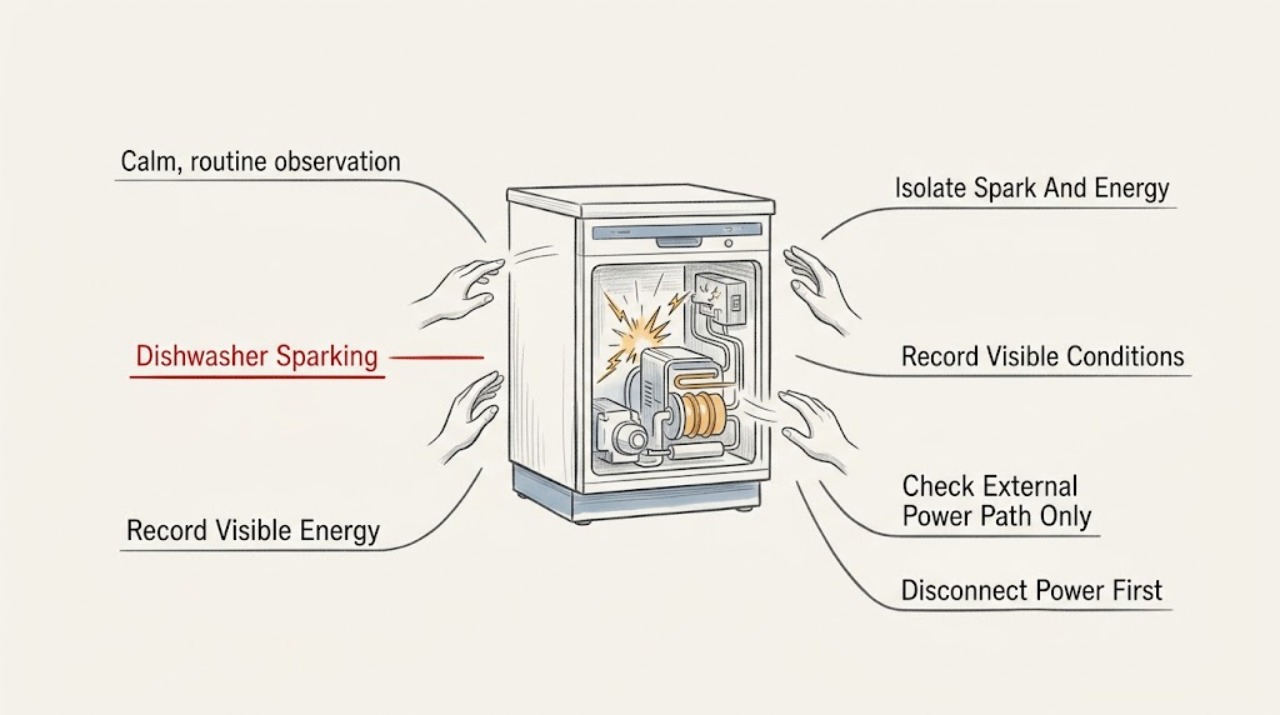
A visible spark, flash, arc, or crackling from a KitchenAid dishwasher is a stop-use symptom, not a reason to run another cycle. If the controls respond and it is safe, cancel the cycle; from a dry, safe position switch off the dishwasher breaker and close the water supply if water is also involved. Do not touch wet electrical areas, pull a wet plug, open the door or access panels to watch the spark, or perform live tests. Record whether the event was at the receptacle, cord, control area, door edge, tub, or underneath, and whether it occurred during fill, wash, drain, heat/dry, or immediately after a door movement. KitchenAid's official materials show that dishwasher families and controls vary by model, and that door latching, power, cycle state, water supply, and control reset are model-specific checks. A spark near the heating element, wiring, control, or cabinet requires qualified appliance service; a damaged or arcing household outlet also requires a qualified electrician.
Work through in order
Diagnostic checks
Use only checks that match the exact appliance or system and its official guide.
-
Check 1
Stop pressing Start or other controls. If the dishwasher is running and the panel responds, cancel it only as the model permits; then, from a dry and safe position, switch off the dedicated breaker. If the machine is plugged in, do not pull a wet or hot plug. Close the accessible water valve if water is present or the dishwasher is filling.
Expected result: The spark stops when the dishwasher is de-energized, the breaker trips or will not hold, water is near the outlet or wiring, or the area cannot be approached safely.
Next step: Keep the dishwasher and affected circuit off. Use only the external observation and documentation steps below; arrange appliance service and electrician evaluation when the household power path is involved.
Stop if: Do not re-energize the dishwasher to reproduce the spark, pull a wet plug, or reach behind the unit.
Why this matters
Why: De-energizing prevents another event but does not identify whether the source is the household circuit, cord, control, heater, motor, or internal wiring. A recurring trip, wet electrical area, or unsafe access is an immediate service boundary.
-
Check 2
Without opening panels or reconnecting power, write down the visible location of the flash: receptacle or plug, cord, control area, door edge, inside the tub, beneath the unit, or unknown. Record whether it happened during fill, wash, drain, heated drying, immediately at startup, or after the door moved, plus any smoke, odor, heat, water, or error indication.
Expected result: The event is localized to the household power path, door/control area, tub/heater area, underside, or cannot be localized safely.
Next step: Give the complete symptom record and model/serial information to service. If the receptacle, plug, or household breaker appears involved, include a qualified electrician in the assessment.
Stop if: Do not run an open-door cycle, remove the lower panel, or use a camera, mirror, meter, or probe inside the appliance to watch for the event.
Why this matters
Why: Location and timing select the correct professional path but do not prove a component failure. A tub or underside event can involve internal electrical or heating circuits that require de-energized technician diagnosis.
-
Check 3
After power is isolated, inspect only the accessible face of the outlet, plug, and cord for scorch marks, melting, looseness, moisture, or damaged insulation. Do not test the affected outlet with another appliance, lamp, meter, or voltage detector after an arc or visible damage.
Expected result: The outlet or plug is hot, discolored, loose, wet, melted, or damaged, or the external power path appears intact.
Next step: Leave the affected circuit isolated and contact a qualified electrician when the outlet or household wiring is implicated. Keep the dishwasher disconnected for appliance service even if the outlet looks normal.
Stop if: Do not replace a plug, repair the cord, change a breaker, use an extension cord, or perform live electrical measurements.
Why this matters
Why: A damaged outlet or plug makes a household electrical fault possible; an intact exterior does not clear the dishwasher's internal wiring or control. Visual inspection cannot establish that the circuit is safe.
-
Check 4
Read the model and serial label from the accessible tub frame or door area without moving the dishwasher. Note whether the controls had been locked, delayed, asleep, or unresponsive before the spark, and whether the door was fully latched. Do not use a control reset or diagnostic mode after a spark unless a qualified technician directs it.
Expected result: The exact model is known and the event was clearly an abnormal flash, or the model is unknown, the door/control state is uncertain, or a code appeared.
Next step: Supply the model, serial, displayed code, and pre-event control state to authorized service. Keep power off when the event involved the door, control, wiring, or any smell/heat.
Stop if: Do not bypass the door latch, hold unknown button combinations, enter technician diagnostics, or reconnect power to test a theory.
Why this matters
Why: KitchenAid separates dishwasher generations and systems, and its no-start guidance treats Control Lock, sleep/delay, door latch, and reset as model-dependent. These states may explain a no-start symptom but do not explain away a visible spark.
-
Check 5
Treat a flash from inside the tub, near the heating element, under the door, or beneath the cabinet as an internal appliance fault. Do not remove the lower access panel or outer door, disconnect a heater wire, attempt internal electrical diagnosis, or inspect the control board yourself.
Expected result: The spark was near an internal component, the event happened during heat/dry or wash, or the source remains unknown after the safe external checks.
Next step: Leave the dishwasher disconnected, close the water supply if appropriate, and arrange qualified appliance service. Report whether the unit was heating, washing, draining, or drying when the event occurred.
Stop if: Do not open the chassis, test energized circuits, replace the heater or control, or reset the appliance after an internal arc.
Why this matters
Why: KitchenAid owner documentation identifies the heating element and electrical installation as safety-relevant areas. An internal spark can involve more than the visible component and is not a user-level part diagnosis.
Use your observations
Decision map
Find the observation that best matches what you see, then follow the next safe action.
-
PATH 01Next step
What you see
The flash or crackle came from the receptacle, plug, cord entry, or breaker, or the breaker trips when power is restored.
Do this next
Keep the circuit and dishwasher off. Have a qualified electrician evaluate the outlet/circuit and appliance service evaluate the dishwasher before reuse.
Why this path and its safety boundary
Why it matters: The household power path may be involved; the dishwasher cannot be cleared simply because its panel later lights.
-
PATH 02Next step
What you see
The flash appeared at the door edge, control area, cord entry, or beneath the unit while controls or the latch were being used.
Do this next
Leave power off and arrange qualified appliance service. Do not bypass the latch or use control sequences to force a start.
Why this path and its safety boundary
Why it matters: A door-switch, control, wiring, or moisture-related appliance fault is possible, and the fault cannot be safely separated without de-energized service diagnosis.
-
PATH 03Next step
What you see
The flash was inside the tub or underneath, particularly during wash, heating, or drying.
Do this next
Do not open the dishwasher. Keep it disconnected and arrange model-specific appliance service with the cycle stage and symptom record.
Why this path and its safety boundary
Why it matters: An internal heating or electrical circuit may be involved; the visible location is not enough to identify a heater, harness, control, pump, or seal as the failed part.
-
PATH 04Next step
What you see
The event was brief and its source is uncertain, with no confirmed damage or odor.
Do this next
Keep the dishwasher off, record the model and circumstances, and request qualified assessment rather than reproducing the flash.
Why this path and its safety boundary
Why it matters: Uncertainty does not establish safety; repeating the cycle would create avoidable exposure to an unknown electrical event.
Helpful context
Understand the symptom
A spark is different from a status light or normal sound
A visible electrical flash, snap, arc, smoke, or burning smell should be treated as abnormal even if the dishwasher later appears to work. KitchenAid's owner material identifies the electrical supply, control, door, heating element, and other components in the appliance and warns that incorrect grounding or electrical installation can cause fire or shock. The safe user task is to isolate and document the event, not to prove the failed part.
Use model identity to select the right service information
KitchenAid's troubleshooting entry separates dishwasher resources by model generation and system, and its no-start guidance says that control lock, sleep or delay, door latching, water supply, and reset behavior vary in the user path. Do not copy a control sequence, diagnostic mode, heater test, or wiring procedure from another KitchenAid dishwasher.
When checks do not resolve it
Need a professional?
Arrange qualified appliance service for any visible spark from the dishwasher, an internal flash near the heater or wiring, a damaged cord, repeated breaker trip, burning odor, smoke, heat, water near electrical parts, or an unresolved source. Use a qualified electrician when the receptacle, breaker, or household circuit appears involved.
Common questions
FAQ
Should I run the dishwasher again to see where it sparks?
No. Stop using it, isolate power from a dry safe position, and document the location and cycle stage without reproducing the event. A visible spark is not a safe user-level diagnostic test.
What if the spark came from the outlet or plug?
Leave the circuit and dishwasher off. Do not plug in another appliance or repair the plug yourself; have a qualified electrician assess the receptacle or circuit and appliance service assess the dishwasher before reuse.
Could the heating element be the cause of a KitchenAid dishwasher spark?
A flash in or near the tub during heating or drying requires the dishwasher to remain off, but location alone does not prove the heater is at fault. KitchenAid's owner material identifies the heating element and electrical installation as safety-relevant; do not remove panels or test internal circuits yourself.
Do Control Lock or Delay Wash explain sparking?
They can explain a dishwasher that appears not to start, not a confirmed electrical spark. KitchenAid documents Control Lock, standby/sleep, Delay Wash, door latching, and reset as separate model-dependent start conditions; a visible flash still requires the stop-use boundary.
Why do I need the exact KitchenAid dishwasher model?
KitchenAid separates troubleshooting by dishwasher generation and system, and controls, heater circuits, door layouts, and service procedures can differ. Record the full model and serial number and do not transfer a diagnostic sequence or part assumption from another model.
Read the exact guide
Official sources
- Not Starting or Operating - Dishwasher - Product Help | KitchenAidKitchenAid Product Help · KitchenAid dishwasher power, Control Lock, standby/sleep, Delay Wash, door latch, water supply, and control reset guidance
- Troubleshoot | KitchenAidKitchenAid · KitchenAid dishwasher model-generation and system-specific troubleshooting entry points
- Owner's ManualKitchenAid · KitchenAid dishwasher owner safety, controls, heating-element identification, and troubleshooting for the covered manual family
- DISHWASHER FEEDBACKKitchenAid · KitchenAid dishwasher Start/Resume, door timing, Delay, and Control Lock behavior for the covered cycle-guide family
Community feedback
Share a repair observation
Share a plain-text repair observation. Accepted observations are published automatically; this page may take a moment to update.