
On this page
Start here
Quick answer
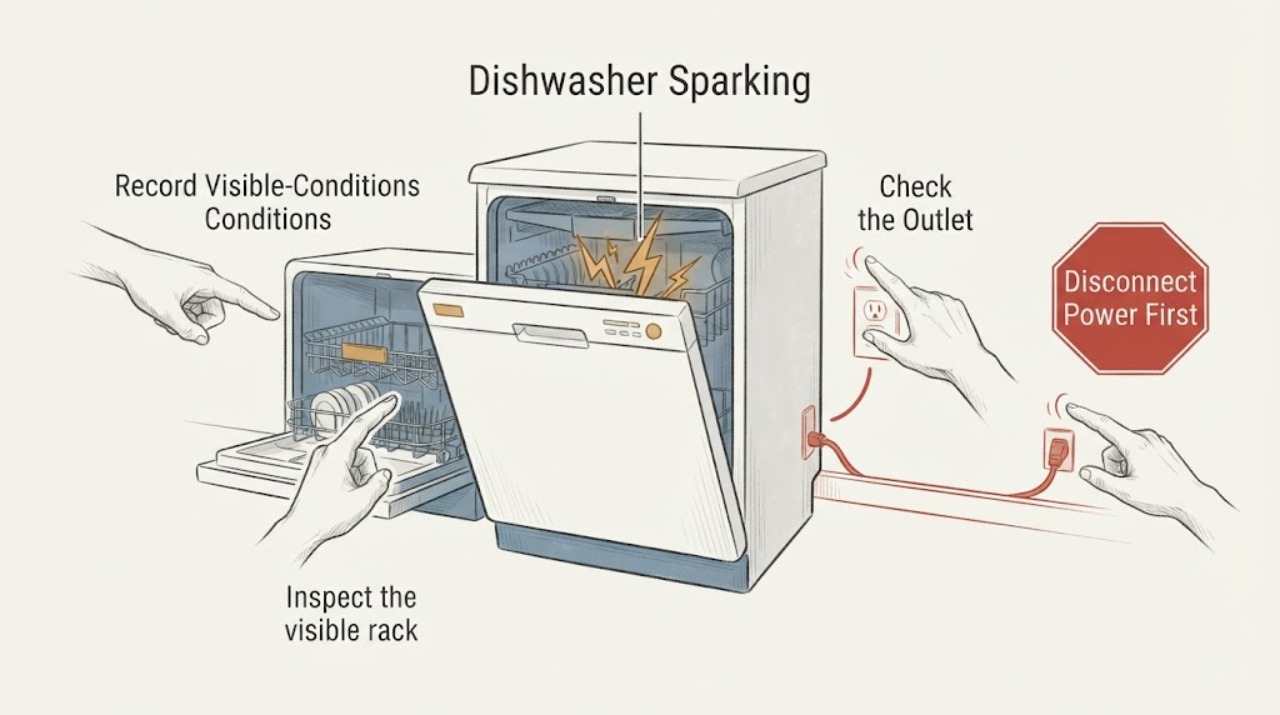
Visible sparking inside or around a Thermador dishwasher is not a normal wash-cycle sound. Stop the cycle, keep the door closed until the appliance is safe to approach, and disconnect power at the breaker only if this can be done without touching a wet or damaged appliance. Check only for an obvious metal utensil or loose item after power is isolated; if sparking repeats, there is a burning smell, smoke, a leak, or a breaker trip, leave the dishwasher off and call qualified service.
Work through in order
Diagnostic checks
Use only checks that match the exact appliance or system and its official guide.
-
Check 1
Stop the current programme and record where the spark appeared, whether there was smoke or a burning odor, whether water was present, and whether a breaker or fuse operated.
Expected result: There is smoke, a burning odor, repeated arcing, water near electrical parts, a tripped breaker, or a single brief flash associated with an item.
Next step: Leave the dishwasher off. If smoke or fire is present, leave the area and call emergency services; otherwise arrange qualified appliance service before another cycle.
Why this matters
Why: These observations separate an immediate electrical or water hazard from a possible loose-object contact, but none proves the cause without inspection.
-
Check 2
If and only if the appliance is fully de-energized and dry to approach, inspect the visible rack and tub for a fallen metal utensil, foil, or other loose item that could contact a spray arm or heater; do not remove covers or touch wiring.
Expected result: A loose item is visible, or the tub and racks are clear but the spark location is uncertain or near the door/control area.
Next step: Remove only the loose item with the power isolated, then do not run a cycle until the appliance is checked if any arcing, odor, or damage occurred. Treat an unclear or control-area spark as a service issue.
Why this matters
Why: A visible object can explain a one-time contact, while a clear tub or control-area spark keeps an internal electrical, heater, or insulation fault possible.
-
Check 3
Check the household breaker and dishwasher outlet only from the safe external side; do not repeatedly reset a tripped breaker or use an extension cord to bypass the circuit.
Expected result: The breaker is tripped, the outlet or cord shows heat or damage, or power appears normal while the dishwasher remains off.
Next step: Leave a tripped or damaged circuit off and call an electrician or appliance technician as appropriate. Do not test live terminals or open the electrical compartment.
Why this matters
Why: A trip or heat damage indicates an electrical fault that cannot be cleared by restarting. Normal power does not rule out a dishwasher-side fault.
-
Check 4
Before service, write down the complete model, any display code, programme, spark location, and whether the event happened during filling, washing, heating, or drying.
Expected result: A code is present, the event repeats at one programme stage, or no code is shown.
Next step: Give these details to Thermador service and do not run another test cycle.
Why this matters
Why: Thermador's error guidance is code- and model-specific; timing and location help the technician distinguish water, heater, pump, electronics, and wiring paths.
Use your observations
Decision map
Find the observation that best matches what you see, then follow the next safe action.
-
PATH 01Next step
What you see
A one-time flash is traced to a visible loose metal object after the appliance is safely de-energized, with no odor, smoke, leak, or damage.
Do this next
Remove only the object and have the appliance checked before normal use if any arc occurred.
Why this path and its safety boundary
Why it matters: Object contact is possible, but the event is not proven harmless.
-
PATH 02Next step
What you see
Sparking repeats, occurs near controls or wiring, or trips the breaker.
Do this next
Keep the dishwasher off and arrange qualified service; do not reset the breaker repeatedly.
Why this path and its safety boundary
Why it matters: An internal electrical, heater, or insulation fault is more likely than a rack-loading issue.
-
PATH 03Next step
What you see
There is smoke, burning odor, visible melting, or water near energized parts.
Do this next
Leave the area for smoke or fire and call emergency services; otherwise isolate power only if safe and contact service.
Why this path and its safety boundary
Why it matters: The symptom has crossed an immediate safety boundary.
-
PATH 04Next step
What you see
A Thermador error code accompanies the spark.
Do this next
Record it exactly and follow only the code's service direction; do not attempt internal repair.
Why this path and its safety boundary
Why it matters: The code may identify a model-specific water, heater, electronics, or safety condition.
Helpful context
Understand the symptom
Sparking is a safety symptom, not a routine dishwasher noise. Note whether it came from the tub, control area, outlet, or nearby wiring, and whether it occurred with a metal object, a leak, smoke, burning odor, or a breaker trip.
Thermador's support materials describe water, drain, heater, electronics, and safety-switch faults by model and advise service for listed technical conditions. They do not authorize opening a dishwasher or testing live parts at home.
Keep the appliance off after a spark. Do not restart it to see whether the arc returns, spray water into the unit, remove panels, or reach behind the control area. A qualified technician must distinguish an item contact from an electrical or heater fault.
Only after diagnosis
Potential parts
- dishwasher heater, wiring, or control component
Consider a component only after a qualified technician identifies the failed electrical or heating part.
Do not order from the sparking symptom; use the complete model and diagnosis.
When checks do not resolve it
Need a professional?
Provide the model, serial information, exact spark location and timing, programme stage, display code, breaker behavior, water or odor observations, and whether a loose object was found.
Common questions
FAQ
Is sparking inside a Thermador dishwasher normal?
No. Stop the cycle and leave the appliance off. A loose object may be visible only after power is isolated, but repeated arcing, odor, smoke, leaks, or a breaker trip requires service.
Can I run the dishwasher once to test it after a spark?
No. Record the location and timing and have the appliance inspected before another cycle.
What should I tell Thermador service?
Give the full model, programme stage, spark location, display code, breaker behavior, odor or water observations, and whether a loose metal item was found.
Read the exact guide
Official sources
- Dishwashers - Error CodesThermador · Official Thermador error-code page with model-specific service directions for heater electronics, water protection, pump, and control faults.
- Dishwashers - TroubleshootingThermador · Official Thermador dishwasher troubleshooting page; it documents normal water circulation noise and separate technical troubleshooting paths.
Community feedback
Share a repair observation
Share a plain-text repair observation. Accepted observations are published automatically; this page may take a moment to update.