
On this page
Start here
Quick answer
For a leaking coffee machine, first locate whether water comes from the tank, drip tray, brew group/filter holder, steam wand, or cabinet. Reseat accessible tanks and seals, clean scale from the inlet or brew path as the model allows, and make one controlled retest. Unplug and seek service for cabinet leaks or water near electrics.
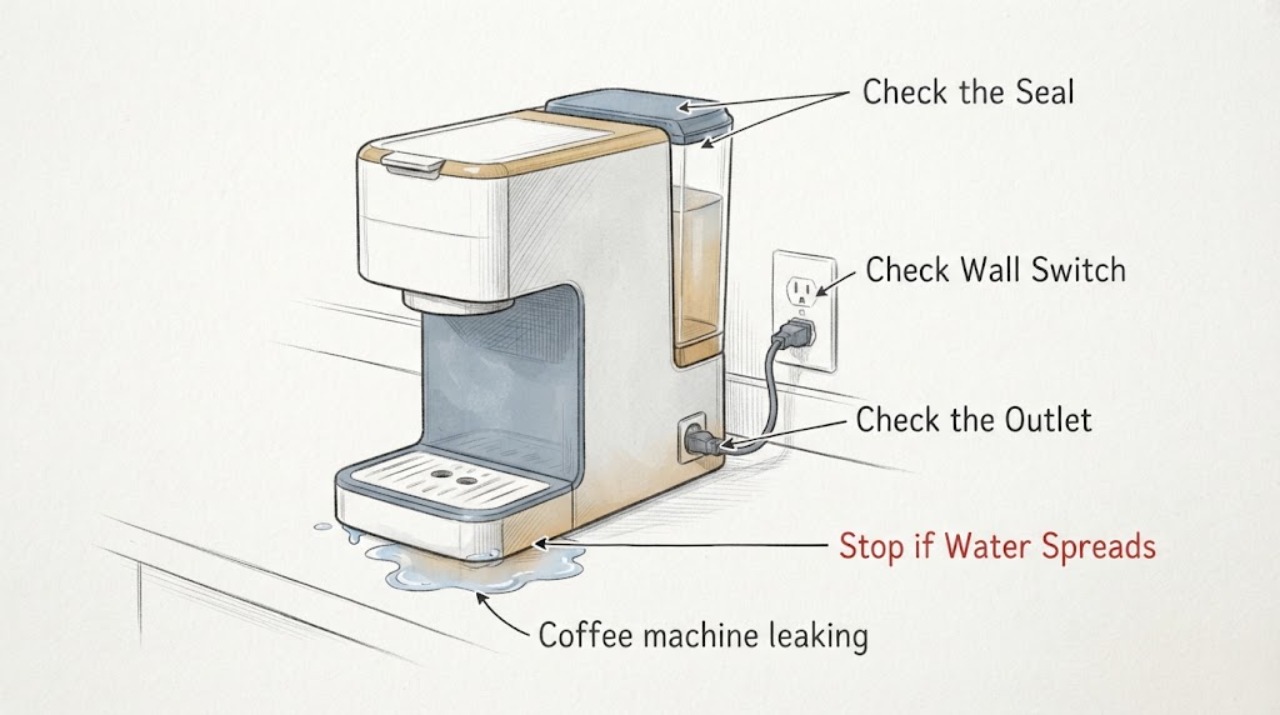
Work through in order
Diagnostic checks
Use only checks that match the exact appliance or system and its official guide.
-
Check 1
Switch off/unplug and cool the machine; locate first wet point under tank, tray, holder, wand, or cabinet.
Expected result: Leak location is identified.
Next step: Do not run if water reaches the cord or cabinet electrics.
Why this matters
Why: Location selects the water circuit and urgency.
-
Check 2
Inspect tank, outlet gasket, and housing seat; refill only to model line and reseat.
Expected result: Tank leaks alone, gasket/tank damaged, or leak occurs only when seated.
Next step: Clean accessible inlet and arrange model support for damage/persistent leak.
Why this matters
Why: Tank fit and inlet are documented checks; damage is a conditional part issue.
-
Check 3
For holder/brew group, verify lock, basket dose, residue, scale, and accessible outlet.
Expected result: Leak is at holder edge or path blocked/dirty.
Next step: Clean/descale only as model procedure and retest once.
Why this matters
Why: Incorrect fit, blockage, and scale can contribute; persistent leak needs technical assistance.
-
Check 4
Inspect wand/tray and run one normal cycle only if no cabinet/electrical leak exists.
Expected result: Leak stops, returns at a specific outlet, or comes from base.
Next step: Contact support with model/serial and leak location.
Why this matters
Why: Repeatable outlet leak needs diagnosis; cabinet leak is not an external-cleaning issue.
Use your observations
Decision map
Find the observation that best matches what you see, then follow the next safe action.
-
PATH 01Next step
What you see
Only tray collection or a small documented preparation drip occurs.
Do this next
Empty tray after cycle and monitor.
Why this path and its safety boundary
Why it matters: Collection/purge water may be normal.
-
PATH 02Next step
What you see
Tank leaks or inlet is scaled/misaligned.
Do this next
Reseat/clean; use only model-confirmed tank/seal.
Why this path and its safety boundary
Why it matters: Reservoir/inlet path is the leading accessible branch.
-
PATH 03Next step
What you see
Holder leak persists after correct locking and approved cleaning.
Do this next
Stop repeated brewing and arrange support.
Why this path and its safety boundary
Why it matters: Gasket, blocked outlet, or internal brew path remains possible.
-
PATH 04Next step
What you see
Leak is under cabinet or near electrics.
Do this next
Unplug when safe and obtain qualified service.
Why this path and its safety boundary
Why it matters: Professional safety boundary.
Helpful context
Understand the symptom
Coffee machines have separate water circuits; puddle location is more useful than the word leaking.
Keep the machine off and cool during inspection.
When checks do not resolve it
Need a professional?
Arrange coffee-machine service for persistent leaks, cabinet/base leaks, or gasket, valve, boiler, pump, or brew-group diagnosis.
Common questions
FAQ
Why does the tank leak?
Check tank seating, applicable cap, and inlet scale. A damaged tank/gasket needs model-confirmed support.
Is a small espresso drip always a fault?
Some models can drip around preparation; a growing puddle, holder leak, or cabinet leak is different.
Can I keep using a machine leaking underneath?
No. Unplug when safe and arrange service.
Read the exact guide
Official sources
- Linea Classic: the water tank is leaking FAQDe’Longhi · espresso coffee machine tank leak checks
- De’Longhi Customer ServiceDe’Longhi · coffee-machine model and serial support
- My coffee machine presents a leakage problem from the filter holder is. Why does it this happen?De’Longhi · espresso coffee machine filter-holder leak checks
Community feedback
Share a repair observation
Share a plain-text repair observation. Accepted observations are published automatically; this page may take a moment to update.