
On this page
Start here
Quick answer
A coffee machine that is not heating may still be warming up, have an incorrectly seated or empty water tank, need descaling, or have a temperature or heating fault. Let the ready indicator finish, confirm the tank is full and seated, run only the model-approved rinse or descale procedure, and distinguish a lukewarm cup from a machine that never reaches ready. Persistent failure needs model-specific service because the heater and control are not user-safe to open.
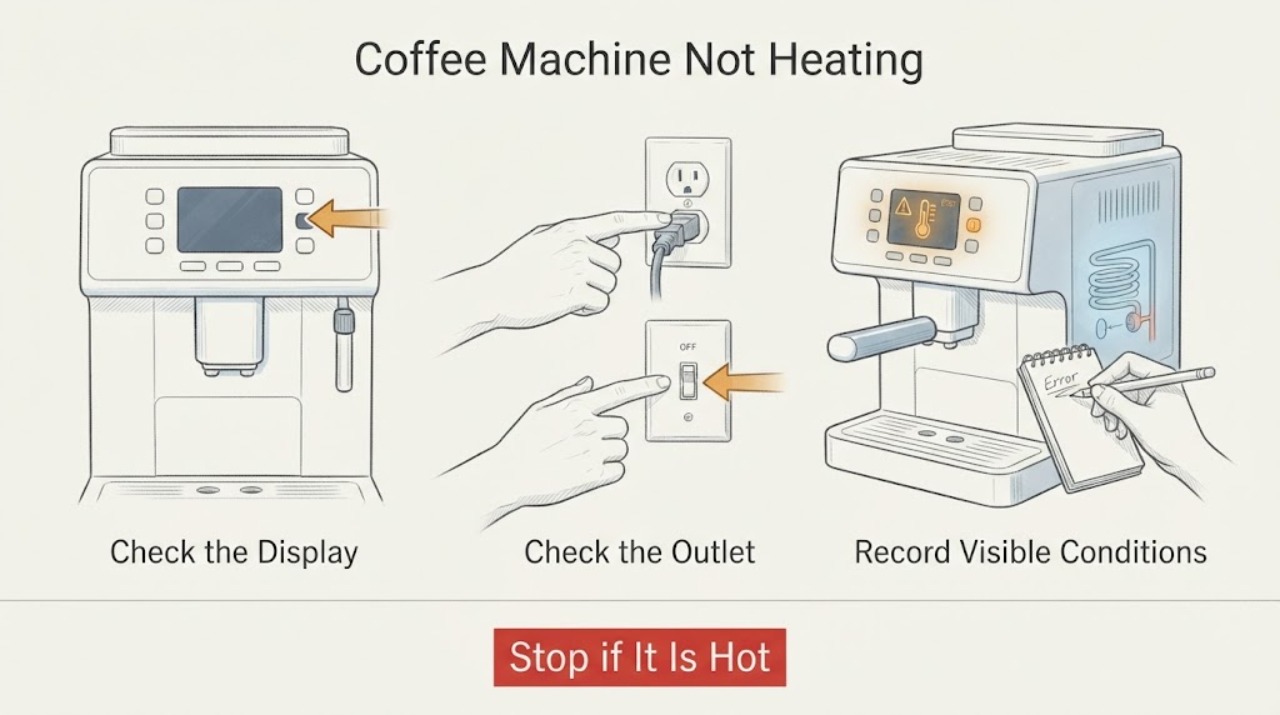
Work through in order
Diagnostic checks
Use only checks that match the exact appliance or system and its official guide.
-
Check 1
Turn the machine on and watch the model’s ready or power indicator without starting repeated brew cycles; note whether it is flashing, becomes steady, or never reaches ready.
Expected result: The indicator is still flashing and later becomes ready, or it remains in warm-up indefinitely.
Next step: Wait through the normal warm-up once; if it never reaches ready, stop and arrange service.
Stop if: Stop for smoke, burning odor, damaged cord, leaking water near electrics, or abnormal overheating.
Why this matters
Why: Breville describes flashing during reheat and a steady-ready state when operating temperature is reached.
-
Check 2
Check the water tank level and press it fully into its dock; verify the machine is set to the intended brew or hot-water function and the outlet is unobstructed.
Expected result: The tank is empty or misseated, or it is full and correctly locked.
Next step: Fill and seat the tank, then run the model’s normal warm-up or hot-water test once.
Stop if: Do not bypass tank sensors or run the pump dry.
Why this matters
Why: Breville lists an empty or incompletely inserted tank as a cause of no hot water and no normal heating flow.
-
Check 3
If the machine reaches ready but coffee remains lukewarm, preheat the cup and portafilter and check whether the model’s maintenance record calls for descaling.
Expected result: Preheating improves the cup, or the drink remains cold despite a ready machine and correct tank.
Next step: Use only the exact model’s descaling and temperature-adjustment procedure; do not open the thermocoil or heater.
Stop if: Do not pour water into electrical areas or use unapproved chemicals.
Why this matters
Why: Breville separates cup/portafilter temperature and scale from a machine that has not reached operating temperature.
-
Check 4
Record the model, indicator behavior, water flow, drink temperature, and whether the fault affects espresso, hot water, or steam, then stop testing after one documented maintenance cycle.
Expected result: Only one function is cold, or all heated functions remain cold.
Next step: Contact the manufacturer or qualified coffee-machine service with the record.
Stop if: Keep the machine off for repeated heater faults, leaks, burning smell, or abnormal electrical behavior.
Why this matters
Why: The affected function helps the service technician distinguish a flow/setting issue from a heating/control fault.
Use your observations
Decision map
Find the observation that best matches what you see, then follow the next safe action.
-
PATH 01Next step
What you see
The ready light is still flashing but becomes steady after the normal warm-up.
Do this next
Preheat the cup and portafilter, then make one test drink.
Why this path and its safety boundary
Why it matters: The machine was heating normally; a cold cup may have resulted from preheating or extraction conditions.
-
PATH 02Next step
What you see
The tank is empty or not fully seated, or hot-water flow is absent until it is corrected.
Do this next
Fill and lock the tank, then follow the model’s normal prime/rinse instructions.
Why this path and its safety boundary
Why it matters: Water delivery can prevent the machine from completing a hot-water or brew operation.
-
PATH 03Next step
What you see
The machine reaches ready but all heated functions stay cold after correct tank, preheat, and model-approved maintenance checks.
Do this next
Stop using the machine and arrange qualified service.
Why this path and its safety boundary
Why it matters: A heater, temperature sensor, control, or scale-related fault needs service-level diagnosis.
Helpful context
Understand the symptom
What the symptom tells you
A coffee machine that is not heating may still be warming up, have an incorrectly seated or empty water tank, need descaling, or have a temperature or heating fault. Let the ready indicator finish, confirm the tank is full and seated, run only the model-approved rinse or descale procedure, and distinguish a lukewarm cup from a machine that never reaches ready. Persistent failure needs model-specific service because the heater and control are not user-safe to open.
Use the exact model information
Controls, code meanings, safe access, and replacement parts vary by model. Record the model and the exact symptom before requesting service.
When checks do not resolve it
Need a professional?
Give the manufacturer or a qualified appliance technician the exact model, serial information, symptom timing, and all observations. Do not open sealed, refrigerant, gas, high-voltage, or energized assemblies.
Common questions
FAQ
Should I wait for the coffee machine to heat before brewing?
Yes. Breville’s manual says the power light flashes during reheat and stops flashing when the machine reaches operating temperature.
Can I replace the heater myself?
No. Check the tank, ready state, cup/portafilter preheating, and exact-model descaling instructions. Heater and thermocoil work requires qualified service.
Read the exact guide
Official sources
- Barista Express Instruction ManualBreville · Coffee machine heating readiness, water tank, descaling, temperature, and service boundary
Community feedback
Share a repair observation
Share a plain-text repair observation. Accepted observations are published automatically; this page may take a moment to update.