
On this page
Start here
Quick answer
A coffee machine’s noise must be classified by pump, grinder, steam, or vibration. De’Longhi guidance links loud pump noise with an empty or poorly seated water tank and air in the circuit; a brief pump sound with water flow can be expected. Turn it off and unplug it before cleaning, and stop for burning odor, grinding metal, leaking water, or a hot cord.
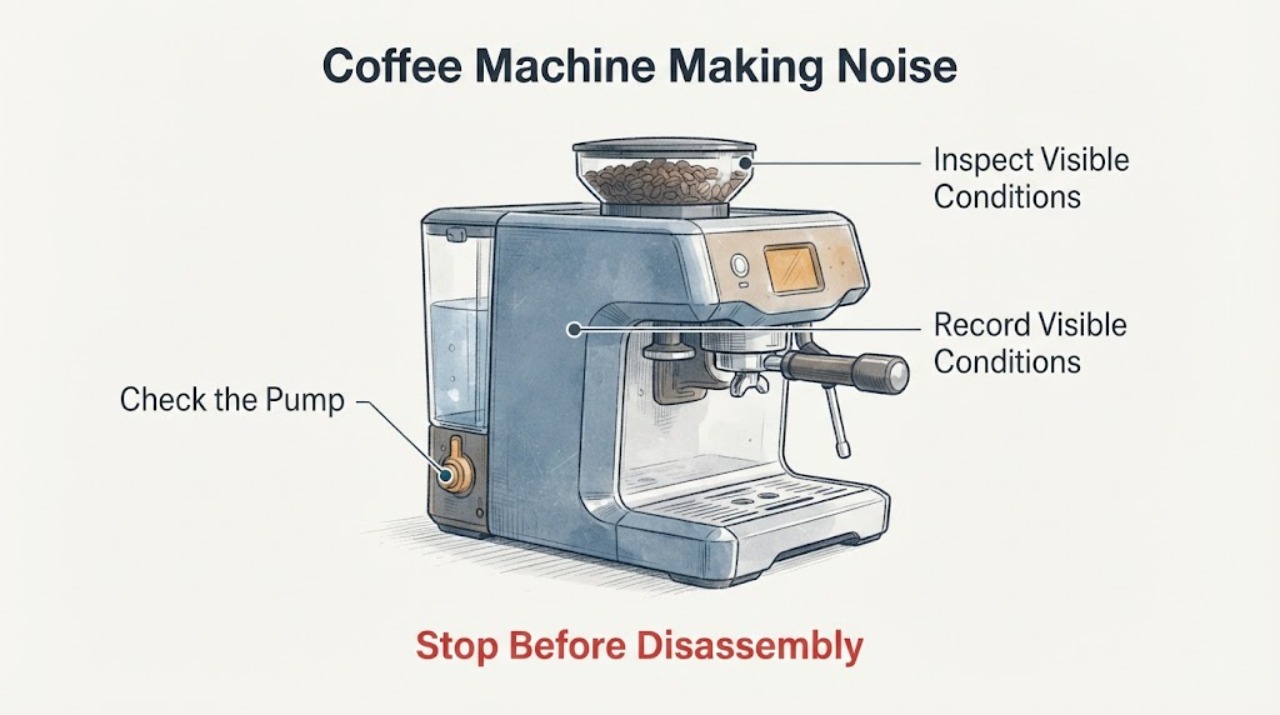
Work through in order
Diagnostic checks
Use only checks that match the exact appliance or system and its official guide.
-
Check 1
Record whether noise occurs during brewing, hot water, steam, grinding, startup, or shutdown; note water flow, vibration, and odor.
Expected result: Stage-specific pump noise differs from a grinder obstruction or loose panel; a noise with no flow needs a water-path check.
Next step: Stop if sound is metallic, worsening, or paired with heat, leak, or odor.
Why this matters
Why: This observation narrows the likely cause but does not identify an internal part by itself.
-
Check 2
Check the water tank level and seating from outside; do not remove it while the pump is delivering or touch hot steam parts.
Expected result: An empty or poorly seated tank can make the pump buzz and prevent water delivery.
Next step: Fill and seat it only as the exact manual permits; stop if leaking or hot.
Why this matters
Why: This observation narrows the likely cause but does not identify an internal part by itself.
-
Check 3
If the machine is safe and the model supports it, follow its documented hot-water/air-purge procedure once and observe whether water returns.
Expected result: Water flow returning with reduced buzz supports air in the circuit; persistent noise without flow leaves blockage or pump service possible.
Next step: Do not run the pump dry repeatedly; arrange service if the sound remains.
Why this matters
Why: This observation narrows the likely cause but does not identify an internal part by itself.
-
Check 4
With power off and cool, inspect accessible drip tray, filter holder, spout, and visible scale/residue according to the manual.
Expected result: A blocked outlet or scale can raise pump load and change sound; it does not prove a pump part failed.
Next step: Clean/descale only with model-approved method; do not insert tools into energized or hot openings.
Why this matters
Why: This observation narrows the likely cause but does not identify an internal part by itself.
-
Check 5
Record model, noise type, tank state, water-flow result, descaling history, and whether a vibration changes when the machine is stable.
Expected result: These details distinguish water starvation, air, scale, vibration, grinder, and internal faults.
Next step: Arrange qualified service for persistent abnormal noise.
Why this matters
Why: This observation narrows the likely cause but does not identify an internal part by itself.
Use your observations
Decision map
Find the observation that best matches what you see, then follow the next safe action.
-
PATH 01Next step
What you see
Loud buzz occurs with empty/mis-seated tank and improves when proper water flow is restored.
Do this next
Use the model’s fill/prime procedure and monitor.
Why this path and its safety boundary
Why it matters: Water starvation or air is more likely.
-
PATH 02Next step
What you see
Noise persists without flow after tank and approved air purge.
Do this next
Stop running the pump and arrange service.
Why this path and its safety boundary
Why it matters: Blockage, scale, or pump fault remains possible.
-
PATH 03Next step
What you see
Noise is metallic/grinding from grinder or accompanied by a leak/burning odor.
Do this next
Unplug when safe and call qualified service.
Why this path and its safety boundary
Why it matters: Mechanical or electrical fault crosses the user boundary.
-
PATH 04Next step
What you see
Only mild vibration occurs with normal flow and no hazard.
Do this next
Stabilize only accessible surfaces and monitor; service if it worsens.
Why this path and its safety boundary
Why it matters: Pump vibration or cabinet contact may be normal for the design.
Helpful context
Understand the symptom
Pump buzz, grinder chatter, steam hiss, and cabinet vibration point to different checks. Noise with no water flow often keeps tank, air, scale, or blockage in scope.
The exact machine may be espresso, bean-to-cup, or pod type; do not transfer a De’Longhi-specific priming sequence to another design.
When checks do not resolve it
Need a professional?
Call qualified coffee-machine service for persistent pump/grinder noise, no flow after tank/approved cleaning checks, leaks, or electrical symptoms.
Common questions
FAQ
Is pump noise normal?
Some pump sound is expected, but loud buzzing with no water is linked by official guidance to tank/air conditions. Persistent noise needs service.
Can I descale to fix any noise?
Only use the exact model’s approved descaling method. Descaling does not prove a pump or grinder fault is fixed.
Why is a coffee machine noisy on first use?
Air in a new or emptied circuit can make the pump loud until water flows. Follow the model’s priming procedure.
Read the exact guide
Official sources
- My machine is buzzing loudly and not dispensing water. What can I do?De’Longhi · Coffee-machine pump noise caused by an empty tank or air in the water system, with safe priming guidance.
- IMPORTANT SAFEGUARDSDe’Longhi · Coffee-machine pump noise, water tank seating, blocked outlet, descaling, and unplug/service safety.
Community feedback
Share a repair observation
Share a plain-text repair observation. Accepted observations are published automatically; this page may take a moment to update.