
On this page
Start here
Quick answer
First decide which symptom you have: no interior light or display at all, or a light/display that works while the refrigerator does not cool or make its normal operating sounds. Read the rating-label model and check that the cord is fully seated, the outlet has power, and any breaker or GFCI has not tripped; do not keep resetting protection or use the appliance if the cord, plug, outlet, or surrounding area is hot, wet, scorched, or damaged. If your model uses a thermostat knob, make sure it is not at STOP/0; if it uses electronic controls, follow that model's wake or temperature-setting instructions. After an interruption, some Danby manuals specify waiting several minutes before restarting, and a refrigerator moved on its side may need the model's upright waiting period before connection. If the light/display is on but the compressor or fan never starts after the documented delay, cooling is absent, a fault code returns, or the unit trips protection, stop and arrange qualified service. Do not remove covers, bypass a thermostat or door switch, probe live wiring, replace a start component, or work on the compressor or refrigerant circuit.
Before you begin
Safety first
- The user may read the model label, inspect the external cord and plug, check an outlet from a safe dry position, follow a documented thermostat/electronic-control setting, and observe normal startup without touching internal parts. Internal power, control, thermostat, start-device, fan, compressor, wiring, and refrigerant work is for qualified personnel.
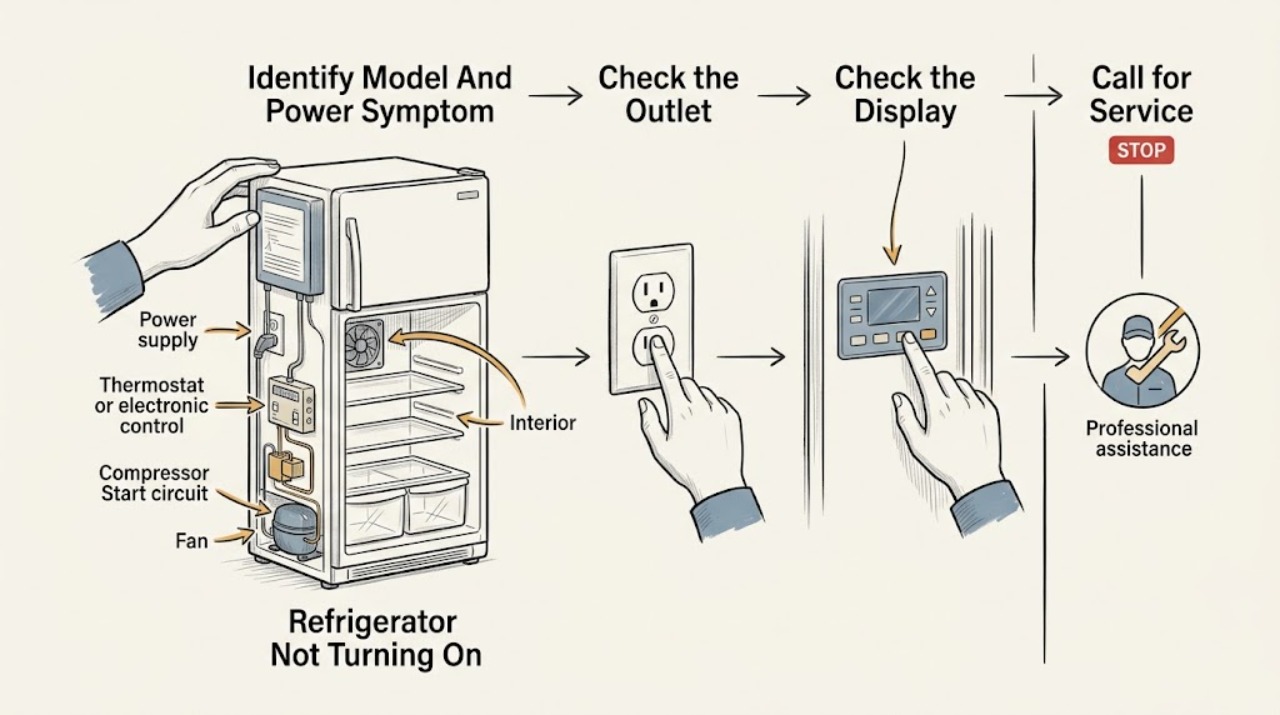
Work through in order
Diagnostic checks
Use only checks that match the exact appliance or system and its official guide.
-
Check 1
Read the rating label and record the complete Danby model. Without opening the cabinet, note whether the interior light, temperature display, control buttons, fan sound, and cooling are present or absent. Check whether the symptom began after a move, cleaning, outage, or breaker/GFCI event.
Expected result: Everything is dark, the light/display works but cooling does not, the control responds but the compressor is silent, the symptom is intermittent, or the model cannot be identified.
Next step: Use the model-matched manual for the remaining checks. If the unit is intermittent or a hazard is present, stop using it and preserve the model and symptom information for service.
Stop if: Do not remove panels or use live measurements to identify the model or power path.
Why this matters
Why: A completely dark unit points first to the external supply path. A light/display-on unit has at least partial power and needs a control, delay, airflow/cooling, or internal-start diagnosis; the visible symptom does not prove which part failed. An unknown model prevents safe assumptions about controls and restart timing.
-
Check 2
From a dry, safe position, confirm the plug is fully seated in the intended outlet and inspect the accessible cord and plug for cuts, crushing, looseness, scorching, moisture, or abnormal heat. If the outlet and appliance area are dry and undamaged, use a known-good ordinary appliance to check the outlet, or check the household breaker/GFCI once without opening the panel.
Expected result: The outlet is dead, a breaker/GFCI is tripped, the cord or plug is damaged/hot/wet, the outlet is loose or scorched, or the outlet and cord appear normal.
Next step: For a dead household outlet or repeated protection trip, arrange qualified electrical service. For a damaged or hot cord/plug/outlet, stop using the refrigerator and isolate power only if safe. If the external supply is normal, continue with the model-specific control and delay check.
Stop if: Do not repeatedly reset a breaker/GFCI, use an extension cord or adapter to bypass the outlet, open the outlet, or continue using a hot/damaged cord.
Why this matters
Why: A dead outlet or single protection event can account for a completely dark refrigerator. Repeated trips, heat, scorch marks, moisture, or cord damage indicate an electrical safety problem. A normal external supply shifts attention to the refrigerator's own switch, thermostat, control, or start circuit.
-
Check 3
Follow only the exact model manual's normal operating control. For a thermostat-dial refrigerator, verify the knob is not at STOP/0 and move it to a documented operating position once. For an electronic model, check whether the display wakes and accepts the documented temperature or power control. Do not hold a door switch closed or bypass any control.
Expected result: The thermostat was at STOP/0, the display wakes and accepts a setting, the control is unresponsive, the display shows a model-specific fault pattern, or the refrigerator still has light but no cooling command.
Next step: Correct only the documented setting and allow the model's normal response time. If the control will not respond or the fault pattern returns, record it and arrange service instead of removing the control panel.
Stop if: Do not short a thermostat, bridge a door switch, remove the control housing, or test control terminals while energized.
Why this matters
Why: A STOP/0 position can intentionally stop cooling on some Danby dial models while leaving the light powered. A responsive electronic display does not prove the compressor path is healthy, and an unresponsive control or fault pattern is a control/service boundary rather than a user-replaceable part diagnosis.
-
Check 4
If operation was interrupted or the refrigerator was recently moved, read the model manual for its restart and upright-settling requirement. Leave the unit connected only when the cord, outlet, and area are safe, wait the documented interval without repeatedly cycling power, and then make one normal start attempt. Do not plug in a unit that was wet, dropped, or moved with visible damage.
Expected result: Cooling starts after the documented delay, the unit was recently on its side/back, no start occurs after waiting, or a trip/noise/odor appears during the attempt.
Next step: Monitor only a normal, stable start. If the refrigerator remains silent or does not cool after the documented delay, move to service with the model and timing; for any hazard, stop using it immediately.
Stop if: Do not keep switching the refrigerator on and off, tilt it to force a start, or work on the compressor or start components.
Why this matters
Why: A short restart delay can be normal after an interruption, and Danby manuals give model-specific upright periods after side/back transport. Failure after those conditions are met makes an internal control, start, compressor, fan, or wiring issue more likely, while a trip, odor, or abnormal noise is a safety stop.
-
Check 5
When the light or display is on and there is no obvious hazard, observe one normal cooling attempt without opening the unit. Note whether the control indicates operation, whether a fan or compressor sound begins, whether the refrigerator begins cooling, and whether the light/display stays stable. Do not touch the rear compressor, fan, capacitors, terminals, or tubing.
Expected result: The compressor/fan starts and cooling returns, the light/display is stable but the compressor never starts, the unit clicks or hums then stops, the display resets, or the appliance trips protection.
Next step: For any persistent partial-power/no-cooling pattern, stop repeated attempts and arrange qualified appliance service. If protection trips or abnormal heat/odor appears, isolate power only from a safe, dry position and do not restart.
Stop if: Do not remove the rear cover, test capacitors or relays, probe live wiring, or attempt a compressor or refrigerant repair.
Why this matters
Why: A stable start supports a setting or normal-delay explanation. A stable light/display with no compressor or fan, repeated click/hum-stop behavior, display resets, or protection trips points toward an internal control, start, motor, wiring, or compressor path; external observation cannot identify the failed component.
-
Check 6
Record the model, symptom category, outlet/protection result, cord and plug condition, thermostat or display state, restart timing, transport history, sounds, cooling response, and any code, odor, heat, moisture, or trip. Keep food in safe cold storage while the refrigerator is out of service.
Expected result: The refrigerator recovered after a safe external correction, or it remains dark, partially powered but not cooling, repeatedly trips, has visible electrical damage, or has a control fault that returns.
Next step: Contact Danby or qualified appliance service with the recorded model and observations. Use a qualified electrician for a dead, hot, scorched, loose, or repeatedly tripping household supply; use appliance service for a refrigerator-specific partial-power or start failure.
Stop if: Do not restore operation after smoke, burning odor, sparks, water near electrics, a hot/damaged cord, repeated trips, or a fallen/wet appliance.
Why this matters
Why: A repeatable recovery after an external correction supports a supply, setting, or normal-delay cause. Persistent failure after those checks requires professional diagnosis of the internal power/control/start/cooling path, and hazard signs require immediate discontinuation rather than another test.
Use your observations
Decision map
Find the observation that best matches what you see, then follow the next safe action.
-
PATH 01Safety boundary
What you see
The interior light and display are dark, the outlet is dead, a breaker/GFCI has tripped, or the cord/plug is visibly damaged or hot.
Do this next
Stop using the refrigerator. If the outlet or household protection is the issue, arrange qualified electrical service; if the cord/plug is the issue, arrange authorized appliance service. Protect the food separately.
Why this path and its safety boundary
Why it matters: An external supply, protection, cord, or plug problem is more likely than a refrigerator thermostat or compressor problem, but repeated trips and heat are electrical hazards.
Safety stop: Do not repeatedly reset protection or use a damaged cord, outlet, extension, or adapter.
-
PATH 02Safety boundary
What you see
The interior light or display works, the thermostat is at STOP/0 or the electronic control is not in its documented operating state, or the event followed an interruption or recent move.
Do this next
Use the exact model manual to set normal operation and observe the documented delay once. If no cooling begins afterward, stop cycling power and arrange service.
Why this path and its safety boundary
Why it matters: A control setting, model-specific startup delay, or transport-settling requirement is more likely than a proven failed compressor. Some Danby designs leave the light available when cooling is stopped.
Safety stop: Do not bypass the thermostat, hold a door switch, or open the control area.
-
PATH 03Safety boundary
What you see
The light/display is stable and the external outlet is normal, but the fan or compressor never starts, the unit clicks/hums and stops, or it remains warm after the model's normal delay.
Do this next
Keep the refrigerator out of service and arrange qualified appliance diagnosis. Provide the exact model, timing, sound pattern, display state, and temperature impact.
Why this path and its safety boundary
Why it matters: An internal control, start component, fan, compressor, or wiring problem is more likely. The pattern cannot safely identify a replacement part and is not an owner-level live test.
Safety stop: Do not remove panels, test a relay/capacitor, touch the compressor, or recharge refrigerant.
-
PATH 04Safety boundary
What you see
There is smoke, arcing, a burning smell, abnormal heat, a hot or damaged plug/cord, repeated breaker/GFCI trips, water near electrical parts, or the refrigerator has fallen into water.
Do this next
Stop using the refrigerator and isolate power only from a safe, dry position if that can be done without contact with the hazard. Arrange qualified electrical/appliance service and protect food separately.
Why this path and its safety boundary
Why it matters: This is a safety event, not a setting or restart problem. Continued operation can worsen electrical, fire, or shock risk.
Safety stop: Do not touch wet electrics, restore power for a test, open the cabinet, or repeatedly reset protection.
Helpful context
Understand the symptom
Start by identifying which part is actually off
“Not turning on” can mean two different diagnostic paths. If the interior light, display, and controls are all dark, begin with the supply and protection path. If the light or display works but there is no cooling, fan activity, or compressor start, power is reaching at least part of the refrigerator and the thermostat/control or internal starting path becomes more relevant. Danby uses both mechanical thermostat and electronic-control designs, so read the full model before applying a reset or control procedure.
Check the outside power path only
With dry hands and a dry surrounding floor, verify the cord is seated and the outlet is live using only a safe, ordinary external check. Inspect the cord and plug without opening anything. A tripped breaker or GFCI may explain a completely dark appliance, but a repeated trip is a warning rather than an invitation to keep resetting it. Do not use a damaged, hot, wet, loose, or scorched plug, outlet, or cord.
Allow for controls, interruption, and recent movement
Some Danby models start cooling through a thermostat knob; an older official manual identifies STOP/0 as a cooling-off position while the light can still remain available. Other models use an electronic button and display. A compressor may also have a restart delay after power interruption, and Danby manuals give model-specific waiting instructions. If the refrigerator was transported on its side or back, follow the exact manual's upright period before plugging it in. These observations help separate a normal control or protection delay from a fault, but they do not authorize opening the electrical compartment.
Safety boundary
Stop conditions
- Stop using the refrigerator for smoke, arcing, burning odor, abnormal heat, a hot or damaged cord/plug, water near electrical parts, repeated breaker/GFCI trips, or a unit that has fallen into water; isolate power only from a safe, dry position.
- Do not repeatedly reset the breaker/GFCI or keep cycling the refrigerator to force a compressor start.
- Do not remove rear, control, or terminal covers; perform live-voltage, continuity, capacitor, relay, thermostat, compressor, fan, or wiring tests; or bypass a thermostat, door switch, or other safety control.
- Do not touch, replace, or recharge a compressor start device or refrigerant circuit as a household repair.
- Do not plug in a refrigerator that is wet, visibly damaged, or has not met the exact model's upright-settling requirement after side/back transport.
When checks do not resolve it
Need a professional?
Arrange qualified appliance service when the outlet and cord are normal but the Danby refrigerator remains dark, the light/display is on while the compressor or fan never starts, a control fault returns, or the unit still does not cool after the model-specific control and restart delay. Use qualified electrical service for a dead, loose, hot, scorched, wet, or repeatedly tripping household supply. Stop using the appliance immediately for smoke, burning odor, sparks, abnormal heat, a damaged plug/cord, water near electrics, or water entry.
Safety scope: The user may read the model label, inspect the external cord and plug, check an outlet from a safe dry position, follow a documented thermostat/electronic-control setting, and observe normal startup without touching internal parts. Internal power, control, thermostat, start-device, fan, compressor, wiring, and refrigerant work is for qualified personnel.
Common questions
FAQ
Why is my Danby refrigerator completely dark?
Check the plug, outlet, and household breaker or GFCI from a safe, dry position, and inspect the cord and plug for damage. Danby specifically recommends checking the power supply, working outlet, proper connection, and cord condition. Stop for heat, scorch marks, moisture, repeated trips, or a damaged cord and arrange qualified service.
Why are the light and display on but my Danby refrigerator is not running?
Some Danby models can leave the light powered when a thermostat is at STOP/0, while other models use electronic controls. Check the exact model's operating state and allow its documented restart delay. If the display remains stable but the fan or compressor never starts or cooling does not return, arrange qualified appliance service rather than testing internal parts.
How long should I wait before restarting a Danby refrigerator?
Use the exact model manual. The cited Danby DBMF100 and DAR194 manuals specify waiting several minutes after an interruption before trying again, and Danby manuals also give a longer upright period after the appliance has been on its side or back. Do not repeatedly cycle power while waiting.
Can a Danby refrigerator's thermostat make it seem like it is not turning on?
Yes, on models with a mechanical dial, STOP/0 can switch off the cooling system even though the light may still work. Electronic-control models use a different procedure. Follow the rating-label model's manual; do not short or bypass the thermostat.
When should I stop trying to start a Danby refrigerator?
Stop for smoke, burning odor, sparks, abnormal heat, a hot or damaged plug/cord, repeated breaker or GFCI trips, water near electrical parts, or water entry. Isolate power only from a safe, dry position and arrange qualified electrical or appliance service. Persistent no-start after external checks also needs professional diagnosis.
Read the exact guide
Official sources
- REFRIGERATOR Owner’s ManualDanby · Model-specific example for temperature controls, transport, and restart timing; other models may differ.
- The fridge is not cooling properly. What should I do?Danby · General Danby refrigerator guidance; exact operating and service instructions remain model-specific.
- DAR194 Manual (3 lang.)Danby · Model-specific example for a mechanical thermostat refrigerator; other Danby refrigerators can use different controls and delays.
- Refrigeration FAQsDanby · General refrigeration guidance; exact controls, power requirements, and service instructions must be matched to the model.
- OWNER’S MANUALDanby · Model-specific example for an electronic-control refrigerator and its display indicators; other Danby models may differ.
- The outdoor fridge is not turning on. What could be the issue?Danby · The published advice is for Danby outdoor fridges; the external power/cord checks are useful as general Danby guidance, but control and installation details vary by model.
Community feedback
Share a repair observation
Share a plain-text repair observation. Accepted observations are published automatically; this page may take a moment to update.