
On this page
Start here
Quick answer
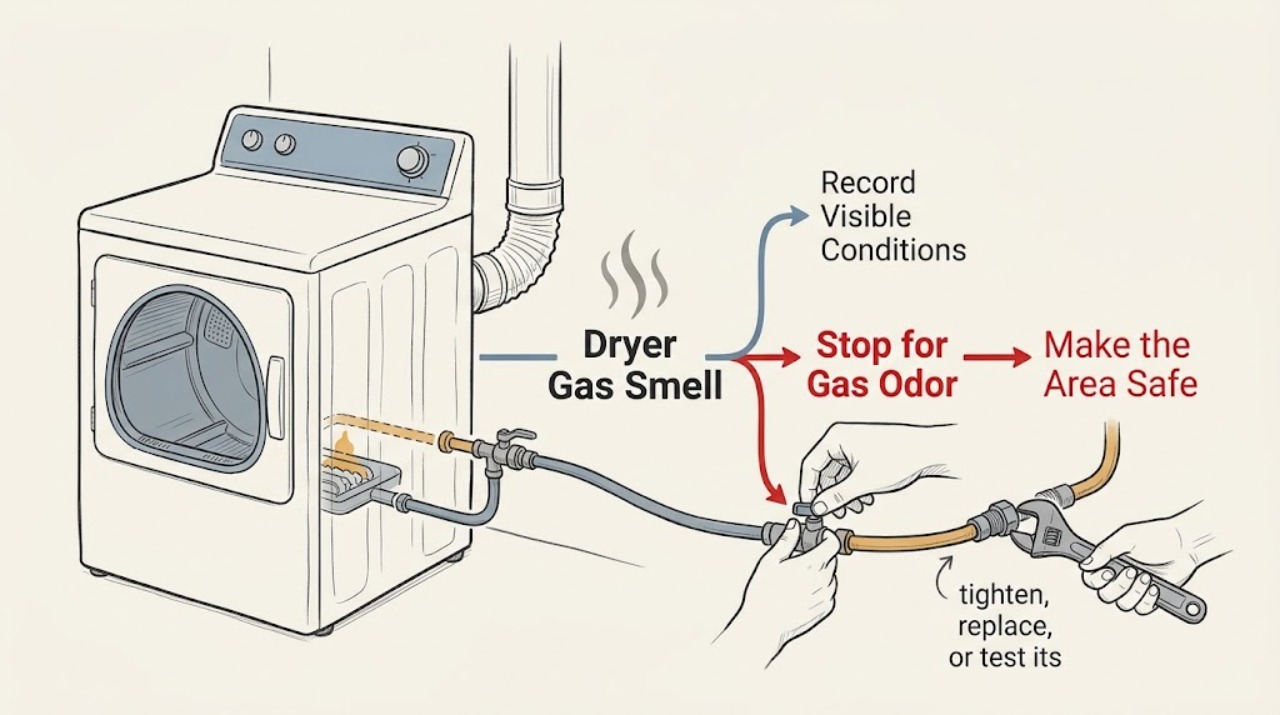
Treat any gas-like smell from an Electrolux gas dryer as a possible gas leak. Stop the dryer if you can do so without touching switches or electrical equipment, leave the building immediately, and from a safe location contact your local emergency service or gas supplier. Do not use a phone inside, turn lights or appliances on or off, light a flame, move the dryer, open panels, adjust the gas valve, or try to find the connector yourself. Keep the dryer out of service until the gas authority or a qualified technician declares the area and appliance safe. After clearance, have the supply, connector, burner, and ventilation checked; if the odor returns, leave again and report it from outside.
Work through in order
Diagnostic checks
Use only checks that match the exact appliance or system and its official guide.
-
Check 1
If you smell gas or hear a hiss near the Electrolux dryer, stop using the appliance and leave the building immediately. Do not operate a switch, light, appliance control, phone, or flame while inside, and do not move the dryer to inspect behind it.
Expected result: The gas-like odor or hissing is present, or anyone has headache, dizziness, nausea, weakness, or breathing trouble; or the odor is no longer noticeable after leaving.
Next step: Stay outside or at another safe location and contact local emergency services or the gas supplier from there. Do not re-enter to shut a valve, retrieve a phone, or test the dryer.
Why this matters
Why: A suspected gas leak can ignite and a combustion appliance can create a serious air-quality hazard. The absence of odor outside does not prove that the appliance or building is safe, and symptoms require fresh air and urgent assistance.
-
Check 2
From the safe location, tell the gas supplier or emergency service that the odor was noticed at or near an Electrolux dryer. Record only what you already know: gas or electric model, when the odor began, whether the dryer was running, any hiss, smoke, abnormal heat, or displayed code, and whether anyone felt unwell.
Expected result: The responder treats the event as a possible gas leak, finds no building-level leak, or directs an appliance inspection; or the source remains unknown.
Next step: Follow the responder's evacuation and re-entry instructions. Request qualified inspection of the dryer and its gas connection before operating it, even if the smell has faded.
Why this matters
Why: A responder's gas test and clearance are more reliable than a smell-based home test. An unknown source still requires the dryer to remain out of service because a connector, supply connection, burner, or another gas appliance may be involved.
-
Check 3
Do not pull the dryer forward or inspect, tighten, replace, or test its gas connector yourself. Once the gas authority has made the area safe, arrange for a qualified professional to inspect the connector, shutoff and supply connection, burner area, and any visible damage.
Expected result: The professional finds a damaged, corroded, displaced, or leaking connection; finds no connector leak but identifies a dryer-side gas fault; or finds no fault during the first inspection.
Next step: Keep the dryer out of service until the professional completes the repair and explicitly clears it for use. If no fault is found but the smell returns, evacuate again and report the recurrence from outside.
Why this matters
Why: The CPSC warns that moving an appliance can cause an older weakened connector to fail and says only a qualified professional should check or replace it. A first clear test does not authorize the user to open the dryer or bypass a safety control.
-
Check 4
After professional clearance, provide the technician with the model number and ask them to verify the gas supply condition, burner operation, and the air space around the dryer. Do not open panels or adjust a gas valve yourself; keep laundry and rugs away from the front and back as the installation instructions require.
Expected result: The supply and burner system are cleared and ventilation space is adequate, or the technician identifies a supply, combustion, installation, or ventilation problem.
Next step: Use the dryer only after the qualified provider has corrected any finding and cleared it. If an error code or heating problem remains, report it rather than repeatedly cycling the appliance.
Why this matters
Why: Electrolux says a gas dryer needs adequate air supply and space for burner ventilation, and directs a natural-gas interruption to the gas company. These checks require model- and installation-specific judgment when a gas odor has occurred.
-
Check 5
Only after the gas authority and appliance professional both say the dryer is safe, follow the model's owner instructions for a short supervised return-to-service check. Stop immediately and leave again if a gas-like odor, hiss, smoke, abnormal heat, or any unusual burner behavior returns.
Expected result: The cleared dryer runs without odor or abnormal symptoms, or any gas-like odor or unsafe symptom recurs.
Next step: For a recurrence, leave immediately and contact emergency or gas support from a safe location; do not conduct another test. If it remains normal, stop use and seek help at the first future gas smell.
Why this matters
Why: A normal supervised cycle after professional clearance is only a confirmation of the cleared installation, not a substitute for a gas-leak test. A recurrence indicates that the appliance or supply is not safe to operate.
Use your observations
Decision map
Find the observation that best matches what you see, then follow the next safe action.
-
PATH 01Safety boundary
What you see
A gas-like odor or hissing is present now, or anyone has symptoms consistent with exposure.
Do this next
Leave immediately without operating switches, flames, electrical equipment, or a phone inside. From a safe location, contact local emergency services or the gas supplier and do not re-enter until directed.
Why this path and its safety boundary
Safety stop: Keep the dryer switched off and out of service; a faded odor still requires qualified inspection before reuse.
-
PATH 02Safety boundary
What you see
A qualified responder has cleared the building but the dryer or its gas connection has not been inspected and cleared.
Do this next
Do not move, open, adjust, or operate the dryer. Arrange qualified appliance/gas inspection of the connector, supply, burner, and ventilation.
Why this path and its safety boundary
Safety stop: Follow the professional's documented repair and return-to-service instructions, keeping the area around the dryer ventilated and unobstructed.
-
PATH 03Safety boundary
What you see
The gas smell returns after professional clearance or during a supervised return-to-service check.
Do this next
Stop, leave the building, and report the recurrence from a safe location. Do not repeat the cycle or attempt a home leak test.
Why this path and its safety boundary
Safety stop: Continue to treat any future gas-like odor as a possible leak and seek help before operating the dryer again.
Helpful context
Understand the symptom
Do not try to distinguish a small leak from a harmless dryer odor by running another cycle. A gas dryer has a fuel supply and burner, and the smell may be strongest near the appliance even when the exact leak point is not visible. Safety takes priority over identifying a part.
The U.S. Consumer Product Safety Commission says to leave immediately when gas is suspected and not to use a phone, light a match, turn a light on, or switch on electrical equipment. Electrolux's dryer guidance sends gas-supply interruption to the gas company and keeps supply, wiring, and ventilation issues within qualified support boundaries.
When checks do not resolve it
Need a professional?
Call emergency or gas support from outside for a current gas smell or hiss; arrange qualified appliance service before reuse even if the smell has stopped. Escalate again immediately if the odor recurs.
Have this ready
- From a safe location or during the service visit, provide the model number, gas or electric type, odor timing and location, whether the dryer was running, any hiss or code, symptoms, and the responder's findings.
Common questions
FAQ
Is a gas smell from an Electrolux dryer ever normal?
Do not assume it is normal. Treat any gas-like smell or hiss as a possible leak, leave immediately, and contact emergency or gas support from a safe location before inspecting or operating the dryer.
Can I check the gas connector by pulling the dryer forward?
No. The CPSC warns that moving an appliance can cause a weakened connector to fail and says a qualified professional should inspect or replace it. Keep the dryer out of service and arrange professional inspection after the immediate gas response.
What should be checked before an Electrolux gas dryer is used again?
After the gas authority has made the area safe, have a qualified professional inspect the supply and connector, burner operation, and ventilation space. Use the dryer only after the professional clears it and stop immediately if the odor returns.
Read the exact guide
Official sources
- Certain Older Gas Connectors May Be DangerousU.S. Consumer Product Safety Commission · Federal consumer-safety guidance for suspected gas leaks and gas-appliance connectors; emergency instructions take precedence over appliance troubleshooting.
- My dryer is running, but does not seem to be heating. What should I do?Electrolux · Official Electrolux dryer support guidance; gas odor or suspected leakage requires emergency gas-safety handling before any appliance checks.
- Laundry Dryer Error Code GuideElectrolux · Official Electrolux dryer error guide; exact codes and installation details vary by model.
Community feedback
Share a repair observation
Share a plain-text repair observation. Accepted observations are published automatically; this page may take a moment to update.